Introduction
Ask ten marketers whether TV or social media delivers better ROI, and you'll get ten different answers, most of them defended loudly. Both channels claim the best reach. Both insist they deliver the best return.
Rising social CPMs, unpredictable algorithm changes, and privacy updates that gutted third-party targeting have forced marketers to question assumptions that felt settled just a few years ago. The idea that TV is "outdated" doesn't hold up against the numbers.
Nielsen counted 125 million U.S. TV households in 2023-24, just under 97% of all households nationwide, according to Nielsen's 2024 audience report. Social platform usage remains high too, but usage and paid-ad reach aren't the same thing.
This article breaks down where each channel wins, where it falls short, and how combining them can outperform either one alone.
TL;DR
- TV delivers broad, trusted, high-attention reach with strong brand recall.
- Social media wins on speed and targeted, lower-funnel action.
- Neither channel is universally better; fit depends on funnel stage, budget, and campaign goal.
- Pairing TV with social creates a measurable halo effect that lifts performance across both.
- Modern direct-response TV buying and remnant inventory access have closed much of the old cost gap with social.
TV vs Social Media: Quick Comparison
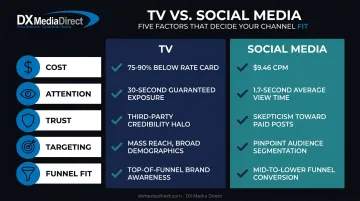
Here's how the two channels stack up across the factors that actually drive budget decisions.
At a glance:
| Factor | TV | Social Media |
|---|---|---|
| Cost | 75-90% below rate card | ~$9.46 CPM (Instagram) |
| Attention | 11.8 sec avg, near-total completion | High skip risk |
| Trust | 20% consumer trust (offline) | 11% trust (online) |
| Targeting | Broadening via CTV | Granular, but eroding |
| Funnel Fit | Upper/mid-funnel | Lower-funnel, real-time |
Cost
TV advertising carries a reputation for high upfront costs. Network primetime spots can run into six figures. But that reputation is outdated. Negotiated media buying and direct-response TV (DRTV) test campaigns change the math entirely.
Remnant inventory, the unsold ad slots networks need to fill, often prices 75% to 90% below rate card. Agencies like DX Media Direct, with decades of relationship-based negotiation experience, can turn a $500,000 budget into the equivalent of $2 million to $5 million in rate-card airtime value.
Social media's barrier to entry is lower, but CPMs keep climbing. eMarketer forecasts Instagram's average CPM reaching $9.46 in Q2 2025, with costs spiking further during competitive seasons like Q4 holiday shopping.
Attention & Engagement
TV is a lean-back medium. Households often co-view, and most ads run unskippable, so completion rates stay near total. Lumen's UK panel study measured 11.8 seconds of visual attention for an average 30-second TV ad, with 43% of ads noticed by at least one viewer, according to Lumen Research's viewability study.
Social scrolling looks different. Viewers are often distracted, solo, and one swipe away from skipping an ad entirely. No directly comparable current benchmark measures social-ad attention using the same eyes-on-screen method, but the behavioral gap is well documented.
Trust & Brand Perception
Kantar's global study of 14,500 consumers found TV the most trusted advertising environment, with offline channels averaging 20% consumer trust versus 11% for online channels, according to Kantar's trust research. WARC separately found only 19% of U.S. adults trusted social advertising at all.
Social platforms also carry brand safety baggage: content moderation gaps, misinformation, and algorithm shifts that can place ads next to unpredictable content overnight.
Targeting Precision
TV targeting has traditionally been broad: demographic and geographic. Addressable and connected TV (CTV) have narrowed that gap, allowing household-level ad delivery within the same program.
Social media still wins on granular behavioral and interest targeting. But Apple's App Tracking Transparency policy and ongoing privacy legislation are eroding that precision, with the IAB reporting that 95% of advertising decision-makers expect continued signal loss.
Measurement & Funnel Fit
TV suits upper- and mid-funnel goals: building awareness and brand trust. Impact often takes weeks or months to fully register in brand lift studies.
Social media excels at lower-funnel work, including clicks, sign-ups, and immediate conversions, all trackable in real time. Neither channel owns the whole funnel; each fits a different stage of the buyer's journey.
Understanding TV Advertising and Social Media Advertising
TV Advertising
TV advertising covers three formats: traditional broadcast and cable spots, addressable TV that swaps creative by household, and connected TV (CTV), the streaming format now capturing nearly half of U.S. viewing time. All three trade on the same core asset: trust built over decades of appointment viewing.
For businesses, that translates into brand credibility that's hard to fake and reach that scales to millions of households in a single flight. Direct-response TV (DRTV), the format DX Media Direct specializes in, pushes that further by building trackable calls-to-action directly into the creative: a phone number, a URL, a promo code.
That distinction matters. Traditional broadcast buying optimizes for reach and frequency. DRTV optimizes for response, and response shows up in the profit column, not just a brand lift study.
Social Media Advertising
TV earns trust through scale and trackable response; social media works on a different axis. It runs across Facebook, Instagram, TikTok, YouTube, and other platforms where users already spend hours daily. Its core strength is speed: launch a campaign, see performance data within hours, and adjust creative before the week is out.
That real-time feedback loop makes social ideal for:
- Testing messaging before a broader rollout
- Retargeting warm audiences already familiar with your brand
- Driving specific actions like clicks, downloads, or purchases
- Iterating creative quickly based on live performance data
Formats range from static feed ads and Stories to short-form video and influencer-driven placements, each suited to a different funnel stage.
TV vs Social Media: What's Better for Your Business?
Choosing between TV and social media comes down to matching the channel to the job at hand.
Before allocating budget, weigh four factors:
- Campaign objective: building brand awareness or driving immediate conversions
- Budget flexibility: a multi-week flight versus daily spend adjustments
- Audience media habits: appointment TV, streaming CTV, or platforms like Instagram and TikTok
- Measurement timeline: waiting 60-90 days for brand lift data versus needing same-week numbers
Choosing the right channel:
- TV/CTV works best when you're building trust at scale, entering a new market, or need broad reach that social's narrower targeting can't replicate cost-effectively.
- Social media works best when you're testing messaging fast, retargeting warm leads, or need immediate, trackable conversions on a tight budget.
- Combining both works best when you want TV to build awareness and credibility while social captures and converts the demand TV creates.
For businesses unsure whether TV fits their model, DX Media Direct structures a 90-day test campaign with a defined window to validate performance before committing a larger budget. Real tracking data replaces guesswork, giving you a lower-risk way to answer the "does TV work for us" question with actual numbers.
Real-World Case Study: TV Advertising Driving Measurable Results
An educational institution came to DX Media Direct facing a familiar problem: enrollment goals weren't being hit in several key markets, despite ongoing digital and social spend. The existing mix wasn't generating enough qualified inquiries to fill upcoming class cohorts.
Rather than pour more budget into the same underperforming channels, the team tested a direct-response TV and radio campaign built around trackable calls-to-action. The test included:
- Real-time performance monitoring across every media outlet
- Head-to-head comparison of all placements against each other
- Fast cuts to underperforming channels, with budget shifted to the strongest performers
The result: a 35% increase in enrollment within 90 days, strong enough to support opening three new campuses. The campaign didn't just hit its target. It changed the institution's growth trajectory.
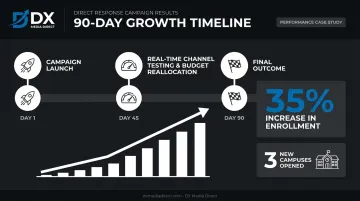
Disciplined testing produced these results, not an assumption that TV automatically outperforms social media. A channel tested with a clear, trackable structure, and cut quickly when it underperforms, delivers results guesswork alone cannot.
If your current media mix has plateaued, a free consultation with DX Media Direct can help determine whether a TV test campaign fits your growth goals. No obligation required.
Conclusion
TV and social media play different roles in a marketing budget. TV builds broad reach, trust, and brand recall that compounds over time. Social media adds speed and precision, delivering immediate feedback on what's working.
The businesses that win match objective to channel: TV for the awareness that primes a market, social for the fast, targeted push that closes the loop. Then they measure both honestly.
Treat TV and social as complementary tools, and the payoff shows up where it matters most: stronger brand recall paired with more efficient customer acquisition over time. DX Media Direct builds these multi-channel plans, pairing 35 years of TV buying expertise with digital execution to turn combined budgets into measurable revenue.
Frequently Asked Questions
Is social media replacing TV?
No. Social media consumption keeps growing, but streaming and traditional TV still command significant daily attention, with streaming alone making up 44.8% of U.S. TV usage per Nielsen. TV remains a complement to social, not a replacement.
Is TV better for you than social media?
Research doesn't show a clean winner on wellbeing. Studies suggest TV viewing tends to correlate with more relaxed, positive moods, while social media's emotional effects are more mixed and depend on how it's used.
Why is Gen Z ditching social media?
They're not, exactly; usage remains high. But fatigue is real: Pew found 45% of teens say they spend too much time on social media, up from 36% in 2022, driven by platform fatigue and privacy concerns.
Does watching TV count as social media?
No. Ordinary TV viewing is passive. "Social TV" refers specifically to viewers who simultaneously discuss or engage with TV content on social platforms while watching. That's a distinct behavior, separate from TV viewing itself.
Which is more cost-effective for advertising: TV or social media?
It depends on execution. Social media has lower entry costs but rising, unpredictable CPMs. Professionally negotiated TV buys, especially through remnant inventory, can deliver stronger effective rates than either assumption suggests.
Can TV and social media advertising work together?
Yes. Combining both creates a halo effect: TV builds broad awareness and trust, while social media reinforces that message and drives the click or conversion that closes the loop.