Introduction
Radio carries a $10.08 billion price tag in 2026. That's BIA's projected U.S. over-the-air radio revenue for the year, up 1.8% from $9.91 billion in 2025, according to Radio Ink's coverage of the BIA forecast.
More spend flowing into the channel means more advertisers competing for the same airtime.
Here's the catch: radio advertising cost has no fixed price tag. A 30-second spot might cost under $100 on a small-market station overnight, or several thousand dollars during morning drive in a top-15 metro.
The price depends on market, daypart, spot length, and how the ad is purchased.
This guide breaks down real 2026 pricing ranges, what pushes cost up or down, the expenses that hide behind the quoted airtime rate, and how to negotiate a smarter deal.
Quick Takeaways
- Radio spot costs range from single digits in small markets to $1,000+ for major-metro placements
- Market size, daypart, ad length, and audience demographics drive most of the price swing
- Frequency matters more than a low rate; a single cheap spot rarely moves revenue
- How you buy matters: self-serve programmatic and relationship-based buying rarely cost the same for identical inventory
How Much Does Radio Advertising Cost in 2026? (Pricing Overview)
Radio ad cost isn't one number. It's a range shaped by market size, station popularity, daypart, and which pricing model a station uses: CPM, CPP, flat rate, or sponsorship.
Most budgeting mistakes happen before the first spot even airs:
- Underbudgeting frequency — one or two spots a week rarely builds enough recall to drive action
- Chasing cheap remnant slots without a testing plan to validate whether they work
- Ignoring production costs that stack on top of the airtime rate
Typical Cost Ranges
2025 industry pricing data puts national/local ranges at:
| Spot Length | Published Range |
|---|---|
| 15 seconds | $1.80 – $315 |
| 30 seconds | $3 – $525 |
| 60 seconds | $5 – $750 |
Even within the "major metro" tier, the spread is wide. The same data shows Boston's average 60-second spot at $1,168.60, while Miami-Ft. Lauderdale averages just $90.77 for the same length. Station popularity and daypart matter more than city size alone.
CPM and CPP, Explained
Stations price inventory using two core metrics:
- CPM (cost per thousand impressions): schedule cost × 1,000 ÷ gross impressions. Example: $2,000 ÷ 100,000 impressions × 1,000 = $20 CPM.
- CPP (cost per rating point): schedule cost ÷ GRPs. Example: $2,000 ÷ 25 GRPs = $80 CPP.
CPP tends to matter more to radio buyers because it's tied directly to audience ratings in a specific market and demographic, not just raw impressions.
Pricing by Market Tier
Budget requirements shift significantly depending on which tier you're buying into:
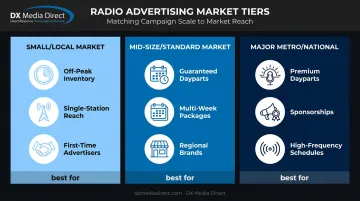
- Small/local market buys: Off-peak or remnant inventory on a single station with local-only reach. Best for local businesses and first-time advertisers testing the channel before committing serious budget.
- Mid-size/standard market buys: Guaranteed dayparts, moderate reach, and multi-week packages. Best for regional brands scaling past their first test with more consistency.
- Major metro/national campaigns: Premium dayparts, sponsorships, and high-frequency multi-station schedules. Best for national brands and direct-response advertisers needing volume for statistically meaningful results.
Key Factors That Affect Radio Advertising Costs
Pricing has no fixed rate card. Reach, timing, and how valuable a station's audience is to advertisers all shape the final cost.
Market Size and Station Popularity
A station's Nielsen ratings and audience rank set its rate card directly: higher-rated stations in bigger markets simply command more per spot. But rank alone doesn't guarantee price. As shown above, Boston's average spot costs nearly 13x Miami's, despite both being major metros.
Daypart and Ad Length
Dayparts price on a clear hierarchy, from most to least expensive:
- Morning Drive (highest cost, largest audience)
- Afternoon Drive
- Midday
- Evening
- Overnight (lowest cost)
One public station rate card (WGLT) illustrates the gap: drive time at $40, midday and evening at $30, overnight at just $15. Industry benchmarks from RAB peg nights and weekends at roughly half the price of drive time on most commercial stations.
Spot length scales cost too:
- A 15-second spot typically runs about 60% of a 30-second spot
- A 30-second spot typically runs 60-70% of a 60-second spot
- A 15-second spot often lands near half the price of a 60-second spot
Audience Demographics and Targeting
CPP calculations are built around a specific demographic within a market, which is exactly why niche or high-value audiences, such as affluent households, younger adults, or specific professionals, carry more weight in negotiations. Reaching 25,000 high-income listeners is worth more to most advertisers than reaching 25,000 people at random.
Seasonality and Demand
Q4 retail season reliably tightens inventory as major retailers and wireless carriers pile into the same slots. Election years compound this: Radio Ink reported that radio CPMs could rise by up to 80% in key markets during the 2026 midterms as political spending competes for limited airtime. If you're planning a Q4 or election-year campaign, lock rates early.
Production Quality
Airtime is only part of the bill. Scriptwriting, voice talent, sound engineering, and music licensing layer on top. Costs range from a few hundred dollars for a simple local read to several thousand for a fully produced, multi-voice spot with licensed music.
Cost Breakdown of Radio Advertising (Beyond Airtime)
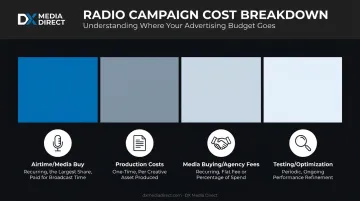
The quoted airtime rate is rarely the full campaign cost. Here's what else factors in:
| Cost Component | Timing | What It Covers |
|---|---|---|
| Airtime / Media Buy | Recurring | The bulk of spend, priced via CPM, CPP, flat rate, or sponsorship; rates vary by market and daypart |
| Production Costs | One-time per creative | Script, voice-over, sound mixing, and licensing, typically ranging from a few hundred to several thousand dollars |
| Media Buying / Agency Fees | Recurring (flat fee or % of spend) | Fees paid to a buying partner for access and negotiation |
| Testing and Optimization | Periodic | Refreshing creative and measuring real performance before scaling budget |
That third row deserves a closer look. Agencies with decades of network relationships have advantages that self-serve programmatic platforms can't replicate. DX Media Direct, for instance, has operated in direct-response media buying for 35+ years, long enough to build relationships that translate into:
- Preferred inventory access unavailable through automated platforms
- Negotiated rates below standard published pricing
- Faster problem-solving when a campaign underperforms
That access doesn't just save money on paper; it directly lowers the effective cost per response.
Testing matters just as much as the buy itself. Refreshing creative every 4-6 weeks and running a structured test, such as a 90-day market trial, validates spend with real performance data instead of guesswork before you commit a larger budget.
Low-Cost vs High-Cost Radio Buys — What's the Difference?
Remnant and self-serve buys look attractive on price. Negotiated, premium-placed buys look attractive on results. Here's how they actually compare:
| Factor | Lower-Cost Buys | Higher-Cost Buys |
|---|---|---|
| Rate & inventory access | Remnant/off-peak spots, programmatic self-serve rate cards, no placement guarantees | Negotiated rates on premium dayparts through direct station relationships |
| Measurability & ROI | Harder to isolate performance, minimal optimization support | Professionally tracked, attribution built in from day one |
| Long-term value | Fine for a quick, low-stakes test; limited scalability | Builds a repeatable playbook with compounding rate advantages over time |
The reach argument still favors radio broadly. Nielsen's 2026 Audio Today report, covered by Radio Ink, puts AM/FM's return at roughly $2 for every $1 spent. That figure assumes a campaign is structured to generate measurable results, though — not just a low quoted rate with no tracking behind it.
Programmatic broadcast inventory is expanding fast, too. iHeartMedia's programmatic revenue is projected to jump roughly 50% year over year in 2026, but that growth reflects easier access and better measurement tools, not proof that programmatic beats negotiated buying on price. Agencies like DX Media Direct still secure lower rates through direct relationships with station reps, the kind of access no self-serve platform can replicate.
How to Budget and Negotiate the Best Radio Ad Rates
Before setting a number, weigh these factors:
- Campaign goal: brand awareness needs different frequency than direct response
- Required frequency: RAB benchmarks show a light schedule (34% reach) needs roughly 11 weekly ads, while a heavy schedule (78% reach) can require up to 61
- Market size: bigger markets cost more per spot but reach more people per dollar of frequency
- Test vs. scale: a first campaign should prioritize learning over volume
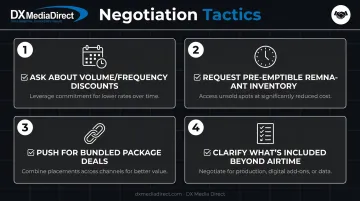
Negotiation tactics worth trying:
- Ask about volume or frequency discounts for multi-week commitments
- Request pre-emptible remnant inventory at a reduced rate if you can tolerate flexible scheduling
- Push for bundled package deals that combine dayparts across sister stations
- Clarify what's included beyond airtime, such as production support, added-value spots, or sponsorship mentions
Experienced media buyers routinely out-negotiate first-time or self-serve buyers, because long-standing relationships with station reps unlock rates and added-value bonuses that simply don't exist inside an insertion-order portal. DX Media Direct offers a free, no-obligation consultation to help identify the right media mix and budget before a single dollar is committed.
Conclusion
Radio advertising cost in 2026 varies by market, daypart, and buying method — but once you understand the components, it stops being a mystery. Airtime, production, buying fees, and testing all play a role, and none of them should be a surprise on the invoice.
Pairing a realistic budget with the right pricing model, whether that's CPM, CPP, flat rate, or sponsorship, leads to smarter spending decisions than chasing the lowest quoted number. The right radio cost is the one that delivers measurable revenue, not the cheapest quote you received. With 35 years of network relationships, DX Media Direct helps advertisers hit that mark.
Frequently Asked Questions
What's a realistic minimum budget to start advertising on radio?
There's no universal minimum, but frequency matters more than rate. A schedule too light to hit meaningful reach won't produce results regardless of how cheap each spot is.
How much does a 30-second radio ad cost?
Published ranges run from roughly $3 to $525 per spot, with major-market CPMs typically landing between $9 and $35. Market size and station popularity drive most of the variance.
How much does a 15-second radio ad cost?
Expect roughly 60% of a 30-second spot's price, or about $1.80 to $315 per spot depending on market and station. Shorter spots work well as reminder ads after a longer spot has run.
Is radio advertising still effective for small businesses in 2026?
Yes. AM/FM still reaches 66% of daily ad-supported audio time among adults 18+, and Nielsen data points to roughly $2 in return for every $1 spent when campaigns are structured well.
What's the cost difference between AM/FM and digital/streaming radio?
Traditional AM/FM uses per-spot and CPM/CPP pricing tied to a market's rating data. Streaming platforms like Spotify use auction-based CPM bidding with advertiser-set budgets, offering tighter targeting but less standardized pricing.
How are radio ad costs calculated (CPM vs. CPP)?
CPM equals schedule cost divided by impressions, times 1,000. For example, $2,000 for 100,000 impressions equals a $20 CPM. CPP equals schedule cost divided by GRPs, so $2,000 for 25 GRPs equals an $80 CPP.