Introduction
Everyone's heard the pitch: digital is where the money is, and broadcast is fading fast. Yet U.S. digital video ad spend hit $54 billion in 2023, with projections near $63 billion in 2024, and digital still only accounts for roughly half of total TV/video spending. The other half? Still broadcast.
Many business owners hear that broadcast is dying or too expensive to bother with. But plenty of brands still lean on TV and radio because nothing else builds instant credibility and mass reach the way a well-placed commercial does.
This guide breaks down what broadcast marketing actually is, the formats that make it up, and its real benefits and challenges. You'll also find the skills the industry demands and how to pick a partner who won't waste your ad budget figuring it out.
Key Takeaways
- Broadcast marketing spans TV, radio, and digital extensions like live streaming
- It remains one of the few channels delivering true mass reach and instant brand trust
- Success hinges on media buying expertise, not just a great commercial
- ROI tracking requires structured measurement, since broadcast lacks native analytics
- The right media partner turns ad spend into a scalable, profitable campaign
What Is Broadcast Marketing?
Broadcast marketing is the use of TV and radio, along with their digital simulcast extensions, to deliver promotional messages to large audiences at scale. Under federal broadcasting law, the term covers the dissemination of radio communications intended for public reception. Commercial stations fund this reach through advertising.
The category has evolved dramatically. Decades ago, a handful of major networks controlled nearly all viewer attention. Today, fragmented specialty stations, streaming simulcasts, and on-demand platforms compete for the same eyeballs.
How the Mechanics Actually Work
Producing a spot is only step one. The real work happens when a media buyer negotiates airtime with a network or station, factoring in:
- Daypart (morning, primetime, late night)
- Program (news, sports, entertainment)
- Geographic market (local, regional, national)
This is where broadcast diverges sharply from digital advertising. Programmatic platforms rely on automated bidding and real-time impression data. Broadcast still runs on negotiated media buys backed by audience research, similar to the panel-and-set-top-box methodology Nielsen uses to estimate who's watching.
Direct-response broadcast marketing takes this a step further. Instead of just chasing impressions or awareness, every creative and airtime decision ties back to a trackable sales outcome, whether that's a call, a website visit, or a completed purchase.
Types of Broadcast Marketing
Broadcast marketing splits into two broad camps: the traditional formats that built the industry, and the digital extensions that keep it relevant.
Traditional Broadcast Formats
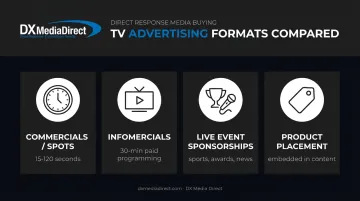
TV advertising includes several distinct formats:
- Commercials and spots: typically 15, 30, or 60 seconds, though direct-response ads commonly run in 30, 60, or 120-second formats to fit their call-to-action
- Infomercials: usually half-hour paid programming built for detailed product demonstration
- Live event sponsorships: tying a brand to sports broadcasts, awards shows, or news coverage
- Product placement: embedding a brand within the actual programming content
Radio advertising plays a different but complementary role:
- Local spot ads for regional or niche audience targeting
- On-air personality endorsements, which borrow trust from a familiar local voice
- Drive-time slots, capturing commuter audiences during radio's highest-listenership hours
Modern & Digital Broadcast Extensions
Broadcast-style reach hasn't stayed confined to TV and radio towers. It's expanded into:
- Live streaming on YouTube Live, Facebook Live, and Twitch, offering real-time video feeds with live chat and audience interaction
- Podcasts and webinars for thought leadership and engaged niche audiences (podcast ad revenue hit $1.9 billion in 2023, growing at a double-digit clip)
- SMS/text broadcast messaging as a fast, direct complement to airtime campaigns, though it's technically wireless messaging rather than broadcast media in the strict sense
Each extension borrows broadcast's mass-reach logic while adding a layer of real-time or trackable engagement traditional TV and radio can't offer on their own.
Benefits & Challenges of Broadcast Marketing
Broadcast marketing isn't a relic, but it isn't without real trade-offs either. Here's the honest picture.
Key Benefits
Massive audience reach. Radio alone captured 67% of daily ad-supported audio time among U.S. adults in Q4 2024, though that number varies by age, with 47% among 18-34 year-olds and 74% among those 35 and up. That's still a scale most digital channels can't match with a single buy.
Beyond reach, broadcast brings:
- Instant credibility: appearing alongside trusted programming lends a brand legitimacy that a banner ad simply can't replicate
- Emotional engagement: combined audio-visual storytelling tends to stick with viewers longer than text or static formats
- Scalable proof through testing: a structured 90-day TV test, done right, produces a clear playbook and hard revenue data before you commit to a bigger spend
DX Media Direct uses this exact 90-day testing approach to prove ROI before clients scale up their broadcast spend.
Common Challenges
Broadcast has real friction points too:
- High upfront costs: production plus airtime adds up fast, especially in primetime. Buying timing matters here: scatter market inventory ran 14% more expensive than upfront inventory in 2023
- Limited micro-targeting: you're paying to reach a broad demographic, not a hyper-specific audience segment, which risks wasted impressions
- Murky ROI measurement: without a defined tracking methodology, it's genuinely hard to know what's working
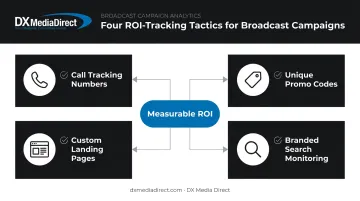
That last point is where most self-serve broadcast efforts fall apart. Experienced agencies close the gap by building tracking into the campaign from day one, using tactics like:
- Call tracking numbers embedded in commercials
- Unique promo codes tied to specific creative versions
- Custom landing pages for each campaign
- Branded search monitoring to catch the "halo effect" broadcast creates online
None of that happens automatically. It takes a dedicated team to build it in.
Skills Needed for a Career in Broadcast Marketing
Broadcast marketing rewards a specific mix of creative and analytical thinking that doesn't show up in most digital-first job descriptions.
Creative and storytelling ability sits at the core. Scriptwriting for a 30-second spot demands a completely different discipline than writing digital ad copy — it means building a narrative arc against a hard time limit, whether for a commercial, an infomercial, or a sponsorship integration.
Analytical skills matter just as much:
- Interpreting viewership and listenership data
- Understanding demographic breakdowns by daypart
- Translating audience research into placement decisions
Negotiation and relationship-building separate the professionals from the amateurs. Securing favorable rates and inventory access happens through direct relationships with network representatives, not automated ad portals. This is a people business first.
Finally, communication and composure under pressure round out the skill set. Broadcast marketers collaborate with producers, directors, and network executives while managing client expectations, often simultaneously.
These interpersonal demands explain why formal credentials matter less than field experience. A degree in marketing, communications, or business is typically preferred, though not always required. Hands-on experience reading audience data and negotiating deals matters more than a diploma.
How to Choose the Right Broadcast Marketing Partner
Not every agency that touches TV and radio buys media the same way. Here's what actually separates a strong partner from a mediocre one.
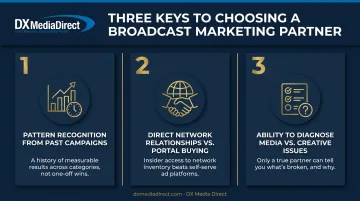
Look for accumulated pattern recognition, not generic formulas. An agency that's run thousands of campaigns knows which dayparts historically drive response for specific product categories, and which networks' audiences convert versus simply watch. That distinction is nearly impossible to learn from a self-serve dashboard.
Prioritize direct network relationships over portal-based buying. Agencies that negotiate directly with network reps can access preferential rates and remnant inventory that automated insertion-order platforms structurally can't offer.
Confirm they can diagnose the real problem. A campaign that underperforms could be a media mix issue, a creative execution issue, or both. A capable partner tells you which, and knows how to fix it.
A quick comparison:
| Partner Type | Media Buying Approach | Rate Access |
|---|---|---|
| Programmatic/self-serve platform | Automated bidding, portal-based insertion orders | Standard rate card |
| Experienced media buying agency | Direct negotiation with network reps | Preferential rates, remnant inventory |
That gap in rate access and diagnostic ability is exactly what separates results from guesswork.
DX Media Direct has spent over 35 years building this relationship-based buying model, running direct-response campaigns across linear TV, CTV, radio, and podcasts.
The agency offers a free, no-obligation consultation for businesses trying to determine whether broadcast can grow their revenue before committing serious budget.
Frequently Asked Questions
What are the main types of broadcast media?
The main types are TV (commercials, infomercials, sponsorships, product placement) and radio (spot ads, personality endorsements), plus modern extensions like live streaming, podcasts, and simulcasts.
What skills do you need for broadcast media?
Key skills include creative storytelling, communication, composure under pressure, and the ability to analyze audience data. A related degree helps but isn't mandatory if you have hands-on experience.
Is broadcast marketing still effective in the digital age?
Yes, especially for mass reach and instant credibility. It's most effective when paired with structured testing and digital retargeting to make results measurable.
How much does broadcast TV advertising typically cost?
Costs vary widely by daypart, program popularity, and market size. Experienced media buyers with direct network relationships typically secure better rates than self-serve or programmatic platforms.
How is ROI measured in broadcast marketing?
ROI is measured through structured tracking: unique promo codes, dedicated call-tracking phone numbers, custom landing pages, and short-term test campaigns, rather than native ad-platform analytics.
What's the difference between broadcast marketing and streaming/CTV advertising?
Broadcast delivers mass, scheduled-audience reach, while CTV and streaming offer granular targeting and near real-time analytics. The two channels work best together, with each strengthening the other's reach and measurement.