That split creates real tension for anyone holding a media budget. Business leaders hear "TV is dying" in one meeting and "TV still dominates reach" in the next. Neither claim tells the whole story.
This guide breaks down what traditional TV advertising actually is, whether it still delivers results, where it genuinely struggles, and how to structure a campaign that produces revenue instead of just impressions.
Key Takeaways
- Traditional TV still commands the majority of adults' ad-supported, long-form viewing time
- Better buying fixes ratings-based measurement flaws — don't abandon TV
- Negotiated CPMs can beat digital when bought through relationships instead of automated platforms
- Winning campaigns depend on smart buying and measurement, not the channel used
What Is Traditional TV Advertising?
Traditional (or linear) TV advertising means commercials placed inside a fixed broadcast or cable programming schedule. Viewers watch on the network's timeline, not on-demand. This distinguishes it from Connected TV (CTV) and streaming formats, where ads get inserted algorithmically into content viewers choose whenever they want.
Common Examples of Traditional TV Advertising
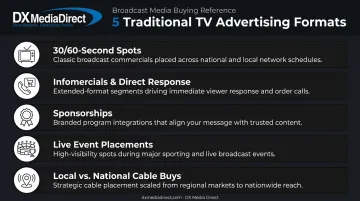
Traditional TV spans several formats, each suited to different goals:
- 30/60-second spots: the standard commercial break format for brand and product messaging
- Infomercials and long-form direct response ads: extended segments designed to drive immediate calls or orders
- Sponsorships: brand integration within a show or segment (think "this program brought to you by...")
- Live event placements: commercial slots during sports broadcasts, award shows, and other high-viewership live programming
- Local vs. national cable buys: regional spot buys targeting specific markets versus nationwide network placements
Traditional advertising as a broader category also includes radio, print, and direct mail, but TV stands apart as the only format that combines sight, sound, and motion in one message, a distinction that matters when comparing recall and engagement across channels.
Does Traditional TV Advertising Still Work?
Linear viewership has declined as streaming grew. That's not in dispute. But a decline in share doesn't mean the channel stopped working — it means the audience split differently than it used to.
Here's what the current data actually shows. Among adults 18+, linear TV accounted for 59% of ad-supported viewing and 69% of long-form ad-supported viewing in May 2025, once YouTube's short-form content is excluded, per TVB's analysis of Nielsen's Gauge data.
In other words, when adults sit down to watch a full show with ads, linear still wins most of that time.
The Measurement Problem Isn't a TV Problem
A widely cited study from the University of Notre Dame gives useful context here. Researchers Shijie Lu, Tsung-Yiou Hsieh, and Rex Yuxing Du analyzed second-by-second viewing data from millions of smart-TV households and found that conventional TV measurement overestimated ad effectiveness by 55%.
The ads likely worked fine. The real issue is that standard ratings-based measurement can't separate ad exposure from pre-existing viewing and buying habits. Someone who already watches a lot of TV and already buys a lot of stuff looks like an "ad success" even when the ad barely moved anything.
This is an argument for better measurement, not for pulling TV budget. Direct-response TV buying, where every spot ties to a trackable call, code, or order, solves exactly the attribution gap this research identifies.
Who's still watching, and why it matters:
- Viewers aged 65-99 spend 74.7% of their TV time with linear programming, per Nielsen's 2025 age-viewing analysis
- Older demographics tend to carry higher purchasing power in categories like healthcare, financial services, and home improvement
- If your buyer skews 45+, traditional TV puts your message directly in front of that audience
Key Benefits of Traditional TV Advertising
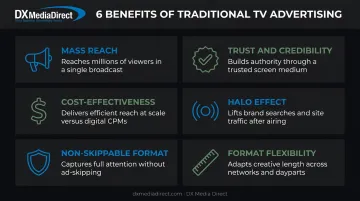
Not every advantage of traditional TV shows up in a click-through rate. Here's where it earns its budget:
Mass Reach: A single prime-time or live-event ad buy (Sunday football, major award shows) puts your message in front of millions of viewers at once. No digital targeting mechanism replicates that scale in one shot.
Cost-Effectiveness: TV's reputation for being expensive is outdated. Remnant inventory (unsold slots networks discount before airtime) can be negotiated 75-90% below rate card, turning a $500,000 budget into $2 million to $5 million in equivalent airtime, a potential 4:1 return.
Non-Skippable, High-Attention Format: Commercials embedded in live programming can't be skipped the way a pre-roll digital ad can. That structural difference alone drives higher message completion.
Trust and Credibility: TV's regulated content standards and decades-long presence build inherent credibility. Kantar's global trust study found 20% average consumer trust for offline channels versus 11% online, a gap that matters most in healthcare, finance, and automotive.
The Halo Effect: TV exposure primes consumers before they hit other channels. A viewer who sees your commercial is more likely to recognize and trust your brand when they later encounter it in search or social.
Format Flexibility: From 15-second brand spots to 30-minute infomercials, TV lets you match ad length to campaign goal, whether that's a quick awareness play or a full direct-response pitch.
Challenges and Misconceptions of Traditional TV Advertising
TV isn't friction-free. Three issues come up constantly, and each has a workaround:
- Rising costs for premium slots. Primetime rates look steep on paper, but media buying expertise unlocks remnant and negotiated inventory instead of paying the full rate card.
- Ad clutter and fatigue. Multiple commercials in one break desensitize viewers. Research from TVision found breaks of 90 seconds or less earn the highest attention, meaning shorter, sharper creative outperforms in cluttered pods.
- Measurement uncertainty. This ties back to the Notre Dame findings above: without a trackable, direct-response framework, advertisers risk crediting or blaming the wrong variable. A campaign that "isn't working" might just be measured wrong.
How to Make Traditional TV Advertising Work Harder for Your Business
The real lever is how the campaign gets bought, tested, and measured, regardless of whether the budget leans TV or digital.
1. Test before you scale. A structured test window, commonly a 90-day TV test, gives you a repeatable playbook instead of a pile of ambiguous data. You learn which networks, dayparts, and creative combinations actually convert before committing a full-year budget.
2. Diagnose correctly when results underperform. Weak numbers usually come from one of two places:
- The media buy: wrong network, wrong daypart, or a rate that made the math impossible from the start
- The creative: a message that isn't landing with the audience it's reaching
Misdiagnosing which one is the problem is where advertisers waste the most money. Fixing creative when the real issue is a bad daypart buy (or vice versa) burns budget without fixing anything.
3. Buy on relationships, not just portals. Long-standing, relationship-based negotiations with network representatives secure preferential rates and inventory access that automated, portal-based programmatic buying structurally cannot reach. An algorithm doesn't get the call about excess Tuesday-morning inventory that needs to move by Thursday. A human buyer with 25+ years of network relationships does.
This is where DX Media Direct fits into the picture. The agency is a full-service, direct-response TV shop with over 35 years of media buying experience and thousands of executed campaigns. It negotiates directly with network reps rather than routing spend through automated platforms, often securing rates 35-90% below standard prime pricing.

Businesses evaluating a TV strategy can start with a free, no-obligation consultation to see what a tested, relationship-driven media buy could look like for their budget.
4. Track the metrics that matter. Skip the vanity numbers. Track calls, clicks, leads, and sales that tie directly back to the campaign. Reach and impressions tell you who saw the ad. Profit-column metrics tell you whether it worked.
Frequently Asked Questions
What are examples of traditional advertising?
Traditional advertising includes TV commercials, radio spots, print ads, billboards, and direct mail. TV stands apart because it combines sight, sound, and motion in a single message format.
Does traditional advertising still work?
Yes, TV still works for reach and brand building, but effectiveness depends heavily on buying strategy, targeting, and measurement approach rather than the channel itself.
Are traditional media advertisements trustworthy?
Yes. Audiences view TV as more credible than digital ads because of regulatory content standards and its established presence, making it valuable for trust-sensitive industries like healthcare and finance.
How much does traditional TV advertising cost?
Cost varies widely by daypart, network, and program popularity. Experienced media buyers with network relationships can often secure far better rates than programmatic platforms, particularly through remnant inventory.
What's the difference between traditional TV and digital or programmatic advertising?
Traditional TV relies on fixed-schedule mass reach and relationship-based buying with network reps. Digital and programmatic advertising use automated, portal-based targeting and bidding systems instead.
How is TV advertising effectiveness measured?
Traditional ratings-based measurement can overstate impact by conflating exposure with existing viewer habits. Direct-response tracking, meaning calls, orders, and unique codes, ties results more accurately to revenue.