Many advertisers pick a station because they like it personally, or because a sales rep called first. That's a costly habit. With thousands of AM/FM stations spread across formats, dayparts, and coverage areas, choosing the wrong one means your ad reaches people who were never going to buy from you.
Terrestrial radio still commands real attention: 88% of all daily AM/FM listening happens through traditional over-the-air receivers, according to Edison Research's Q1 2025 Share of Ear study. That's a massive, engaged audience if you reach the right slice of it.
This guide walks through what actually goes into choosing a radio station, the metrics that separate real audience delivery from hype, and how to confirm your picks are paying off.
Key Takeaways
- Match station format and audience to your customer profile — fit beats popularity
- AQH, Cume, and GRP numbers show what a station delivers, not what it claims
- Daypart and CPP/CPM choices can swing cost-efficiency dramatically across a campaign
- Track results by station and daypart, then drop underperformers promptly
- Experienced media buyers secure rates and inventory that self-service platforms can't match
What Does "Choosing a Radio Station" Actually Involve?
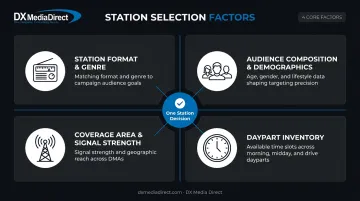
Choosing a radio station means matching four things to your campaign: format, audience composition, coverage area, and daypart inventory. Get the intersection right, and the station does targeting work your ad budget can't do alone.
Advertisers generally choose between two broad categories:
- Terrestrial AM/FM stations — local or regional signals with geographically defined reach
- Syndicated or network-affiliated programming — content distributed nationally through local affiliates, useful for brands chasing broader awareness
- Streaming simulcasts — the same signal delivered digitally, often sold as separate inventory with app-based listening data
These aren't mutually exclusive. Nielsen reports that more than 93% of radio listeners tune into a network-affiliated station weekly, meaning the local signal you buy may still carry national programming and inventory. Knowing which one you're actually purchasing changes how you plan reach.
Station Format & Genre
Talk, news, sports, and specific music genres each pull a distinct crowd. A classic rock station skews differently than a Spanish-language contemporary hits station, even in the same city. Format is usually the first filter advertisers apply, since it screens out audiences that will never convert regardless of price.
Audience Composition & Demographics
Format hints at who's listening, but Nielsen ratings data confirms it: age, gender, and household income skew differently even within the same genre. A country station in one market might over-index with women 35-54, while a similarly formatted station elsewhere skews male and younger. Request the station's Nielsen audience profile before buying, not just its format label.
Coverage Area & Signal Strength
A station's broadcast contour, the FCC-defined boundary where reception is generally protected from interference, determines whether it fits a hyper-local, regional, or multi-market campaign. Reference classes vary widely: a Class A FM contour runs about 17 miles, while a Class C station can reach roughly 57 miles. Terrain can shrink or stretch that in practice, which is why the FCC itself notes reception isn't guaranteed everywhere inside the line.
Daypart Inventory
Stations sell time in blocks, morning drive, midday, afternoon drive, evening, and overnight, and each block carries different listener volume and pricing. Don't assume mornings always win: Nielsen trend data has shown afternoon drive outperforming morning drive in several top-10 markets. The right slot depends on when your audience listens, not industry convention.
Why the Right Station Choice Matters for ROI
Getting station selection right isn't an academic exercise. It shows up directly in your numbers.
- Stronger brand recall. A 2019 pharmaceutical campaign study commissioned by Cumulus Media and Westwood One found heavy AM/FM listeners had 3x the ad recall and 47% higher aided awareness than the general market.
- Less wasted spend. When a station's listener base doesn't match your customer profile, you're paying to talk to people who were never buying anything from you anyway.
- Higher trust transfer. Local stations build credibility over years. A host reading your ad live carries some of that trust into your message, something a random national buy rarely replicates.
Station fit compounds. A slightly better-matched audience, at a slightly better daypart, adds up to a lower cost-per-acquisition across a full campaign.
What to Consider When Choosing the Best Radio Stations to Advertise On
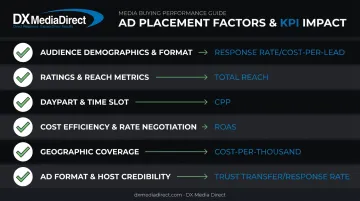
Treat this as a checklist connecting station-level specs to outcomes you can actually measure: reach, cost-per-acquisition, response rate.
Target Audience Demographics & Format Alignment
Match a station's age, income, gender, and interest data to your customer profile. This single comparison drives more wasted or effective spend than any other decision on this list. KPI affected: response rate and cost-per-lead.
Station Ratings & Reach Metrics
A station's reputation and its delivered audience aren't the same thing. Ratings metrics reveal what actually happened, not what people assume happened.
| Metric | What It Tells You |
|---|---|
| AQH | Average persons listening during a 15-minute period |
| Cume | Unique people reached during a daypart |
| Rating | AQH divided by total population, x100 |
| Share | AQH divided by total radio listening, x100 |
| GRP | Sum of rating points across a full schedule |
Metric impacted: total reach and frequency of message delivery.
Daypart & Time Slot Selection
Drive-time slots cost more because more people are listening and paying closer attention. Overnight and midday slots cost less but deliver smaller, sometimes less engaged audiences. What it moves: cost-per-point (CPP) and impressions delivered.
Cost Efficiency & Rate Negotiation (CPP/CPM)
Rates swing by market size, demographic desirability, and seasonal demand — political season and holidays both push prices upward. Inside Radio's 2025 forecast pegged overall U.S. radio cost inflation at just 1%, but that average hides real station-by-station variation. Benchmark quotes; don't accept a rate card at face value. KPI affected: cost-efficiency and ROAS.
Geographic Coverage vs. Campaign Objectives
A hyper-local business, a dentist or a home services company, needs a tight signal footprint. A regional or national brand needs broader contour reach even if part of that coverage falls outside the immediate customer base. Metric impacted: cost-per-thousand relative to in-market versus out-of-market waste.
Ad Format & Host Credibility
Produced spots, live reads, sponsorships, and testimonials transfer different amounts of host trust to your brand. A live read from a host listeners have followed for years often outperforms a slicker produced spot from an unfamiliar voice. Keep the message simple: ads built around four separate points generated less than half the recall of single-message creative, according to a 2025 Radio Ink report. What it moves: listener trust transfer and resulting response rate.
How to Measure Whether You Chose the Right Stations
Selecting a station is a hypothesis. Tracking performance is how you find out if you were right.
- Direct attribution tools. Promo codes, vanity URLs, and dedicated phone lines trace traffic back to a specific station or daypart. Pair vanity URLs with a code or number, since listeners often just search the brand name instead.
- Brand-lift surveys. Periodic surveys measure whether a station is actually moving awareness and recall among its listeners, not just airing your spots.
- Reach and frequency reports. These confirm whether the audience you're paying for matches the audience you're actually getting.
- ROAS calculation. Divide attributable revenue by total radio spend. This is the clearest signal of whether a station has earned its place in your schedule.
If a station's ROAS lags behind the rest of your schedule for two or three consecutive reporting periods, swap it out. Keeping an underperforming station out of habit is one of the most common ways radio budgets leak away.
How DX Media Direct Helps You Choose and Buy the Right Radio Stations
Finding the right station on paper is half the job. Securing the right rate, the right daypart, and actual inventory access is the other half, and that's where most self-service ad portals fall short.
DX Media Direct has spent 35 years buying direct-response media, long enough to build real pattern recognition across dayparts, networks, and product categories. That history means fewer guesses when a client asks "which station, and when."
Instead of routing orders through automated insertion platforms, DX Media Direct negotiates directly with network representatives. That relationship-based approach delivers advantages programmatic platforms can't replicate:
- Secures preferential rates negotiated station-by-station, not by rate card
- Accesses remnant inventory that stretches ad budgets further
- Reaches daypart inventory often locked out of self-service portals
When a radio campaign underperforms, the cause isn't always the station. Sometimes the media mix is off; sometimes the creative simply isn't landing. DX Media Direct works through both sides of that equation rather than assuming the fix is always "try a different station."

If you're evaluating radio as part of your media plan, DX Media Direct offers a free, no-obligation consultation to walk through station options, ratings data, and budget scenarios before you commit to a schedule.
Conclusion
Matching a station's audience, format, and daypart inventory to your campaign priorities and budget matters more than chasing the most popular name in the market.
Station performance shifts over time. Ratings change, formats get retooled, and audience composition drifts, so a good pick today can become a mediocre one in eighteen months. Review your schedule periodically rather than setting it once and walking away.
Pair a solid selection framework with experienced media buying, like the approach DX Media Direct brings to every campaign, and radio stops being a guessing game. It becomes a measurable channel that shows up in the numbers that matter most: leads, calls, and revenue.
Frequently Asked Questions
How do I choose the best radio stations to advertise on?
Match your audience demographics to a station's format, then check its ratings data, AQH and Cume, before comparing cost against reach. The best station is the one where all three line up with your budget and goals.
What are the top radio stations to advertise on?
There's no universal "top" list. Rankings depend on local market ratings and audience fit, so check a market's ratings service or ask a media buyer for market-specific data before assuming a well-known station is your best option.
How do I find radio stations available in my area?
Tools like RadioLocator or the FCC's FM Query let you search stations by location and pull coverage maps. Local station sales reps can also send you rate cards and detailed coverage data directly.
Does radio advertising work for small businesses?
Yes, particularly for businesses with a regional customer base. Radio's broad local reach and host credibility make it effective for driving calls and store visits, though results vary by market and execution.
How much does it cost to advertise on a radio station?
Costs vary widely by market size, daypart, and demand; rates tend to rise during elections and holidays. Rather than relying on published averages, request a station-specific quote showing CPP or CPM for your target demographic.
How long should a radio ad be?
Standard lengths are 30 or 60 seconds. Media buyers often find 30-second spots outperform both shorter and longer formats, largely because they force a single, focused message and a clear call to action.