Introduction
Two businesses put up billboards on the same highway last spring. One drove a measurable spike in store visits within three weeks. The other spent its entire budget on a board most drivers can't recall seeing at all.
The difference wasn't the medium. Billboards remain one of the most-noticed ad formats in the country, with more than 90% of US travelers reporting they noticed out-of-home advertising in the prior month, according to a study cited by the Out of Home Advertising Association of America.
The failure comes from location, design, or measurement mistakes that are entirely avoidable.
This guide breaks down what separates a billboard that builds real recall from one that blends into roadside clutter. It covers strategic placement, design rules built for a few seconds of attention, format selection, realistic budgeting, and how to track whether a campaign is actually working.
Key Takeaways
- Billboard success hinges on strong location, high-contrast design, and adequate campaign duration
- Aim for seven words or fewer per board, the OAAA benchmark for quick roadside readability
- Rate cards are a starting point—experienced buyers often negotiate better rates
- ROI is indirect and multi-touch, needing structured tracking tools, not instant digital attribution
What Makes a Billboard Marketing Strategy Effective
A billboard marketing strategy is the combination of audience research, location selection, message design, and campaign timing, all pointed at one measurable business goal. Skip any of these four and the campaign becomes a guessing game.
Most businesses treat billboards as a creative exercise: design something eye-catching, put it up, hope for the best. That's backward. Location and audience fit come first. Design and timing follow.
Location and Audience Alignment
Traffic count alone doesn't tell the full story. Geopath's visibility-adjusted measurement standard factors in dwell time, viewing angle, illumination, and apparent display size, not just how many vehicles pass by, according to its [standards documentation] (Geopath's standards documentation). A board on a slow, high-visibility corridor can outperform one on a fast highway where drivers barely glance up.
Match placement to actual customer behavior:
- Business districts for reaching weekday commuting professionals
- Residential corridors for consistent morning and evening exposure
- Retail-adjacent roads for last-mile purchase decisions
- Event or venue routes for time-sensitive local promotions
A board perfectly designed but sitting in a low-traffic, poorly angled spot will consistently underperform a simple message placed where the right eyes travel daily.
Timing, Frequency, and Campaign Duration
OAAA treats four weeks as the standard buying and measurement cycle for out-of-home campaigns, per OAAA's planning guide. That's a useful planning unit, but retention depends more on repeated exposure than a fixed calendar minimum.
A few proven tactics worth building into any strategy:
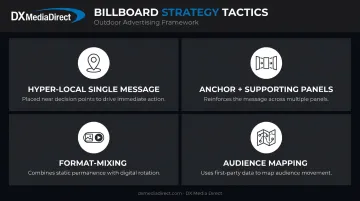
- Hyper-local single-message boards placed near the exact point of decision (a turn, an exit, a storefront)
- Anchor-plus-supporting-panel combinations that repeat one message across multiple nearby boards for reinforcement
- Format-mixing, pairing static permanence with digital's ability to rotate creative for time-sensitive offers
- Audience mapping using first-party data to confirm where actual customers travel, not just where inventory happens to be available
Align launch timing with product seasons, local events, or industry calendars whenever possible. A landscaping company launching in February wastes exposure that a March or April launch would capture at full value.
Billboard Design Principles That Capture Attention in Seconds
Drivers get a few seconds, sometimes less, to register a billboard message. Every design decision has to serve legibility first.
OAAA's creative guidance sets seven words or fewer as a proven benchmark for message length, noting the board should be understandable "in a few seconds," per OAAA's best-practices guide. That's not a suggestion for minimalists. It's the actual ceiling for what a moving driver can absorb.
One Theme, One Idea, One CTA
Cramming a phone number, a discount, a tagline, and a logo onto one board doesn't communicate more. It communicates nothing clearly. Pick one idea, commit to one call to action, and treat everything else as noise competing for the same three seconds.
Contrast and Legibility
A few non-negotiables:
- Large, blocky fonts readable from a distance, not decorative script
- High color contrast between text and background (dark text on light, or vice versa)
- The "shrink-and-squint" test: if it's unreadable from 15 feet on paper, it won't read at 45 mph either
Make It Memorable, Not Just Informational
Purely informational copy gets ignored. A striking visual, a flash of humor, or genuine curiosity sticks. Think about which billboards you actually remember from your last road trip. It's rarely the ones listing features.
Before committing a full budget to one concept, test two or three creative directions on a small scale, the same approach DX Media Direct uses when piloting outdoor campaigns for clients before committing to a full-market rollout. Design that gets nods of approval in a conference room doesn't always survive contact with a real highway.
Types of Billboard Formats and Choosing the Right One
Not every format serves the same goal. Choosing based on availability instead of campaign fit is a common, expensive mistake.
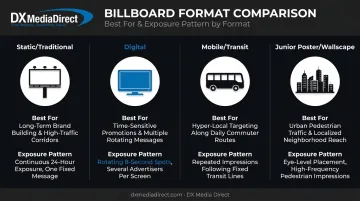
| Format | Best For | Exposure Pattern |
|---|---|---|
| Static/traditional | Long-term brand building | Consistent 24/7 message, contracts often six months or longer |
| Digital billboard | Time-sensitive promotions | Creative rotates every few seconds among several advertisers, real-time updates |
| Mobile/transit | Hyper-targeted local pushes | Route-specific, flexible timing, strong for events |
| Junior poster/wallscape | Dense urban campaigns | Smaller footprint, high-frequency exposure in walkable areas |
Static billboards suit brands playing the long game, a message that stays consistent and builds recognition over months. Digital billboards make sense when copy needs to change frequently, such as a limited-time offer or a seasonal push, though the message shares screen time with several other advertisers.
Mobile and transit options work well for hyper-local campaigns or event-driven pushes where a fixed board doesn't reach the right audience. Junior posters and wallscapes fit dense urban markets where sheer frequency of exposure matters more than a single dominant placement.
The decision rule is simple: match the format to three variables:
- Campaign goal, whether it's long-term brand building or a time-sensitive push
- Budget and the contract length you can commit to
- How often the creative needs to change
Availability should be the last factor considered, not the first.
Billboard Advertising Costs and Smart Media Buying
Billboard pricing swings widely based on four factors: location and traffic volume, format, campaign duration, and seasonal demand.
Typical monthly ranges by geography:
- Rural placements: $250 to $750
- Suburban/mid-sized city boards: $750 to $2,500
- Major metro/urban boards: $2,500 to $15,000+
- Highway placements: $2,000 to $5,000
By format, static billboards generally run $250 to $14,000 per month depending on location, while digital billboards range from $1,200 to $15,000+ per month. Mobile and transit advertising typically falls between $300 and $2,500 per month, making it one of the more accessible entry points for localized campaigns.
CPM: The Metric That Actually Lets You Compare
Cost per thousand impressions, or CPM, is the standard way to compare value across locations and formats. A cheaper board isn't automatically a better deal if it delivers far fewer qualified impressions than a pricier one nearby.
Why Rate Cards Aren't the Real Price
Published rate cards are a starting point for negotiation, not the final number. Vendors hold back preferential inventory and pricing for buyers with established relationships. Self-serve booking portals and programmatic platforms simply can't replicate that level of access.
This is where a full-service agency earns its keep. DX Media Direct has spent 35+ years building media-buying relationships across TV, radio, and outdoor networks. That negotiation leverage stretches an out-of-home budget further than going direct through a vendor portal. Businesses evaluating billboard options can request a free consultation to benchmark whether their current quotes reflect fair market pricing.
Measuring ROI and Turning Billboards Into a Direct-Response Channel
Billboards don't come with clicks or pixels. There's no dashboard refreshing in real time. Getting reliable numbers just requires building tracking into the campaign from the start.
Practical Tracking Tools
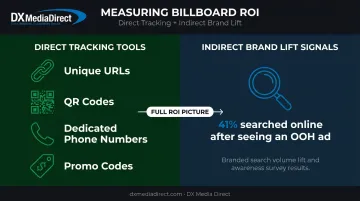
- Unique URLs printed on the board and dedicated to that campaign alone
- QR codes linking directly to a landing page built for that specific placement
- Dedicated phone numbers that route calls back to a trackable line
- Promo codes redeemable only through the billboard's specific messaging
Watching Brand Lift When Direct Attribution Isn't Possible
Not every response shows up as a click or a call. Comscore surveyed more than 1,580 consumers and found 41% searched online after seeing an out-of-home ad, according to OAAA's release of the Comscore findings. Watching branded search volume and running periodic awareness surveys gives a leading indicator even when nobody scans a QR code.
Test Before You Scale
Once tracking numbers and brand lift signals are in place, the next step is proving the campaign works before scaling it. Run a focused 60-to-90-day test in one or two markets before committing to a full multi-market rollout. Real performance data, not a boardroom guess, should drive the decision to scale spend.
When a campaign underperforms, the harder question is why. Weak placement and weak creative look identical from the outside — low calls, low foot traffic, no lift — but each demands a different fix.
That's where pattern recognition across thousands of executed campaigns pays off. Knowing whether to swap the location or rework the message turns a guessing game into a repeatable playbook.
Frequently Asked Questions
Are billboards an effective marketing strategy?
Yes, when paired with strategic location and simple design. Billboards deliver consistent, high-frequency exposure that builds brand recall in ways many short-lived digital ads simply don't match.
What are the top billboard marketing strategies?
Precise audience and location mapping, single-message simplicity, mixing static and digital formats, and running a test period before scaling spend. Together, these prevent the most common billboard failures.
What is the 3 second rule for billboards?
Viewers typically register a billboard message in just a few seconds while driving or walking past. Copy should stay to seven words or fewer with one clear visual focus.
What is a billboard marketing strategy?
It's the combined plan of location selection, audience targeting, creative design, and timing, built around a specific, measurable business goal rather than a one-off creative decision.
How much does billboard advertising cost?
Costs vary widely by location, format, and duration, ranging from around $250 monthly for rural static boards to $15,000+ for premium digital placements in major metros. Partnering with an experienced media buyer like DX Media Direct helps benchmark fair pricing and can unlock remnant inventory discounts.
How do you measure the ROI of a billboard campaign?
Use trackable tools like QR codes, unique URLs, and promo codes to tie inquiries directly to the campaign. Pair those with indirect indicators, such as branded search uplift and sales trends, for a fuller picture.