Many businesses struggle to figure out where audio fits into a media plan crowded with digital options. Radio itself has moved well past AM/FM. It now spans digital streaming platforms like Pandora and Spotify, plus the fast-growing podcast market, giving advertisers more ways to reach listeners than ever.
This guide covers what a radio spot actually is, how pricing works across radio and podcasts, how the two channels stack up against each other, and how smarter media buying can multiply your results without multiplying your budget.
Key Takeaways
- A radio spot is a paid radio commercial, usually 15, 30, or 60 seconds.
- Costs depend on daypart, market size, spot length, and frequency, not one flat rate.
- Podcast ads run on a CPM model, with mid-roll placements typically priced higher than pre- or post-roll.
- Relationship-based media buying can unlock rates and inventory that automated platforms structurally can't access.
What Is a Radio Spot? Definition, Formats, and How It Differs From a Jingle
A radio spot is the industry term for a paid advertisement aired on radio, defined simply as "an announcement or advertisement on the radio." That definition has stretched to cover digital radio and podcast placements too, since the underlying idea (a paid audio message inserted into programming) hasn't changed.
Spots come in two production styles:
- Live reads: delivered on-air by a DJ or host, often framed as a personal endorsement
- Produced spots: pre-recorded with voice-over, music, and sound effects
The delivery style matters more than most advertisers assume. A 2022 Nielsen study found that 44% of AM/FM listeners and 56% of podcast listeners pay closer attention to host-read ads than to pre-produced ones. Personality-driven delivery earns attention that a polished script alone often can't.
Produced spots aren't one-size-fits-all, either. They can take the form of a straight read, a scripted dialogue between two voice actors, a monologue, or a jingle. A jingle is simply one creative tool within a spot, not a separate category of advertising.
Common Radio Spot Lengths
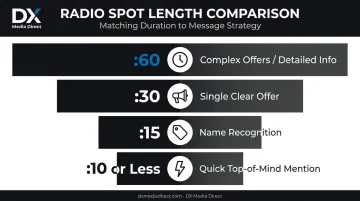
Length should match your message, not the other way around:
- :60: for complex offers, detailed information, or building awareness of a need
- :30: for a single, easy-to-grasp offer or one clear point
- :15: for simple name recognition
- :10 or less: for quick, top-of-mind mentions
Most stations offer these standard durations, though availability can vary by market.
Radio Spot vs. Jingle: What's the Difference?
A jingle is a short, sung, musical piece built for memorability. Think of the tune you can't get out of your head after hearing a brand's name set to music. A radio spot is the entire commercial unit that airs. A spot may or may not include a jingle.
Here's the simplest way to picture it: a 30-second spot where a voice actor reads a straight list of sale details is still a spot, no jingle required.
A 30-second spot built around a sung four-note branding hook, like a classic insurance company jingle, is also a spot, just one that uses a jingle as its creative device.
Radio Advertising vs. Podcast Advertising: What's the Difference?
Radio and podcast advertising both deliver audio ads, but the listening experience, targeting, and measurement differ significantly.
Each format delivers audio differently:
- Traditional AM/FM relies on live, daypart-based broadcasts, often reaching listeners in cars; stations sell ad time by market, format, and time slot.
- Digital and streaming radio (Pandora, Spotify) functions like a live broadcast but adds granular targeting by listener demographics and habits.
- Podcasts work on-demand: episodes are downloaded or streamed, with ads embedded directly inside the audio file.
Podcast ads typically come in three placements:
- Pre-roll: plays at the start of an episode
- Mid-roll: plays within the content, between segments
- Post-roll: plays at the end
Podcasts also lean more heavily on host-read endorsements than radio does. Host-read and announcer-read formats accounted for roughly 55% of 2021 U.S. podcast ad revenue, while radio still relies on a mix of produced spots and live reads depending on the station and daypart.
Both channels command serious reach. According to the Radio Advertising Bureau, AM/FM radio reaches 87% of U.S. adults 18 and older every week. Edison Research's Infinite Dial study found weekly podcast consumption climbing to 45% of Americans 12 and older, roughly 130 million people.
These numbers use different age bases, so they shouldn't be compared head-to-head. Together, they show audio advertising still reaches enormous, complementary audiences.
How Much Does Radio and Podcast Advertising Cost?
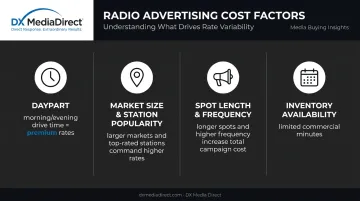
Neither radio nor podcast advertising has a fixed price tag. Instead, four variables drive the number on your invoice.
For radio, pricing hinges on:
- Daypart — morning and evening drive time command premium rates because listenership peaks during commutes
- Market size and station popularity — a major-market news station will cost significantly more than a niche station in a small town
- Spot length and frequency — longer spots and more airings increase cost
- Inventory availability — stations have limited commercial minutes per hour, so popular slots can sell out during high-demand seasons
Podcast advertising works differently. It's typically priced on a CPM basis (cost per thousand downloads or listens). Libsyn's 2026 advertising guide lists baked-in, host-read averages of roughly $24 to $26 CPM for a 60-second spot and $18 to $22 for a 30-second spot, though these are network-specific benchmarks, not industry-wide standards.
| Podcast Inventory Type | Typical CPM Range |
|---|---|
| Baked-in host-read (:60) | $24–$26 |
| Baked-in host-read (:30) | $18–$22 |
| Dynamic episodic | $18–$22 |
| Dynamic full-catalog | $14–$16 |
Mid-roll placements generally command the highest CPM, followed by pre-roll and then post-roll, though some networks price all three placements equally. Rates also shift over time. Libsyn's average 60-second CPM moved from $22.84 in September 2023 to $21.36 in August 2024, showing month-to-month and year-over-year fluctuation rather than a fixed seasonal pattern.
Whether you're buying radio or podcast time, the "rate card" number is rarely the final number. Negotiation, timing, and volume all move the price, and agencies with established network relationships, like DX Media Direct, can often secure rates below what's published on the card.
Why Radio and Podcast Advertising Still Deliver Real ROI
The "nobody listens to radio anymore" myth doesn't hold up. With 87% weekly AM/FM reach and podcast consumption climbing past 45% of Americans, audio remains one of the widest-reaching ad channels in the country.
Reach matters more than most advertisers realize. Research from the Ehrenberg-Bass Institute tracked 41 Australian alcohol and mixer brands from 1996 to 2015. Once brands stopped broad-reach advertising, average sales dropped:
- 16% after one year
- 25% after two years
- 36% after three years
Broad exposure, not narrow targeting, kept sales steady.
That same principle shows up in industry-specific data. A frequently cited 2018 study commissioned by Westwood One reported that a personal-care brand saw roughly $12 in purchase activity for every $1 spent on radio. It's a compelling number, but it comes from a single campaign, and no publicly available report breaks down the sample size or method behind it. Treat it as an encouraging data point, not a guaranteed return for every campaign.
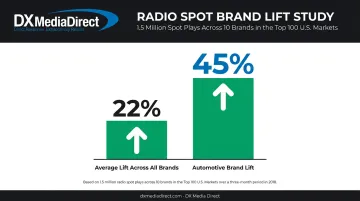
More reliable is a defined attribution study. The RAB and TagStation analyzed 1.5 million spot plays across 10 brands in the top 100 U.S. markets over a three-month period in 2018. The result: a 22% average incremental lift in store traffic tied to radio exposure, with automotive brands seeing lifts as high as 45%.
These lift numbers show reach's power, but frequency matters too. You may have heard of the "rule of seven," the idea that listeners need seven exposures before acting. That number is closer to marketing folklore than proven science. What research does support is simpler: consistent, sustained reach beats short bursts of high frequency. Plan your campaign length around staying in front of your audience over time, not hitting a magic number of impressions.
Best Practices for Creating and Buying Effective Radio and Podcast Ads
Great audio advertising comes down to two things: a script that converts, and a media buy that reaches the right ears at the right price.
Crafting a High-Converting Script
Every effective spot follows the same basic structure:
- Hook: grab attention in the first three to five seconds
- Value proposition: state the offer clearly, in plain language
- Call to action: tell listeners exactly what to do next
A few rules make this structure work harder:
- Repeat the essentials. Phone numbers, websites, and offers should be said more than once. Listeners are often driving, multitasking, or half-listening.
- Stick to one message per spot. A 30-second ad crammed with three offers usually delivers zero of them clearly.
Choosing the Right Media Buying Strategy
Self-serve programmatic platforms make buying audio ads feel simple, but simplicity has a cost. These platforms run on automated insertion orders. They sell rate-card inventory and can't negotiate the preferential rates or premium daypart access that come from actual human relationships with network representatives.
That's where relationship-based buying changes the math. DX Media Direct has spent more than 35 years building direct-response media buying relationships across radio, podcast, TV, and CTV.
That kind of track record often opens access to remnant inventory, unsold ad slots that broadcasters discount heavily rather than let go unused. In practice, a media buyer who negotiates rates at a fraction of rate-card pricing can turn a $500,000 budget into the reach and frequency of a $2.5 million campaign. That's an outcome a self-serve platform simply isn't built to deliver.
Experienced buyers bring something else self-serve tools can't: judgment. When a campaign underperforms, they can tell whether the problem is weak creative or poor placement, and adjust the right lever instead of guessing. If you're weighing your options, DX Media Direct offers a free consultation to walk through what your budget can realistically achieve across radio and podcast placements.
Frequently Asked Questions
What does "radio spot" mean?
A radio spot is a paid radio commercial, typically running 15 to 60 seconds. It can be delivered live by a host or pre-produced with voice-over, music, and sound effects.
How much does a radio spot cost?
Cost depends on daypart, market size, spot length, and how often it airs. Rates vary widely by station and region, so getting a direct quote is the only way to know for certain.
What is the difference between a radio spot and a jingle?
A jingle is a short, sung musical branding element. A radio spot is the full commercial, which may or may not include a jingle as one of its creative tools.
What's the difference between radio and podcast advertising?
Radio delivers ads through live broadcast dayparts across AM/FM and streaming platforms. Podcast ads are placed inside downloadable episodes as pre-roll, mid-roll, or post-roll spots, often read by the host.
Is radio advertising still effective today?
Yes. According to Nielsen, AM/FM radio reaches 87% of U.S. adults weekly, and research links this exposure to measurable lifts in store traffic and sales, making it one of the more cost-effective channels available.
How do I know if my radio or podcast ad is actually working?
Track measurable outcomes like calls, promo code redemptions, and website traffic tied to your campaign dates. Testing your media placement separately from your creative helps you pinpoint what's actually driving, or holding back, results.