Introduction
You can skip a pre-roll ad. You can scroll past a sponsored post. You can't skip a billboard on your commute.
That's the built-in advantage of out-of-home advertising, and it's why global OOH spend keeps climbing even as other channels fight for attention in crowded feeds. U.S. OOH revenue hit a record $9.1 billion in 2024, up 4.5% year over year, with digital OOH growing even faster at 7.5%, according to the Out of Home Advertising Association of America.
But here's the catch many advertisers run into: should you buy OOH directly through media owners, run it programmatically through a demand-side platform, or blend both? Get this decision wrong, and you'll waste budget on the wrong locations, the wrong audience, or rates that don't reflect what you actually need.
This guide breaks down what OOH media buying really involves, how direct and programmatic buying differ, the strategic factors that separate winning campaigns from wasted spend, and how to measure whether it's working.
Key Takeaways
- OOH spans billboards, transit, street furniture, and place-based media, bought directly or programmatically
- Direct buying unlocks relationship-based pricing and premium inventory unavailable through automated platforms
- Programmatic OOH (pDOOH) offers speed and real-time targeting for short-term campaigns
- ROI depends on impressions, attribution studies, and behavioral action data, not visibility alone
- The best buying strategy fits your campaign goals, not the lowest CPM alone
What Is OOH Media Buying?
OOH media buying is the process of planning, negotiating, and purchasing ad placements in physical, public environments, everything from a highway billboard to a digital screen in a shopping mall.
It differs fundamentally from digital media buying. Instead of targeting a device, you're targeting a physical space that a specific audience passes through repeatedly.
The Four Standard OOH Formats
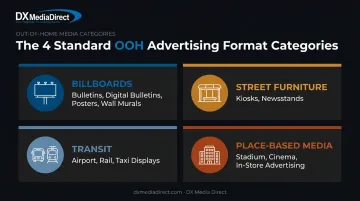
According to OAAA's industry classification, OOH breaks down into four categories:
- Billboards — bulletins, digital bulletins, posters, wall murals, and spectaculars
- Street furniture — bus shelters, kiosks, and newsstands
- Transit — airport, bus, rail, and taxi displays
- Place-based media — arena, stadium, cinema, and in-store advertising
Static vs. Digital OOH
Traditional (static) OOH means one fixed creative running for the full flight, giving you 100% share of voice at that location. Digital OOH (DOOH) rotates multiple advertisers' content across a screen, trading exclusivity for flexibility and lower entry cost.
Choosing between static and digital formats is just the starting point. A strong OOH buy blends creative strategy, audience data, negotiation skill, and timing, and getting that mix right often determines whether a campaign delivers strong recall or fades into the background.
Why this matters right now: OOH consistently outperforms other channels on recall. A 2023 Solomon Partners benchmark found printed OOH achieved 86% recall and digital OOH achieved 84%, ranking highest among all media channels tested. In a media landscape full of skippable ads, that built-in trust and attention translate directly into buying leverage for advertisers who understand how to negotiate for it.
Direct vs. Programmatic OOH Buying: Choosing Your Approach
This is the single biggest strategic decision advertisers face when entering OOH. It shapes your cost structure, your flexibility, and how much creative control you retain.
Direct OOH Buying
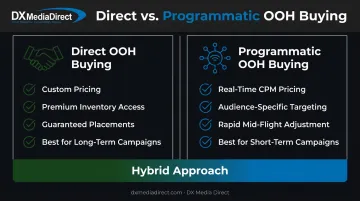
Direct buying means working with media owners or specialized agencies through relationship-based negotiation, not an automated portal. That relationship often unlocks:
- Custom pricing tied to campaign scope, not a rate card
- Access to premium inventory that never hits open exchanges
- Guaranteed placements and full-market takeovers
Direct buying works best for long-term market dominance campaigns and brand-building efforts, particularly integrated static-plus-digital placements where consistency matters more than speed.
Programmatic OOH Buying
Programmatic OOH (pDOOH) uses demand-side platforms to buy digital screen inventory in real time. Pricing runs on a CPM basis and fluctuates with demand and targeting specificity. Place Exchange's H2 2023 report on its own platform recorded an average CPM of $7.24, up slightly from $7.17 in H1, though this reflects one platform's activity, not a universal market rate.
Programmatic is best suited for:
- Short-term or flash campaigns
- Audience-specific targeting tied to mobile or location data
- Performance-driven campaigns that need rapid mid-flight adjustment
Which Approach Delivers Better Value?
Cheaper doesn't automatically mean better. Pricing only makes sense in the context of what you're trying to achieve: reach, precision, or brand dominance in a specific market.
Relationship-based buying, the model DX Media Direct has built over 35 years across direct-response advertising, can secure media rates and inventory access that automated, portal-based platforms are structurally unable to match. Programmatic simply runs on a different model, built for automated scale rather than negotiated relationships.
A buyer who's negotiated with the same network reps for decades can often get value programmatic simply can't offer: better placement, added flexibility, or pricing that reflects a real relationship instead of an auction floor.
For most advertisers, a hybrid approach works best: use direct buys to lock in premium, long-term placements, and layer programmatic on top for short-term or audience-specific flexibility.
Strategic Factors That Drive OOH Campaign Success
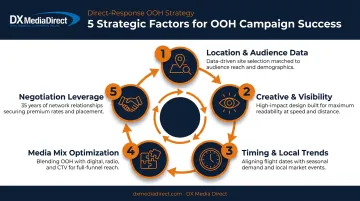
Buying the right inventory is only half the equation. These factors determine whether your OOH investment actually performs.
Location and Audience Data
Foot traffic, vehicular movement, and demographic data determine whether a placement reaches the right people. Before committing to any site, research local traffic patterns and consumer data specific to that market, not just national averages.
Creative and Visibility
OOH audiences engage with content in seconds, not minutes. That means:
- Concise messaging (five to seven words works best for drive-by billboards)
- High-contrast visuals readable from a distance
- One clear message per placement, not three competing ideas
Timing and Local Trends
Dayparting and regional consumer behavior shape relevance. A billboard near a commuter corridor performs differently at 7 a.m. than at 7 p.m., and campaigns that ignore this leave performance on the table.
Media Mix Optimization
Here's a mistake that costs advertisers real money: failing to distinguish between an underperforming placement and underperforming creative. They require completely different fixes.
Swap creative on a bad location, and you'll still get flat results. Move great creative to a better location, and you often see immediate lift. Experienced buyers develop pattern recognition across categories and dayparts, precisely so they can diagnose which problem they're actually solving.
Negotiation Leverage
Buyers with established network relationships routinely access better rates, added value, or premium inventory that simply isn't available to first-time or self-serve buyers navigating a portal alone. This is why relationship-based negotiation, built over decades rather than sourced through a self-serve portal, remains one of the clearest differentiators between average campaigns and consistently profitable ones.
Measuring ROI in OOH Advertising
Measuring OOH ROI requires more than counting how many people saw an ad. It's a layered system combining delivery metrics with attribution data.
Delivery metrics establish the baseline:
- Impressions
- Reach
- Frequency
Attribution studies connect that exposure to real outcomes:
- Mobile location data tracking store visits before and after exposure
- QR code engagement, which lets you track scan rate, time, and location in real time
- Brand lift studies measuring shifts in awareness and purchase intent
These tools have made OOH attribution far more precise than the traffic-count estimates advertisers relied on a decade ago. A 2024 OAAA study found 73% of consumers viewed digital OOH favorably, and among those who'd recently seen a DOOH ad, 76% reported taking action as a result.
That's measurable behavioral impact, extending well beyond raw impression counts.
How to Choose the Right OOH Media Buying Partner
Not every OOH buying partner delivers the same value. Before committing budget, evaluate these factors:
- Track record: How many years has the partner operated, and how many outdoor campaigns have they actually executed? Pattern recognition across networks and product categories only comes from volume and time in the market.
- Negotiation model: Find out whether the partner negotiates directly with media owners and network reps, or relies solely on self-service portals. This single factor affects the rates and billboard inventory you'll actually access.
- Test-and-learn framework: A strong partner can structure a short-term OOH market test before you commit to a full campaign, so you validate the strategy with real data first.
Agencies with decades of direct-response media buying experience, like DX Media Direct, typically offer scalable test frameworks and free, no-obligation consultations. This lets advertisers pressure-test an OOH strategy before scaling spend. If a partner can't explain how they negotiate rates or prove past outdoor results, that's a signal to keep looking.
Frequently Asked Questions
What is OOH in media buying?
OOH stands for out-of-home advertising, meaning ads placed in public or physical spaces like billboards, transit displays, street furniture, and place-based screens. It covers both traditional static formats and digital (DOOH) formats.
What is the ROI of OOH advertising?
ROI varies by format and measurement method, but it's typically assessed through impressions, attribution studies, and consumer action metrics like store visits or QR scans. OOH consistently performs competitively against TV and digital on recall and action rates.
What's the difference between OOH and DOOH?
Traditional OOH uses one fixed creative for the entire flight, giving full share of voice at that location. DOOH uses digital screens that rotate content among multiple advertisers, trading exclusivity for flexibility.
Is programmatic OOH cheaper than direct buying?
Cost depends on campaign goals, not buying method. Direct buys often deliver stronger value for premium, long-term placements, while programmatic suits short-term, precision-targeted campaigns.
How much does OOH advertising typically cost?
Pricing varies by location, format, size, and campaign duration, with high-traffic urban placements commanding premium rates. OOH delivers competitive CPMs compared to other major media channels.
How do I get started with an OOH media buying campaign?
Start by defining your campaign goals, whether that's reach, precision targeting, or long-term brand dominance. Then choose a direct, programmatic, or hybrid buying approach with guidance from a partner like DX Media Direct, whose 35 years of direct-response advertising experience helps match the right mix to your budget.