Introduction
TV still moves more product than any digital channel out there, from local service businesses to national retail chains. Despite everyone's obsession with programmatic and social, a well-placed television spot generates trackable sales lift that most performance marketers would kill for.
Here's the problem: most "greatest TV ads" lists rank campaigns by laughs and social shares. Virality isn't revenue. A spot everyone remembers isn't automatically a spot that moved units off shelves.
This article skips the popularity contest. Below are five TV campaigns with publicly documented sales data tied directly to their airing, plus what advertisers can actually borrow from each one.
TL;DR
- TV success gets measured in sales lift and incremental revenue, not views or applause
- Winning campaigns pair sharp creative with disciplined media buying, not one or the other
- Five sourced case studies show measurable revenue and lead gains from real campaigns
- A simple framework at the end shows how to build your own accountable TV test
What "Measurable Results" Actually Means in TV Advertising
Brand-awareness metrics (impressions, social chatter, "how many people saw it") tell you reach. They don't tell you whether anyone bought anything. Direct-response metrics (sales lift, cost-per-acquisition, incremental revenue, call and website volume) tell you whether the campaign paid for itself.
That distinction plays out at scale, too. TV isn't a niche channel chasing digital's shadow. U.S. television ad spending was expected to reach roughly $60.6 billion in 2024, according to Statista. That's a massive amount of budget riding on creative and media decisions that often go unmeasured.
Why TV Attribution Used to Be Guesswork
TV's reputation problem has always been attribution. Unlike a paid search ad, a linear spot doesn't come with a built-in click-tracker. That gap gets closed through:
- Matched-market testing — running the ad in select markets while holding others as a control group
- Unique offer codes tied to specific creative or air dates
- Dedicated phone numbers and URLs that isolate response by channel
None of this happens by accident. Every campaign in this article used a deliberate testing structure: specific markets, specific windows, specific tracking, rather than a single "launch it everywhere and hope" national rollout.
That distinction matters. The five examples below were selected because they have publicly reported performance numbers attached to them, not because they won a Cannes Lion.
Top TV Advertising Examples That Drove Measurable, Trackable Results
Every campaign on this list has a documented sales, unit, or revenue figure connected to its TV push. Some numbers are cleaner than others, and we've flagged where attribution gets murky.
Old Spice – "The Man Your Man Could Smell Like" (2010)
Old Spice was a fading legacy brand until Wieden+Kennedy flipped the target audience. Instead of talking to the men who use the body wash, the campaign spoke to the women who actually buy it in the house. The TV spot launched, then got amplified almost immediately through hundreds of personalized digital response videos.
| Category | Detail |
|---|---|
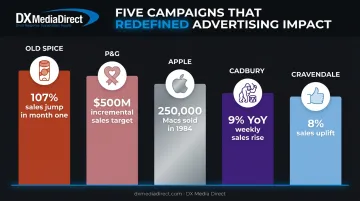
| Key Metric Achieved | Body-wash sales jumped 107% in the month following launch, per Nielsen data reported by AdWeek |
| Media Strategy | Broadcast TV spot paired with rapid-fire social and digital follow-up content |
| Why It Worked | Audience insight (targeting purchasers, not users) plus a creative hook bold enough to earn free media attention |
Worth noting: that 107% figure covers a one-month window. Nielsen also tracked +55% over three months and +27% over six months, still strong but less headline-friendly.
P&G – "Thank You, Mom" (Olympics Campaign)
P&G's Olympic tear-jerkers spanned far more than a single ad, forming a coordinated media strategy synced to the world's biggest live broadcast events. The company placed spots during peak Olympic viewership across multiple Games, betting that emotional storytelling would land harder next to live sports drama.
| Category | Detail |
|---|---|
| Key Metric Achieved | P&G projected $500 million in incremental sales as a campaign target tied to its Olympic push |
| Media Strategy | Placement synchronized with high-attention live broadcast windows across multiple Olympic Games |
| Why It Worked | Emotional creative reinforced by premium placement during peak-attention live events |
A fair caveat here: the $500 million figure was P&G's stated goal going in, not a confirmed, audited outcome. The campaign involved TV, digital, and sponsorship together, so isolating TV's exact share is tough. Still, the dayparting strategy, buying against guaranteed high-attention moments instead of average time slots, is the real lesson.
Apple – "1984" (Macintosh Launch)
One ad. One airing. Maximum scarcity. Apple ran "1984" exactly once during the Super Bowl, then let earned media and word-of-mouth do the rest of the work.
| Category | Detail |
|---|---|
| Key Metric Achieved | Apple's internal target was 50,000 Macs in 100 days; it hit that number by day 73, then sold 250,000 units during 1984, according to Macworld's review of Apple's own figures |
| Media Strategy | Single premium spot engineered to generate press coverage and conversation far beyond the paid buy |
| Why It Worked | Bold creative combined with deliberate scarcity: one airing made the ad itself a news event |
This one's launch sales, not a clean ad-isolated experiment. Product availability and press coverage played a role too. But the scarcity strategy of buying less to make it count more still holds up.
Cadbury Dairy Milk – "Gorilla" (2007)
Cadbury needed to rebuild trust after a product safety controversy tanked consumer confidence. Rather than lead with product shots, the brand ran a spot with zero dialogue, zero product mentions, and a gorilla playing drums to Phil Collins.
| Category | Detail |
|---|---|
| Key Metric Achieved | Weekly sales rose 9% year-over-year during the weeks the ad aired, per Campaign |
| Media Strategy | Broad daypart coverage to maximize reach during the trust-rebuilding window |
| Why It Worked | An emotional, unexpected concept reconnected with lapsed buyers who'd drifted away after the controversy |
By the end of October 2007, value sales were up 7% for the year: a different window, same underlying trend. The lesson: sometimes rebuilding trust means talking about anything except the product.
Cravendale – "Cats With Thumbs" (2011)
Milk is about as low-interest a category as exists. Cravendale broke through anyway with a low-budget, high-concept ad about cats plotting to steal opposable thumbs.
| Category | Detail |
|---|---|
| Key Metric Achieved | Thinkbox documented an 8% sales uplift tied to the campaign |
| Media Strategy | Targeted placement against grocery-shopper demographics rather than a broad national buy |
| Why It Worked | High shareability extended organic reach, reinforcing recall right at the point of purchase |
Some sources cite this as a year-over-year figure, but Thinkbox's original case study doesn't confirm that framing, so treat the 8% as a solid, if slightly ambiguous, result.
How We Chose These Examples (And Common Mistakes to Avoid)
Every campaign above made the list for one reason: publicly documented sales, unit, or revenue data tied to the TV push. No entries here got picked because they won awards or racked up shares.
That's a stricter bar than most "best TV ads" roundups apply, and it exposes a mistake we see advertisers make constantly:
- Judging a campaign's success by impressions or likes instead of profit-column numbers
- Assuming a creative that "feels" clever will automatically convert
- Never separating a weak media buy from weak creative — so the wrong element gets blamed (or fixed)
That last point is where most advertisers get stuck. Was the ad the problem, or was it airing in the wrong daypart on the wrong network to the wrong audience?
Telling the difference takes pattern recognition built from executing thousands of campaigns across networks and dayparts. DX Media Direct has accumulated that experience over 35 years in this business.
A programmatic dashboard can't replicate it, because that recognition comes from watching real campaigns succeed and fail across real media buys, not from an algorithm optimizing toward a proxy metric.
Turning These Lessons Into Your Own Measurable TV Campaign
You don't need a Super Bowl budget to run a measurable TV campaign. You need a structure that isolates what's working from what isn't.
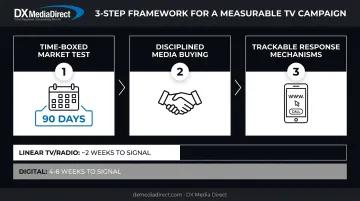
- Start with a time-boxed test, not a national launch. A defined 90-day test across select markets lets you validate creative and media mix before committing a full budget.
- Pair strong creative with disciplined media buying. Network relationships and daypart selection directly affect cost-per-response. Automated, self-serve platforms can't replicate this, since they bid into an auction rather than negotiate placement.
- Build trackable response mechanisms in from day one. Dedicated phone numbers, offer codes, and unique URLs let you tie results directly to the campaign in hard numbers, not estimates.
With these mechanisms in place, the next question is how quickly you can read the results.
- Linear TV, radio, and podcasting: Produce a usable performance signal within about two weeks, enough to gauge whether a show or network is worth the spend
- Digital placements: Often need four to six weeks of tuning before a clear pattern emerges
Advertisers who understand this timeline difference can reallocate budget away from underperforming placements fast, instead of waiting out an arbitrary "brand awareness" runway that mostly benefits the media seller, not the advertiser.
Conclusion
The most memorable TV ad and the most profitable TV ad aren't always the same thing. Apple's "1984" is iconic; Cadbury's "Gorilla" rebuilt trust and moved product. Both matter, but only one of those outcomes shows up in a bank account.
When you're evaluating a TV campaign or a media partner, ask for trackable revenue data, not award nominations. If a partner can't tell you cost-per-response or sales lift, they can't tell you whether the campaign worked.
Want to see what a measurable TV test looks like for your business? Request a free, no-obligation consultation with DX Media Direct and let's talk numbers, not just creative.
Frequently Asked Questions
What are examples of TV advertising?
TV advertising spans brand commercials, direct-response spots, infomercials, and event sponsorships. This article focuses specifically on examples with documented, trackable sales results rather than creative alone.
What is the most famous TV advertisement?
Apple's "1984" is among the most frequently cited; AdAge named it Commercial of the Decade for the 1980s. Fame and measurable sales impact aren't always the same thing, though.
What products are most advertised on TV?
Pharma, CPG, retail, auto, insurance, and direct-response consumer products dominate TV ad spend. These categories suit TV's mass reach and its ability to build trust for high-consideration purchases.
How do you measure the success of a TV advertising campaign?
Track sales lift through matched-market testing, use dedicated offer codes or response numbers, and apply attribution modeling to connect airings with actual purchase or lead activity.
What makes a TV ad effective at driving measurable sales?
A clear offer with a strong call-to-action, paired with strategic media placement and precise audience targeting. Creative alone rarely drives sales without the right media strategy behind it.
How long does it take to see results from a TV advertising campaign?
Direct-response campaigns often show initial results within days of airing. Broader brand-lift effects typically need several weeks of sustained placement before they're reliably measurable.