Many business owners assume TV advertising is a black box: expensive to buy, impossible to track, and reserved for national brands with seven-figure budgets. That mindset is outdated.
Done right, cable TV advertising can generate calls, form fills, and sales you can count, not just brand impressions you can't. This post breaks down how strategic buying and direct-response tactics turn cable spend into a real revenue channel.
Key Takeaways
- Cable reaches nearly 25% of TV viewing, especially among adults 50+
- Effective campaigns start with a trackable goal, then build media buys around it
- Call-tracking numbers, unique URLs, and QR codes convert viewers into trackable leads
- Per-spot costs vary by market, but package deals and agency ties lower rates
- A blended cable-plus-CTV approach often outperforms either channel alone for local leads
What Is Cable TV Advertising (and Why It Still Drives Leads)?
Cable TV advertising means buying and placing commercials on subscription-based cable networks, delivered through dedicated cable infrastructure rather than over-the-air broadcast signals. In the industry, these commercials go by a few names: commercial, spot, or simply ad. All three terms describe the same thing, and you'll hear them used interchangeably by media buyers and network reps alike.
There are two core buying models:
- Spot ads — targeted to a specific geographic zone through a local cable provider, ideal for businesses with a regional or local footprint
- Network ads — distributed nationally across a cable network's entire footprint, such as ESPN, HGTV, or CNN, better suited for brands with wider distribution
Why Cable TV Remains a Strong Lead-Generation Channel
Cable has one advantage digital platforms struggle to replicate: a trusted, brand-safe environment. Viewers associate cable networks with established programming, and that credibility rubs off on the advertisers who show up during the breaks.
Cable also delivers something increasingly rare: appointment viewing. Live sports broadcasts and breaking news coverage still pull focused, undistracted audiences who aren't scrolling past your ad the way they might skip a pre-roll spot.
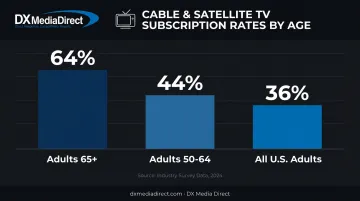
That audience skews older, too. 64% of adults 65+ and 44% of adults 50-64 subscribed to cable or satellite in 2025, compared to just 36% of all U.S. adults, according to Pew Research Center. If your target customer is 50-plus, cable puts you in front of them at a rate most CTV campaigns can't match.
For businesses selling home improvement, financial services, healthcare, or legal services, this incremental reach fills a gap that digital-only campaigns leave wide open.
How Cable TV Advertising Turns Viewers Into Measurable Leads
Direct-response cable campaigns aren't built around impressions or brand recall. They're built around one specific, trackable action, and that decision happens before a single dollar is spent on media.
Maybe the goal is phone calls. Maybe it's form fills or promo code redemptions. Whatever it is, defining that action upfront shapes everything downstream, from creative scripting to which networks and dayparts make the buy.
Building Trackable Response Mechanisms
Once the goal is set, the mechanics of tracking come next:
- Dedicated call-tracking numbers assign a unique phone number to each spot, network, and daypart, so you know exactly which airing generated which call
- Unique URLs, promo codes, and QR codes bridge the gap between the TV screen and digital conversion, letting viewers act immediately from their phone
- Matching landing pages repeat the exact offer from your ad, like "$500 off," instead of linking to a generic homepage
Small businesses commonly lean on QR codes for this exact reason. It's a low-friction way to move someone from the couch to your website in seconds.
Using Dayparts and Frequency to Maximize Response
With tracking mechanisms in place, the next decision is where and how often that ad actually airs. Daypart selection matters as much as network selection. Primetime delivers the biggest audiences, but weekend and late-fringe slots typically cost less per spot, which can stretch a smaller budget across more airings.
Frequency compounds this effect. A viewer who sees your commercial once might not remember it. A viewer who sees it five times across a week is far more likely to act.
Here's the tricky part: if response rates lag, is that a media-mix problem (wrong network, wrong daypart) or a creative problem (weak offer, unclear call-to-action)? Telling the two apart takes pattern recognition built from watching hundreds of campaigns unfold, not a single dashboard metric. This is where an experienced buying partner earns their keep.
How to Advertise on Local Cable TV: A Step-by-Step Buying Guide
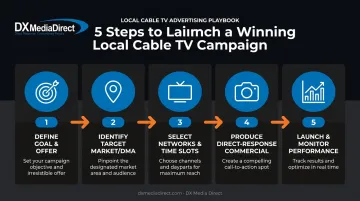
If you're wondering how to actually get a commercial on local cable, here's the process:
- Define your goal and offer first. Decide whether success means call volume, form fills, or something else, before you contact a single network.
- Identify your target market (DMA). Choose between a spot buy for local/regional zones or a network buy for national reach.
- Select networks and time slots. Match your choices to where your audience actually watches, then request rate proposals from local cable providers or MVPDs (multichannel video programming distributors) to compare pricing. Agencies with established network relationships, like DX Media Direct, typically negotiate lower rates than self-service portals can offer.
- Produce a direct-response-optimized commercial. It needs a clear call-to-action, a trackable phone number or URL, and a digital bridge like a QR code.
- Launch and monitor real performance data. Track calls, leads, and conversions, not just reach or GRPs, and adjust media placement or creative as the numbers come in.
Skipping step one is the most common mistake. Businesses buy media first and figure out tracking later, which makes clean attribution nearly impossible.
How Much Does It Cost to Advertise on Cable TV?
Cable ad costs swing widely based on a handful of factors:
- Market size: a spot in a major DMA (designated market area) costs more than the same spot in a smaller regional market
- Network popularity: high-demand channels command higher rates than niche networks
- Time slot: primetime costs more than daytime or overnight
- Ad length: 30-second spots are standard, but 15-second and 60-second options exist at different price points
- Seasonality: rates climb around major sports events and holiday seasons
Getting the best possible rate depends on how you buy:
- Local spots start more affordably, while national or primetime buys cost significantly more
- Package deals bundling multiple airings across networks and dayparts lower the per-spot cost
- Agencies with established network relationships, like DX Media Direct's 35 years in direct-response TV buying, secure rates self-serve buyers simply can't access
- Testing with a modest single-DMA budget lets you prove out response data before scaling spend
Cable TV vs. CTV, Streaming, and Local Broadcast: Which Fits Your Lead Goals?
Every TV format trades off reach, targeting, and cost differently.
| Format | Strength | Trade-off |
|---|---|---|
| Cable (spot/network) | Niche channel targeting, lower CPM | Smaller total reach than broadcast |
| CTV/streaming | Granular digital-style audience targeting | Higher CPMs, fragmented inventory |
| Broadcast | Broad national/local reach | Highest CPM of the three |
In national primetime upfront estimates for 2024-25, cable averaged $20.60 CPM versus broadcast's $43.35 CPM, per Media Dynamics' 2024-25 upfront report. Cable's cost advantage holds up even at the national level.
Cost isn't the only variable, though. CTV/streaming adds precision targeting, but its supply is scattered across apps and platforms, making frequency harder to build than cable.
The breakdown for lead-focused budgets:
- Cable: Stronger results with predictable frequency and reach
- CTV/streaming: Added precision once cable performs, at higher CPMs
- Broadcast: Best for scale over efficiency
DX Media Direct often starts clients on cable, then layers in CTV as budgets grow, extending reach efficiently.
Why a Direct-Response Media Buying Partner Outperforms Self-Serve or Programmatic Platforms
Self-serve and programmatic tools are great at executing a media plan. They're not equally skilled at diagnosing why a plan isn't working.
When a campaign underperforms, an algorithm can tell you the numbers went down. It can't tell you whether that's a media-mix problem or a creative problem, and that distinction determines what you fix.
That kind of judgment comes from experience, not software.
DX Media Direct has spent 35+ years negotiating directly with network representatives, building relationships that translate into rates and inventory access self-serve platforms structurally can't offer. Across thousands of executed campaigns, that experience compounds into pattern recognition. The agency's media buyers can identify:
- Which dayparts underperform for specific industries
- Which creative angles stall out before they scale
- Which media mix actually moves the needle on lead volume
Rather than guessing, DX Media Direct runs structured 90-day TV tests designed to build a scalable playbook, not just generate inconclusive early data. If you're weighing whether cable TV can actually move your business forward, a free, no-obligation consultation is a low-risk way to find out before committing serious budget.
Frequently Asked Questions
What is advertising on TV called?
TV advertising is most commonly called a commercial, spot, or simply an ad. These terms are used interchangeably across the industry, though naming conventions can vary by region.
How much does it cost to advertise on cable TV?
Costs vary by market size, network, daypart, and spot length, with seasonality also playing a role. Package deals that bundle multiple airings typically lower the per-spot cost.
How do you advertise on local cable TV?
Contact a local cable provider or media buying agency, then define your campaign goals and target zones. From there, produce and submit a compliant commercial that meets the network's technical standards.
How do you measure the ROI of a cable TV ad campaign?
Track performance using dedicated call-tracking numbers, unique promo codes, and custom URLs tied to specific spots. Brand lift studies can supplement this by measuring awareness and intent shifts.
What's the difference between spot and network cable TV ads?
Spot ads target a specific local or regional zone through a local cable provider. Network ads distribute nationally across a cable channel's entire footprint, reaching a much broader audience.
Is cable TV advertising still effective in the streaming era?
Yes, particularly for reaching older demographics and viewers during live sports and news. Cable still commands a substantial, engaged audience that many CTV-only strategies underrepresent.