Introduction
Most home services companies, law firms, clinics, and franchise owners treat TV like it's out of their league. Too expensive. Too "big brand." Better left to national advertisers with seven-figure budgets.
Meanwhile, competitors in their own market are running local TV spots that fill their appointment books every week.
The businesses that do try TV often make a different mistake: they run a polished, brand-awareness style ad, then can't tie a single call or booked job back to the spend.
No tracking number. No offer. No way to know if it worked.
This guide breaks down how service businesses can build a TV strategy around direct response, not just visibility, covering goal-setting, creative, media buying, and how to measure actual ROI before scaling spend.
Key Takeaways
- TV builds trust and reach best through direct-response principles, not brand awareness
- Start with measurable goals like calls or booked jobs, not vague visibility
- Story-driven creative with an urgent, repeated call-to-action outperforms feature-list pitches
- Media mix and negotiation affect cost-efficiency as much as creative itself
- A defined test window protects budget and builds a repeatable, scalable playbook
Why Television Advertising Still Works for Service Businesses
Local providers, plumbers, attorneys, contractors, and clinics face a trust problem digital ads can't fully solve. Anyone can run a Facebook ad, but fewer businesses can afford network airtime, and viewers know it.
That perception translates into measurable trust advantages. Consumers are 1.5 times more likely to trust TV ads than website ads, and 2.5 times more likely than social media ads, according to a 2025 VAB report drawing on MRI-Simmons data. For a service business asking someone to invite a stranger into their home or trust their health to a new provider, that credibility gap matters.
Streaming has made precision advertising affordable, too. It reached 43.8% of total U.S. TV viewing in March 2025, per Nielsen, roughly 10 points higher than two years earlier. Fragmentation across platforms like Roku, Hulu, and Peacock used to mean spreading a budget too thin.
Now it means smaller service businesses can access household-level targeting once reserved for national brands, without paying national brand prices.
That precision only pays off if the campaign asks viewers to do something specific, though. Brand-awareness TV and direct-response TV are not the same product:
- Brand-awareness TV builds recognition over time, with no immediate call-to-action tracking
- Direct-response TV (DRTV) asks for an immediate, measurable action, such as a call, visit, or booking
Service businesses need to build around the second model. Brand awareness is nice. It doesn't fill a schedule.
How to Build a Television Marketing Strategy That Drives Real Business
A TV strategy that generates revenue starts before the camera ever rolls.
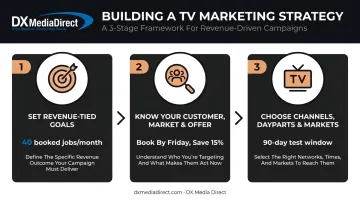
Set Revenue-Tied Goals Before You Buy Airtime
"More visibility" is not a goal you can budget against. It fails because nobody can say what success looks like, or when to pull the plug.
Reframe the objective around outcomes:
- A plumbing company sets a goal of 40 booked jobs per month from TV, not "brand recognition in the metro area"
- A dental practice targets 15 new patient calls per week instead of "getting our name out there"
Once you have a specific target, calculate a target cost-per-lead or cost-per-acquisition before selecting any media. That number becomes the benchmark for judging every dollar spent.
Know Your Ideal Customer, Market, and Offer
Viewing habits vary sharply by service category. Homeowners planning renovations watch home-improvement programming on weekends. Business decision-makers catch morning news before 9 a.m. A landscaping company airing spots only in daytime slots misses the evening viewers planning weekend projects.
Research your audience's dayparts and networks, then build an offer around urgency:
- A limited-time discount ("$500 off HVAC installs booked this month")
- A free consultation window tied to a specific date
- A seasonal promotion matched to demand spikes (storm damage, tax season, allergy season)
A vague ad tells viewers you exist. A time-bound offer gives them a reason to pick up the phone today.
Choose the Right Channels, Dayparts, and Local Markets
Match the platform to the objective:
- Broadcast or cable works well for mass local urgency, such as seasonal service demand spikes
- Streaming/CTV delivers narrower, household-level targeting for higher-consideration services
Test across multiple dayparts and networks initially. A 90-day test window typically provides enough data to identify genuine winners. Once response data comes in, narrow spend to the combinations that actually convert, not the ones that just felt right at launch.
Creative Strategies That Turn Viewers Into Callers
The strongest media plan can't rescue an ad nobody responds to.
Lead With a Relatable Story, Not a Product Pitch
Viewers have seen enough hard-sell, feature-list ads to tune them out on instinct. A relatable character facing a familiar problem, followed by a clear resolution, builds connection before it asks for a conversion.
Think of the homeowner staring at a leaking water heater at 11 p.m., not a bulleted list of warranty terms.
Make Your Call-to-Action Clear and Urgent
Every second of airtime should point toward one next step. Ambiguity kills response rates.
- State the action clearly: call now, book today, visit this address
- Repeat it at least twice within the spot
- Pair it with a dedicated trackable phone number or promo code, so every response attributes back to that specific ad
Without a trackable number, you're guessing whether the spot worked. With one, you know within days.
Balance Production Value With Authenticity
Heavily produced ads suit premium or regional brand campaigns. Local service businesses often see stronger response from something rougher around the edges: actual customers walking through problems they really had, in their own words.
MNTN reported a striking internal comparison: testimonial-style CTV ads produced 436% higher visit rates, 62% lower cost per visit, 18% higher conversion rates, and 67% lower cost per acquisition than their higher-production, brand-awareness ads featuring a celebrity spokesperson, according to MNTN's own campaign analysis.
That comparison wasn't a controlled test, and the testimonials reached a higher-intent audience. Still, it's a useful directional signal: polish isn't the priority. Believability is.
Choosing Your Media Mix: Linear, Cable, and Streaming
Self-serve programmatic CTV platforms are convenient. You log in, set parameters, and the algorithm buys inventory at market rate. But convenience carries a cost most advertisers never see.
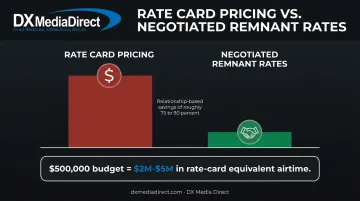
Programmatic pipes typically deliver inventory at or near rate card, plus a technology fee on top. They can't access unsold remnant inventory, the ad slots networks need to move before airtime, because that requires a human conversation with a network rep, not an automated bid.
DX Media Direct has spent 35 years building exactly those relationships. Its buyers negotiate directly with network representatives on three fronts: available inventory, the client's response goals, and rates that make the campaign financially work.
The result:
- Negotiate remnant rates 75% to 90% below rate card pricing in many cases
- A $500,000 budget that can deliver airtime equivalent to $2 million to $5 million at rate card
- Network and daypart combinations chosen using decades of pattern recognition across product categories, not a one-size-fits-all bidding algorithm
An algorithm doesn't know a station has excess Tuesday-morning inventory it needs to clear by Thursday. A network rep with a 25-year relationship does.
Measuring ROI and Scaling With a Structured Test
None of this matters if you can't prove which dollars produced which results.
Before launch, set up:
- Call tracking numbers unique to the TV campaign, separate from digital or print
- Dedicated landing pages that only receive TV traffic
- Promo codes viewers mention or enter to redeem the offer
DX Media Direct's attribution reporting then ties calls, web visits, and conversions back to specific stations, programs, time slots, and creative versions. This lets you optimize in near real time rather than guessing after the fact.
Run the test over a defined window, commonly around 90 days, long enough to gather sufficient volume to tell the difference between underperforming media placement and underperforming creative. Guessing wastes budget; a proper test window generates evidence.
Once a channel, daypart, and creative combination proves measurable ROI, scale methodically:
- Expand into adjacent markets before going national
- Increase frequency in proven dayparts before testing new ones
- Reinvest savings from remnant-rate negotiations into additional reach, rather than pocketing them as margin
Brands that follow this model often move from a five-figure weekly test into a seven-figure annual commitment, once the numbers hold up. That's a scaling decision made on evidence, not optimism.
Frequently Asked Questions
What is the best way to advertise on TV?
Set a specific, measurable goal, then research your audience's viewing habits and dayparts. Match your creative and channel selection to a direct-response call-to-action that gives viewers a reason to act now.
What are the key creative strategies in successful television advertisements?
Emotional storytelling that mirrors a real customer problem, a clear call-to-action repeated at least twice, and a trackable response mechanism such as a phone number or promo code. Skip the feature-list pitch.
How much does TV advertising cost for a small service business?
Costs vary by market size, daypart, network demand, and production. Relationship-based media buying can access remnant inventory at a fraction of rate card, often reducing costs well below self-serve programmatic pricing.
Is TV advertising still effective for service businesses in the streaming era?
Yes. Fragmentation across streaming platforms has made precise, household-level targeting more affordable for smaller advertisers, since no single distributor dominates viewing time.
How do I track ROI from a TV advertising campaign?
Use dedicated call tracking numbers, unique landing pages, and promo codes tied specifically to the TV spot. Attribution reporting then ties responses back to the exact station, daypart, and creative version.
How long should I test a TV campaign before scaling it?
A defined window, often around 90 days, gives enough data volume to distinguish an underperforming media mix from underperforming creative before committing additional budget.