Introduction
Digital ad costs are climbing fast. According to eMarketer, Instagram's average CPM hit $9.46 in Q2 2025, and marketers everywhere are chasing the same shrinking pool of paid social inventory. That's pushing direct response advertisers to look at channels that produce trackable revenue, not just impressions.
Radio gets filed under "brand awareness" more often than it should. But for direct response advertisers, its real value shows up in call volume, cost-per-acquisition, and the profit column.
This article breaks down why radio works for direct response campaigns specifically, backed by data rather than reach stats alone, and how to get measurable results from it.
TL;DR
- Trackable radio ties call tracking, promo codes, and dedicated URLs to a specific station or script
- Lower costs than TV, and increasingly than paid social, boost margins on every acquired customer
- Fast production lets advertisers test offers and scripts in days, not weeks
- Skipping structured testing leads to wasted spend and unpredictable lead flow
- A partner like DX Media Direct secures rates and reads data self-serve platforms can't match
What Is Direct Response Radio Advertising
Direct response radio advertising means one thing: spots built around a specific, trackable call-to-action. That's a phone number, promo code, or URL designed to get an immediate action, not just build recall over time.
Ad Age's own definition of direct marketing gets at this precisely, describing it as advertising that communicates directly with a targeted consumer and seeks an immediate, measurable response.
You'll typically see this format in:
- Infomercial-style DRTV/radio hybrid campaigns
- Lead-generation offers for financial services, legal, and healthcare brands
- Subscription services with recurring revenue models
- E-commerce brands running 60- or 120-second spots with clear response mechanisms
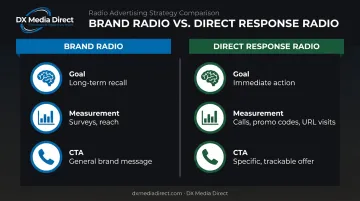
The distinction matters. Brand radio measures success through recall studies. Direct response radio measures success through leads, calls, and sales that show up in the profit column.
Key Advantages of Radio Ads for Direct Response
The advantages below focus on metrics you can actually measure: cost per acquisition, response rate, scalability. Each one gives a business a hard number to track, not just an impression to guess at.
Built-In Trackability Ties Spend Directly to Revenue
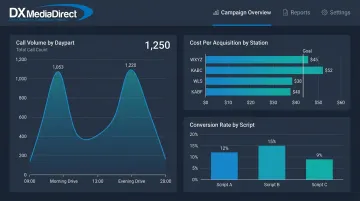
Direct response radio spots are engineered with unique phone numbers, promo codes, or landing pages baked into the creative. Every response gets attributed to a specific ad, station, or daypart, with no guesswork required.
This differs sharply from brand radio. Brand campaigns lean on recall studies weeks or months after airing. Direct response campaigns generate hard data in real time.
The Radio Advertising Bureau (RAB) defines attribution as the analytical science of identifying which marketing tactics contribute to sales or conversions. Its research documents several tools currently used for this: platforms that link commercial airtimes with web traffic spikes, call-tracking codes, and multi-touch attribution models that isolate radio's contribution across the customer journey.
The results back this up. Attribution technology has documented campaigns where radio drove 1.3 million incremental conversions and 224,000 incremental app installs for a sports-betting advertiser, with another campaign attributing more than 370,000 app installs directly to radio exposure.
Why this matters:
- Advertisers can see exactly which station, daypart, and script combination is profitable
- Budget reallocation becomes evidence-based instead of a hunch
- Decisions happen faster because the data is already there
KPIs affected: cost per lead, cost per acquisition, call volume, conversion rate, media mix efficiency.
This advantage matters most during a new offer launch or a market test, when you need proof of what's working before committing a bigger budget.
Low CPM Enables Profitable Customer Acquisition at Scale
Radio's cost structure gives direct response advertisers room to breathe. A recent Dentsu/Lumen study found AM/FM broadcast radio to be 8 times more cost-effective than TV on an attention-adjusted basis, and 11 times more efficient than the study's overall attention-cost-per-thousand benchmark.
That's attention CPM, not a straight dollar-for-dollar comparison to social CPM. Still, the direction is consistent: radio's cost base sits well below TV, and it's holding steady while paid social inventory gets more expensive by the quarter.
Lower media costs translate into something direct response advertisers actually care about:
- More frequency for the same budget
- The ability to test several regional markets simultaneously
- Wider margin on every acquired customer, since acquisition cost eats less of the revenue
KPIs affected: CPM, cost per acquisition, media efficiency ratio, gross margin per acquired customer.
This advantage shows up most when scaling a validated offer across multiple markets, or when budgets are tight but volume goals aren't.
Fast Production and Flexible Formats Enable Rapid Testing
Radio spots can go from script to air in days. TV and print can't compete on that timeline. The Radio Advertising Bureau notes that radio production costs less than video production, which lets advertisers tailor spots to specific programming formats without a full reshoot every time they want to test something new.
That flexibility opens the door to structured testing:
- Write multiple script variants for the same offer
- Rotate them across dayparts and stations
- Track response rate by variant
- Kill the losers, scale the winners
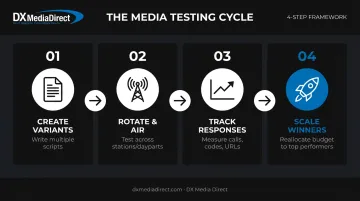
Formats like live host reads, rotating scripts, and standard 60-second spots make this kind of A/B testing practical in a way that's harder to pull off with TV. RAB also points out that radio lets advertisers adapt quickly to shifts in the business or the marketplace, such as a launch delay, a pricing change, or a seasonal push, without waiting weeks for new creative.
KPIs affected: time-to-launch, test-cycle speed, response rate by daypart or script variant.
This matters most during a product launch, a seasonal offer test, or a media mix validation before a bigger national push.
What Happens When Direct Response Radio Strategy Is Missing
Radio isn't a set-it-and-forget-it channel. Treat it that way and the symptoms show up fast:
- Inconsistent lead flow: call volume swings week to week with no clear explanation
- Overpaying for inventory: without negotiated rates or station relationships, self-serve and automated platforms price inventory inefficiently
- Reactive management: teams chase performance after a bad week instead of scaling from data that already proved what works
The pattern is almost always the same. Advertisers buy a schedule, run it for a few weeks, and either declare victory or pull the plug based on gut feeling rather than daypart-level data. Neither decision is grounded in anything measurable.
Structured testing exists specifically to prevent this. Skip it, and you're reacting to whatever happened last week instead of managing a campaign that's actually moving forward.
How to Get the Most Value from Direct Response Radio
Radio performs best when it's tested like a science experiment, not launched like a leap of faith.
Run structured tests before committing big budget. A 90-day test across multiple stations and dayparts gives you enough data to separate signal from noise. Anything shorter and you're likely reacting to normal week-to-week variance rather than a real trend.
Review performance data by daypart, network, and script regularly. Weekly or biweekly reviews let you catch underperformers early and reallocate budget toward the combinations producing the lowest cost per acquisition. Don't wait for a quarterly report to make this call.
Work with a partner who has real network relationships. This is where most self-serve platforms structurally fall short. DX Media Direct brings 35 years of network relationships and pattern recognition across dayparts and categories: the kind of insight that comes from executing thousands of campaigns, not from a rate card.
A few things a relationship-based buyer can typically do that a portal-based platform can't:
- Secure rates below standard card pricing through direct rep relationships
- Read attribution data early enough to catch a losing script before it drains budget
- Distinguish an underperforming media mix from underperforming creative, and know which one to fix first
DX Media Direct offers a free, no-obligation consultation for advertisers who want a second set of eyes on their current mix before scaling spend further.
Conclusion
For direct response advertisers, radio's real value comes down to trackability, cost efficiency, and the ability to test fast and cheap before scaling up.
These advantages compound. A campaign that's tested and refined consistently outperforms one that's launched once and left alone, week after week, market after market.
That consistency turns structured, relationship-driven radio buying into an ongoing growth lever, refined campaign after campaign. DX Media Direct brings that same approach—decades of relationships paired with constant testing—to every radio buy we manage.
Frequently Asked Questions
What is the ROI of radio ads?
ROI varies by industry, offer, and market. Direct response radio is trackable through call codes and promo codes, so benchmark cost-per-acquisition against your own target margins rather than a generic industry average.
How do radio ads work?
Radio ads are purchased by daypart and station based on audience demographics, then air on a set schedule. Direct response spots add a specific call-to-action, such as a phone number, code, or URL, to prompt immediate listener action.
What are the benefits of radio ads?
Radio offers wide reach and cost-efficient frequency, plus a trusted local connection with listeners. For direct response advertisers specifically, the biggest wins are trackability and fast testing cycles.
How do you measure the success of a direct response radio campaign?
Call tracking numbers, unique promo codes, and dedicated landing page URLs are the primary tools. Each one attributes a response directly to a specific station, daypart, or script.
What makes a radio ad "direct response" versus a brand awareness ad?
Direct response ads include an explicit, trackable call-to-action built to prompt immediate action. Brand ads focus on recall and image over a longer timeframe, without a hard conversion metric attached.
How much does direct response radio advertising typically cost?
Costs vary by market size, station, daypart, and campaign length, so there's no fixed national rate. Working with a media buyer with established network relationships, like DX Media Direct, typically secures better rates than self-service or programmatic options.