Direct-response (DR) radio scripts follow different rules. Every second has to earn a measurable action, not just brand recognition. Add too many words to fill the time, and you can actually hurt yourself: 24 extra words in a standard 30-second spot correlated with a 27% drop in web response, according to a Westwood One analysis of ad copy data.
This guide covers the 6 C's of a high-converting DR script, a step-by-step writing process, annotated examples, and what a 30-second spot really costs.
Key Takeaways
- DR scripts prioritize one offer and a trackable CTA over brand storytelling
- 30-second scripts run 75-85 words; 60-second scripts run 150-170 words
- Strong DR scripts hit all "6 C's": Clear, Concise, Conversational, Compelling, Credible, Call-to-Action
- Media buying strategy affects results as much as the script itself
What Is a Direct-Response Radio Script?
A direct-response radio script is copy built around one specific offer and one trackable response mechanism: a phone number, promo code, or URL. That's the core difference from brand-awareness spots, which exist to build recall over months or years, not to prompt an immediate reaction.
DR scripts succeed or fail based on outcomes, not sentiment:
- Calls generated
- Website visits
- Coupon or promo code redemptions
- Sales tied back to a specific airing
If your goal is leads or sales rather than being remembered, the script needs a different backbone. Every line should move a listener closer to picking up the phone or typing in a URL, nothing more. That precision starts with knowing exactly how much room you have to work with.
Word Count Guide by Spot Length
Timing matters more than word count, but these benchmarks help you draft with the right density:
| Spot Length | Word Count Benchmark |
|---|---|
| 30 seconds | 75-85 words |
| 60 seconds | 150-170 words |
Keep these production notes in mind:
- These are production rules of thumb, not a fixed industry standard
- Music intros, sound effects, and natural pauses all eat into your available word count
- Always time the script aloud at a normal conversational pace before locking it in
The 6 C's of a High-Converting Direct-Response Radio Script
Six elements separate a DR script that converts from one that just plays in the background:
- Clear – The listener should know what's being sold and why it matters within seconds. No wordplay, no clever setup that delays the point.
- Concise – DR radio has zero room for filler. Every word should push toward the CTA; cut anything that doesn't sell the offer or clear an objection.
- Conversational – Write the way people actually talk. Use contractions, keep sentences short. Radio is heard once, not reread, so it has to land immediately.
- Compelling – Genuine urgency, such as a deadline, limited quantity, or seasonal tie-in, gives listeners a reason to act now instead of "someday." Fake urgency erodes trust fast.
- Credible – Listeners are being asked to act right now, not just remember a name later. A specific guarantee, a real number, or an actual customer reference closes that trust gap.
- Call-to-Action – The CTA carries the whole spot. Keep the number or URL simple, repeat it two to three times, and place it at natural pause points so it sticks by ear.
Hit all six and the script does its job. Miss even one, especially Clear or Call-to-Action, and the rest of the spot is wasted airtime.
How to Write a Direct-Response Radio Ad Script Step by Step
Most people draft a radio script like a story: setup, then payoff. That's backward for DR work. Start with the offer and the CTA, then write everything else to support those two elements.
- Nail the offer and CTA first: decide exactly what you're asking the listener to do, call, visit, or redeem, before writing a single line of the hook.
- Open with the listener's pain point: the first 5-8 seconds should name a problem your audience already recognizes, not a company tagline.
- Present one offer and its strongest benefit: resist listing every feature. RAB's copywriting guide recommends building the entire script around a single central idea rather than a stack of claims.
- Add real urgency: a deadline, limited inventory, or seasonal relevance gives listeners a reason to act today instead of shelving the idea.
- Repeat the phone number or URL two to three times: keep it simple enough to remember by ear, no vanity spellings, no long extensions.
- Read it aloud and time it: cut or trim until it fits your spot length at an unhurried pace, not a rushed sprint to squeeze in one more sentence.
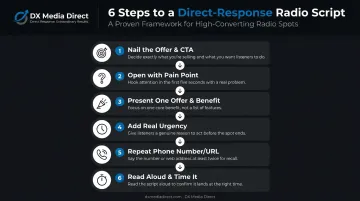
That's the whole structure: an offer, a reason to act, and a clear way to respond.
Direct-Response Radio Script Examples
Here's how that structure plays out for a hypothetical local business, "Riverside Heating and Cooling," running a limited-time summer promotion.
30-Second Script
[Hook, 0:00-0:05] "Is your AC blowing warm air in the middle of summer?" [Offer, 0:05-0:15] "Riverside Heating and Cooling will inspect your system for free and take fifty dollars off any repair." [Urgency, 0:15-0:20] "This offer ends Friday, so don't wait for a breakdown." [CTA, 0:20-0:30] "Call 555-0142 now. That's 555-0142. Riverside Heating and Cooling."
60-Second Script
[Hook, 0:00-0:05] "Is your AC blowing warm air in the middle of summer?" [Offer, 0:05-0:20] "Riverside Heating and Cooling will inspect your system for free, take fifty dollars off any repair, and every technician is licensed and background-checked, so you're not letting a stranger into your home." [Urgency, 0:20-0:30] "This offer ends Friday. After that, inspections go back to full price." [CTA, 0:30-0:45] "Call 555-0142 now to book your free inspection. That's 555-0142." [Repeat CTA, 0:45-0:60] "Riverside Heating and Cooling, 555-0142. Call before Friday."
Notice the extra 30 seconds didn't go toward storytelling. It went toward a second benefit and a repeated CTA.
A brand-style version of this same spot might spend the full minute building a feeling, 'At Riverside, we treat your home like our own,' without ever mentioning a phone number or a deadline.
That approach works for a national brand investing in recall over years, but it's wasted airtime for an advertiser who needs the phone to ring this week.
Radio Ad Costs: What a 30-Second Spot Really Costs
There's no single national price for a 30-second radio spot. Too many variables affect it.
Ad Results Media reports pricing between $3 and $525 per rating point (CPP) for a 30-second ad, depending on market size, station format, and daypart. That's a cost-per-rating-point figure, not a flat per-airing price, and it swings enormously between a small-market AM station and a top-10-market FM drive-time slot.
For DR advertisers specifically, three factors matter more than the sticker price:
- Daypart: Morning and afternoon drive command premium rates but often deliver the audience volume needed for a real response.
- Frequency: DR success usually requires repeated airings so listeners hear the offer enough times to act, not just recognize the name.
- Audience match: A station's listener base has to align with who actually buys your offer. Cheap airtime to the wrong audience isn't a bargain.
Because pricing varies so much by market and format, request quotes rather than relying on published rate cards. This is where relationship-based buying earns its keep.
DX Media Direct has spent 35+ years building direct relationships with network and station representatives, negotiating rates before programmatic buying platforms existed. That history gives direct-response advertisers access to inventory and pricing that automated, portal-based platforms structurally can't match.

A free consultation can help evaluate whether your current media mix is priced and placed for the kind of response DR campaigns actually need.
Frequently Asked Questions
What are the 6 C's of a radio advertising script?
Clear, Concise, Conversational, Compelling, Credible, and Call-to-Action. A DR script needs to hit all six inside a tight word count, usually 75-85 words for a 30-second spot.
What is an example of a radio advertising script?
See the 30-second annotated example above. It opens with a specific pain point, states one offer, adds a real deadline, then repeats the phone number twice in the closing seconds.
How much does a 30-second radio ad cost?
Industry benchmarks put pricing at roughly $3 to $525 per rating point, depending on market size, format, and daypart. Relationship-based media buying can secure better rates than self-service or programmatic platforms.
How long should a direct-response radio ad be?
30- and 60-second spots are most common. A single clear offer with one CTA usually fits comfortably into 30 seconds. Use 60 seconds only if you have a second, distinct benefit worth adding.
How many times should I repeat my phone number or website in a radio ad?
Two to three times. Place one repetition right after the offer and another at the close so it's the last thing listeners hear.
How do I track results from a radio ad?
Use a dedicated tracking phone number, a unique landing page URL, or a promo code tied only to the radio campaign. That lets you attribute calls, visits, or redemptions directly to the airing.