Introduction
Local TV advertising isn't just for car dealerships and big-box retailers anymore. Home services companies, law firms, dental practices, financial advisors, and auto repair shops run local TV campaigns every week — and not for brand awareness alone. They're doing it to generate calls.
Owners, marketing directors, and multi-location groups increasingly treat local TV like any other lead channel: something with a cost-per-lead, a tracking number, and a renewal decision every quarter.
Getting there involves real friction. Negotiating airtime, producing a direct-response spot instead of a branding reel, choosing the right dayparts, and connecting a 30-second commercial to an actual phone call: none of that happens by accident.
That effort is worth it. Local broadcast TV news remains the most trusted news source for 88% of U.S. adults, according to TVB's 2025 Local Broadcast News Study. That trust advantage is hard for most digital channels to match.
This guide covers how service businesses actually use local TV to generate measurable leads, not theoretical best practices.
Key Takeaways
- Local TV lead gen requires a defined service area, a repeatable offer, and call-ready staff
- A 90-day flight with call tracking is the standard way to validate cost-per-lead before scaling
- Dayparting and direct-response creative drive most of the difference in lead volume, not brand-style spots
- Campaign setup requires a trackable offer and dedicated tracking numbers, with airtime negotiated or purchased self-serve
- Sustainable results come from treating TV as a measurable, iterative channel rather than a one-time brand spend
When Should You Use Local TV Ads for Service Business Lead Generation?
The right trigger is operational readiness, not budget size. You need a defined local or regional service area, a repeatable offer, and enough staff to handle a sudden jump in inbound calls.
Local TV tends to work well for:
- Home services, including HVAC, roofing, plumbing, and restoration
- Legal services, especially personal injury and mass tort intake
- Medical and dental practices with high-ticket procedures
- Financial services, including tax relief, debt settlement, and insurance
- Auto repair and specialty automotive services
These categories share two traits: high transaction value and a broad local audience that watches linear TV.
It's the wrong tool when:
- Your service radius is a few zip codes, not a metro area
- You don't have a clear call-to-action or offer to advertise
- The test budget is too small to reach meaningful weekly frequency
Campaigns also need several consecutive weeks of consistent airing before lead volume settles into a pattern you can actually judge. DX Media Direct typically structures these tests to run 90 days, since one good week or one bad week doesn't tell you much on its own.
If you're already running paid search or social ads, you're in a stronger position to add TV. You already have a cost-per-lead baseline to measure against, which makes the TV test far easier to evaluate honestly.
What You Need Before Launching a Local TV Lead-Gen Campaign
Three things need to be in place before your first spot airs, or you'll end up with data you can't trust.
- Direct-response creative with a held offer: Your spot needs an on-screen phone number or URL, plus an offer viewers actually have time to write down. Without this, TV drives brand lift, not trackable leads.
- Dedicated tracking number, landing page, and call-handling capacity: No tracking means no real cost-per-lead calculation. No staffing means the calls you generate go unanswered — which defeats the entire point.
- Media buying knowledge or a buying partner: Inventory quality and rates vary enormously by station, daypart, and negotiation history. Inexperienced buying usually means overpaying for underperforming slots.
Each of these is a prerequisite. Skipping any one weakens the campaign and makes the results impossible to interpret.
How to Launch a Local TV Ad Campaign for Lead Generation (Step-by-Step)
Lead-generation results depend on following a defined sequence: offer, tracking, buying, airing, monitoring, evaluation. Skip a step and you'll usually find out at the 90-day mark, when the numbers don't add up and nobody can say why.
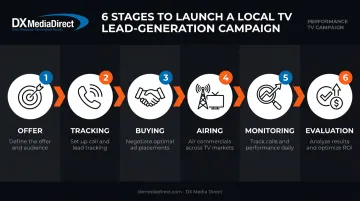
Setup and Preparation
Build the creative around a specific offer, not a general statement about your company. A hook needs to land in the first few seconds, before viewers reach for the remote.
Your spot should include:
- A specific, limited offer (a dollar amount, a free inspection, a same-day appointment)
- One clear call to action
- An on-screen phone number or URL held long enough to be written down
- A hook in the opening seconds that states the problem you solve
The most common setup error is producing a branding-style ad: polished, emotional, no trackable CTA. It looks good in a client meeting. It's nearly impossible to measure once it airs.
Initiating the Campaign
Campaigns launch one of two ways: direct negotiation with station or network sales reps for a flight (commonly sold in 13-week increments), or through a media buying partner securing preferred rates and available inventory. Agencies with established network relationships, such as DX Media Direct, often secure better rates and remnant inventory than a business could negotiate on its own.
Initiation isn't instant. Expect credit checks, contract terms, and confirmed air dates before your first spot runs. Once it does, stations issue affidavits of performance, documentation confirming the ad aired in its scheduled slot. That paperwork is your confirmation the campaign started correctly.
Operating the Campaign Correctly
Dayparting should match your audience's viewing habits, not a generic template. Home services and financial services generally align with daytime and early news; legal and medical services often perform well in evening or weekend slots.
Frequency matters more than most advertisers expect. A single exposure rarely converts into a call — viewers typically need to see the ad several times in a week before it registers enough to act on.
Consistency compounds this effect. Pulling a campaign on and off tends to produce erratic lead flow. A steady, uninterrupted flight builds the recognition that actually drives calls.
Monitoring During the Campaign
Track weekly:
- Call volume by tracking number
- Cost-per-lead
- Which stations and dayparts produce the most calls
Two failure patterns look similar but need different fixes:
- High impressions with low call volume points to a creative problem: the offer or hook isn't landing.
- Low impressions with low calls points to a media mix problem: you're not reaching enough of the right audience.
Confusing the two leads advertisers to fix the wrong thing.
Wrapping Up and Evaluating the Flight
Close out the 90-day test by compiling total leads and cost-per-lead, then compare that number against your benchmarks from other channels. That comparison, not gut feel, determines whether you renew, adjust, or cancel.
An abrupt stop-start pattern without this evaluation step wastes the reach you already built. It also makes it harder to judge whether the campaign actually worked, since you never let it run long enough to know.
Where Local TV Ads Deliver the Best Lead-Gen Results for Service Businesses
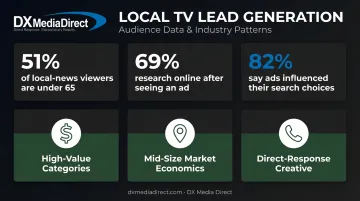
Local news dayparts, morning and daytime programming, and weather segments tend to skew toward an older, homeowner-heavy audience. Nielsen data shows roughly 51% of the traditional linear local-news audience is under 65, meaning a substantial share of viewers fall into the decision-maker demographic that home services and financial advertisers target.
That audience also does something valuable after seeing an ad: it searches. TVB's 2025 study found local broadcast news advertising prompted further online research among 69% of home remodelers, with 82% saying it influenced their search selections.
A few other patterns hold up across industries:
- High-value categories: Roofing jobs, legal settlements, and dental implants often generate enough revenue per lead to cover higher CPMs several times over.
- Mid-size market economics: Fewer advertisers compete for the same slots, often producing lower CPMs than major metros — though the discount varies by market and season.
- Direct-response creative: Ads featuring a clear phone number or URL tend to outperform brand-style spots in these dayparts, since viewers already primed to search respond fastest to an explicit call-to-action.
Best Practices for Maximizing Lead Generation from Local TV
A few disciplines separate campaigns that produce reliable lead flow from ones that produce confusing reports.
- Run the full flight before judging results. Shorter tests rarely produce enough data to be reliable — give the campaign time to establish frequency before pulling the plug.
- Match your offer to seasonal demand. HVAC campaigns should ramp ahead of summer heat; tax relief campaigns should peak before filing deadlines.
- Use a unique tracking number or promo code per station and daypart. Aggregated tracking hides which placements actually work, making it impossible to reallocate budget with confidence.
- Work with an experienced direct-response media buyer when possible. Agencies like DX Media Direct, which has run thousands of campaigns over 35 years, develop pattern recognition that's hard to replicate. That experience helps identify whether underperformance stems from creative or media mix, a distinction that trips up many first-time TV advertisers.
Conclusion
Successful local TV lead generation follows a disciplined sequence: offer, tracking, buying, monitoring, evaluation, in that order. Creative matters less than most advertisers assume.
Treat a 90-day test as your standard unit of measurement, not a quick trial you judge after two weeks. If you're weighing whether local TV fits your service business, DX Media Direct offers a free, no-obligation consultation to help validate the media plan before you commit budget to it.
Frequently Asked Questions
How much does a 30-second local TV ad cost?
Pricing depends heavily on market size, program, daypart, and demand for that inventory, so there's no single nationwide rate. Costs also shift based on spot length and production requirements, so quotes vary widely between markets.
How do I get an ad on local TV?
You can negotiate directly with station or network sales reps, or work with a media buying partner that already has network relationships. Direct negotiation gives you control; a buying partner often secures better rates through established volume and history.
How many leads can a local TV ad campaign generate for a service business?
There's no fixed number: lead volume depends on offer strength, weekly frequency, and market size. A strong offer running at consistent frequency in a receptive market will always outperform a weak offer running sporadically.
What is the best daypart for service business TV ads?
Daytime programming and early local news generally align well with homeowner and decision-maker viewership for home services, legal, and financial categories. The right choice still depends on your specific audience and offer.
How long should a local TV test run before scaling the budget?
A 90-day (roughly 13-week) flight is the standard test length. Shorter runs rarely produce enough consistent data to judge true performance.
Is local TV advertising still effective compared to digital lead generation channels?
Local TV works best alongside digital advertising rather than replacing it. Local broadcast news ads drive additional online research and search activity, boosting digital results while generating direct calls.