Introduction
Picture a local HVAC company that's spent the last three years pouring budget into Google Ads. Cost-per-click keeps creeping up, and lead quality is inconsistent.
The owner is staring at a spreadsheet wondering if there's a better way to reach homeowners before the next heatwave hits.
There is, and it's not new. U.S. out-of-home (OOH) advertising revenue hit a record $9.1 billion in 2024, up 4.5% year-over-year, with digital OOH growing even faster at 7.5%. OAAA calls it the fastest-growing traditional medium in America, ahead of TV, radio, and print.
Formats once reserved for national brands, like digital billboards and transit panels, are now accessible to local plumbers, dentists, and law firms.
This guide covers what OOH actually is, which formats fit service businesses, realistic costs, how to track leads down to the dollar, and how to launch a test campaign without betting the whole marketing budget.
Key Takeaways
- OOH is booming, opening formats once reserved for national brands to local service businesses.
- Printed OOH generates higher recall than desktop or mobile digital ads.
- Costs vary widely by market and format, so local benchmarking matters more than national averages.
- Call tracking, QR codes, and geofencing make OOH fully measurable, not "spray and pray."
- A 60-90 day test run lets you validate performance before committing to a long-term buy.
What Is OOH Advertising?
Out-of-home (OOH) advertising is any ad your customers encounter outside their homes. Billboards, bus shelters, transit panels, and digital screens in public spaces all count.
There are two main categories:
- Traditional (static) OOH: printed vinyl or paper displays on billboards, bus benches, and shelters. The message stays fixed for the length of the contract.
- Digital OOH (DOOH): electronic screens that rotate creative, update remotely, and can even change by time of day.
Both are within reach for local service businesses, depending on budget and campaign goals.
Here's the part that matters most for a plumbing company or dental practice: national brands use OOH for broad brand awareness across huge audiences. Service businesses use it differently: the goal is reaching the people who live within your actual service radius, not chasing broad awareness across an entire market.
That distinction changes everything about how you plan a campaign, and it's why hyperlocal placement usually beats broad-reach buys for businesses that depend on local calls.
Why OOH Advertising Works for Service Businesses
Presence Builds the Trust Digital Ads Can't
Service businesses sell trust. You're letting someone into a home, handling a legal matter, or managing a health issue. A billboard that's been on the same corner for months signals stability in a way a Facebook ad never will.
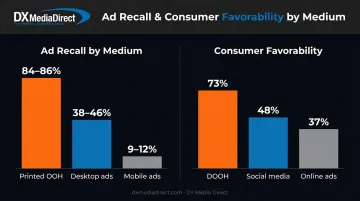
That impression sticks: printed OOH generates 84%-86% recall, compared to 38%-46% for desktop ads and just 9%-12% for mobile ads. A separate 2024 Harris Poll found 73% of consumers viewed DOOH favorably, well ahead of social media (48%) and online ads (37%).
Timing Meets Territory
An HVAC ad seen every day near the neighborhoods it services builds top-of-mind awareness. When the AC dies on a July afternoon, that's the number people remember.
Other advantages stack on top of this:
- Unskippable format: No ad blockers, no scroll-past; the ad is simply there.
- Hyperlocal dominance: Sustained placement in a specific ZIP code makes you the default choice, not just another search result.
- Cross-channel lift: OOH exposure drives people toward search and direct site visits later, reinforcing whatever digital campaigns you're already running.
Digital advertising still has a role in a service business's marketing mix. OOH simply adds what digital can't: physical, repeated, unavoidable presence in the exact area where your customers live.
Types of OOH Formats Best Suited for Service Businesses
Not every format fits every budget or business model. Here's how the main options break down.
Billboards & Roadside Displays
Best for building broad awareness along commute routes near your service area. Larger regional players such as roofing companies, law firms, or home improvement businesses get the most mileage here. They can absorb a wider reach radius and still convert enough of it into leads.
Transit & Street-Level Ads
Bus benches, shelters, and local transit panels are the budget-conscious option. They deliver high frequency in a tightly defined neighborhood, which suits businesses targeting a few specific ZIP codes rather than an entire metro area.
Digital OOH (DOOH) Screens
DOOH gives you flexibility static formats can't. Running a seasonal HVAC tune-up promo or a tax-season legal offer? Update the creative remotely instead of reprinting and reinstalling. That flexibility matters most when your offer changes by season or you want to test multiple messages quickly.
| Format | Best For | Relative Cost |
|---|---|---|
| Billboards | Regional service businesses, broad commuter reach | Moderate to high |
| Transit/Street-level | Neighborhood-specific targeting, high frequency | Low to moderate |
| DOOH screens | Time-sensitive offers, frequent creative updates | Moderate |
DX Media Direct negotiates placements across billboards, transit, and DOOH networks directly, so you get the right format for your service area without paying inventory markups.
How Much Does OOH Advertising Cost?
OOH pricing depends on format, market size, traffic volume, and campaign length. Benchmark against your local market, not national averages, since posted rates vary enormously by region.
A few real examples illustrate the range:
- A half bus-shelter ad in a small Massachusetts transit district runs around $35/month.
- A full, illuminated shelter placement in the same district costs closer to $75/month.
- A small New York transit district charges roughly $315/year for a bus shelter box.
- A California airport digital-screen network, covering multiple 75-inch and 110-inch displays, runs about $850/month for a synced 10-second spot.
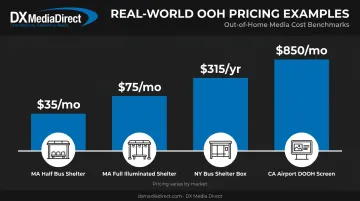
These are local, posted examples, not a national standard. Larger markets and premium locations will run considerably higher.
What Moves the Price Up or Down
- Contract length: longer terms mean better rates. One transit district cut its bus-ad price from $2,590/month (open term) to $1,650/month (12-month commitment).
- Quantity: additional placements in the same package typically cost less per unit than the first one.
- Illumination and static vs. digital: illuminated and digital formats tend to command a premium, though the exact markup varies by operator.
- Demand: high-traffic locations get pricier as availability tightens.
Start Small, Then Scale
Rather than locking into a large annual buy, run a defined 60-90 day test in your core service area first. This mirrors the de-risking playbook DX Media Direct uses across every channel it manages: prove performance on a small scale, then negotiate a longer commitment once the numbers hold up.
How to Measure ROI and Track Leads from OOH Advertising
The idea that OOH is "unmeasurable" is outdated. Attach direct-response mechanics to a placement and you can trace results just as precisely as a digital campaign.
Call tracking is the most practical tool for a service business. Assign a unique tracked phone number to each OOH location. Now you know exactly how many calls, and how much revenue, each billboard or bus shelter actually generates.
Other mechanics worth layering in:
- QR codes linked to a dedicated landing page, so you can count scans and conversions per location.
- Promo codes unique to the placement, tying a booked job directly back to the ad.
- Geofencing and mobile retargeting — capture anonymized device data near a placement, then retarget those users with ads that drive calls or bookings.
For a small service business, brand-lift and foot-traffic studies matter less than they do for national campaigns. Prioritize hard numbers, calls, booked jobs, and revenue tied directly to each location.
Interpreting those numbers correctly is where experience counts. DX Media Direct has run direct-response media tests across TV, radio, and outdoor for 35 years. That track record helps distinguish a genuinely underperforming placement from a slow-burning brand asset that just needs more time.
If you're building a measurable media mix and want a second opinion before committing spend, DX Media Direct's free, no-obligation consultation is a low-risk way to pressure-test your plan.
How to Launch a Successful OOH Campaign for Your Service Business
A test campaign doesn't need to be complicated. Follow this sequence:
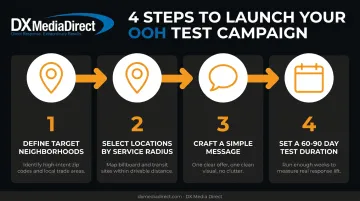
- Define your target neighborhoods and audience. Map your actual service area, not a generic radius.
- Select locations based on that service radius. Prioritize routes and spots your ideal customers pass daily.
- Craft a simple message. Seven words or fewer, one clear call-to-action, and a trackable phone number front and center.
- Set a defined test duration. 60-90 days is enough to gather real recall and response data before scaling.
Once your test parameters are set, don't run OOH in isolation. Integrate it with your existing channels:
- TV campaigns
- Digital ads
- Call tracking lines
This way, a customer who saw the billboard and later searches your name gets counted, not lost in the data.
Partnering with a media buyer with direct, relationship-based access to inventory and rates changes what's possible.
DX Media Direct's 35 years of network relationships and pattern recognition across media types give clients an edge when evaluating outdoor placements, translating into rates that portal-based buying simply can't match.
Frequently Asked Questions
What is OOH in advertising marketing?
OOH stands for out-of-home advertising, meaning any ad encountered outside the home. Billboards, transit displays, and digital screens are all examples. It reaches audiences in real-world, public settings rather than on a screen at home.
How much does OOH advertising cost?
Cost varies by format, market, location, and campaign duration. Small local placements, like bus shelters, often start far lower than large-format urban billboards. Request a custom quote for accurate pricing in your specific market.
Is OOH advertising effective for small, local service businesses?
Yes. Hyperlocal formats like transit ads and neighborhood billboards can be highly effective and affordable when paired with trackable response mechanisms like unique phone numbers or QR codes.
How does OOH compare to digital advertising for lead generation?
OOH builds unskippable, trust-building awareness, while digital campaigns excel at direct conversion. Combining both typically outperforms either channel run alone.
Can I track calls or leads generated from a billboard or transit ad?
Absolutely. Unique tracked phone numbers, QR codes, and dedicated landing pages let you attribute calls and leads directly to a specific OOH placement.
How long should a service business run an OOH campaign to see results?
Plan for roughly 60-90 days. That's enough time to gather meaningful data on recall and response before committing to a longer-term buy.