That's why a growing number of service businesses are looking back at television.
TV advertising gets dismissed as a "big brand" tactic, something reserved for national retailers rather than the roofing contractor down the street. Used correctly, though, TV drives phone calls, booked appointments, and signed clients, not just awareness.
This article breaks down the practical advantages of TV advertising for service businesses: what makes it work, how to measure it, and where it delivers a real return.
Key Takeaways
- TV builds trust, shortening sales cycles for legal, medical, and financial services
- Local and regional buys deliver mass reach without paid search's bidding wars
- Paired with call tracking and promo codes, TV becomes measurable for lead generation
- Treating TV as a one-off spend instead of a tested channel leads to disappointing results
- The right media buying strategy matters more than a polished commercial
What Is Television Advertising for Service Businesses?
Television advertising for service businesses means running 15- to 60-second commercials on broadcast, cable, or connected TV to generate calls, bookings, or website visits, not just brand impressions.
It shows up most often in industries where trust and local relevance decide whether someone picks up the phone:
- Home services: HVAC, roofing, plumbing, pest control
- Legal: personal injury, family law, mass tort
- Healthcare: dental practices, medical groups, urgent care
- Financial services: banks, credit unions, wealth management
The goal is a filled schedule, a booked job, or a signed client. Every element of a well-run campaign, from the daypart to the call-to-action, should point back to that outcome.
Key Advantages of Television Advertising for Service Businesses
The advantages below focus on outcomes service businesses actually track: calls, leads, cost per acquisition, and closed revenue. Each one ties directly to how these businesses grow, through visibility that creates demand, trust that converts leads into clients, and numbers that justify the spend.
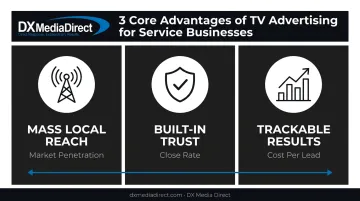
Advantage 1: Mass, Localized Reach That Builds Market Presence
Digital targeting narrows an audience down to a sliver of a market. TV does the opposite. It reaches a large share of a local or regional market in a short window.
Because Nielsen organizes the country into Designated Market Areas, or DMAs, a broadcast or cable buy can be concentrated exactly where a service business operates, whether that's a single metro or a multi-county territory.
That's a structural advantage paid search doesn't offer. You're renting attention across an entire market instead of competing keyword-by-keyword for slivers of it.
Reach at that scale matters because Nielsen reports that the average U.S. adult spends 32 to 35 hours per week with television, depending on the season. Few other channels offer that much sustained attention from a local audience.
Consistent local reach builds top-of-mind awareness. When a water heater fails at 11 p.m. or a legal issue surfaces unexpectedly, the business that's been showing up on screen for months gets the call first, not the one ranked third in a search auction.
KPIs impacted:
- Market penetration
- Brand awareness lift
- Cost per reach
- Share of voice in the local market
This advantage matters most when entering a new service area, competing against local providers who dominate paid search, or facing seasonal demand spikes, such as HVAC in summer or tax services in Q1.
Advantage 2: Built-In Trust and Credibility That Shortens the Sales Cycle
Consumers subconsciously associate a TV presence with legitimacy. Appearing on television, even on a local cable network, signals a business has the scale and stability to advertise there.
That halo effect matters more for services than products, since customers are hiring someone to enter their home, manage their money, or handle their health.
Trust isn't a nice-to-have in these categories. It's the primary purchase barrier. A homeowner researching roof replacement, or a family evaluating personal injury attorneys, filters for credibility before ever picking up the phone.
Recent research backs this up. TVB's 2025 Home Improvement Purchase Funnel study found 44% of respondents named broadcast or cable TV as the most important influence on their awareness of a home improvement provider, compared with just 8% for social media. That gap matters for any service business competing on trust rather than price.
When trust is established before first contact, the sales cycle changes:
- Leads arrive pre-qualified, already convinced the business is credible
- Skepticism and friction drop before the first call
- Reps spend less time overcoming objections and more time closing
KPIs impacted:
- Conversion and close rate
- Average deal size
- Lead quality
- Customer acquisition cost
This trust advantage counts most for high-ticket, high-consideration services: legal representation, financial planning, major home renovations, and medical procedures, where deciding to trust someone comes before deciding to buy.
Advantage 3: Trackable, Direct-Response Results When Paired With the Right Media Strategy
Modern TV advertising doesn't have to rely on vague brand-lift studies. Structured as direct-response, it includes dedicated phone numbers, promo codes, and unique landing pages, turning every airing into a measurable event. That's the difference between TV as a brand expense and TV as a revenue channel with a visible cost-per-lead.
TVB and CIMM's 2025 local-TV measurement showcase includes real examples. One regional law firm running linear TV alongside OTT saw a 16% increase in market reach and a 25% jump in online lead activity, measured over a trailing 90-day schedule.
An Arizona roofing company saw a similar payoff from creative testing: a single testimonial-style commercial drove 65% of its attributed web visitors, far outperforming other creative in the same campaign.
These aren't outliers. They're what happens when a service business tests, measures, and adjusts, instead of airing a spot and hoping.
Running a structured test:
Most service businesses go wrong here in one of two ways: they skip TV entirely, or they run a single unmeasured campaign and walk away disappointed. A better approach is a time-boxed test, often 90 days, built to answer specific questions:
- Which networks and dayparts actually drive calls, not just impressions
- Which creative angle performs best (testimonial, offer-driven, urgency-based)
- What the real cost per lead looks like once volume builds
DX Media Direct has run this kind of test for direct-response clients for 35 years, building pattern recognition across dayparts and networks from thousands of executed campaigns.
A media buy that looks identical on paper can produce very different results depending on when and where it runs. Knowing that difference before spending six figures is the entire point of testing.
KPIs impacted:
- Cost per lead
- Cost per acquisition
- Calls and bookings generated
- Return on ad spend
Testing pays off most for service businesses under pressure to justify marketing spend with hard numbers, or whose digital channels have plateaued and need a new source of scalable volume.
What Happens When TV Advertising Is Missing or Ignored
Skipping TV, or relying solely on digital channels, has predictable consequences for service businesses:
- Rising cost-per-click, as local competitors bid up the same limited set of keywords
- Inconsistent lead flow that swings with every algorithm update or platform policy change
- Limited reach into higher-income households, since TVB's High-Net-Worth research shows broadcast TV reaches 86-88% of adults worth $500,000+, a group that outspends average consumers on home improvement, legal, and dental services
- Lower perceived credibility compared to competitors who do have a TV presence
- Harder differentiation, since businesses without TV compete mainly on price or reviews, both easy for competitors to match
The businesses that feel this most operate in categories with defined local markets and high customer lifetime value, particularly home services, legal, and financial services. When a competitor airs consistently and you don't, the gap in perceived authority compounds every month.
How to Get the Most Value from Television Advertising
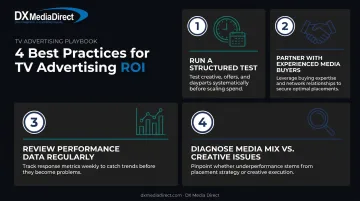
TV advertising delivers the strongest ROI when treated as a tested, tracked, ongoing channel rather than a one-off campaign. A few practices separate service businesses that get real ROI from those that don't:
- Run a structured test before scaling. Use call tracking numbers, promo codes, or unique landing pages to validate a media mix over a defined window, often 90 days, before committing to a full annual spend.
- Partner with experienced media buyers for direct network access. DX Media Direct negotiates directly with network representatives instead of submitting insertion orders through an automated portal. This relationship-based approach gives clients access to remnant inventory at rates programmatic platforms can't match.
- Review performance data on a regular cadence. Track which stations, dayparts, and creative are actually generating calls and bookings, then shift budget toward what's working.
- Don't confuse a media mix problem with a creative problem. A commercial can be well-made and still underperform if it airs in the wrong daypart or on a network with low affinity for a service category. Diagnosing which one is failing takes pattern recognition built from real campaign data.
Service businesses that follow this process treat every dollar spent as data. That discipline is what makes TV scale predictably as a long-term growth channel.
Conclusion
TV advertising works for service businesses when reach, trust, and measurability combine into one system:
- Reach puts your business in front of the right local audience
- Trust shortens the distance between a commercial and a booked job
- Tracking proves the campaign is working in hard numbers
These advantages compound. A business that's been visible and consistent for a year builds a different level of local credibility than one that just launched its first spot.
For service businesses ready to scale bookings beyond a plateaued digital mix, TV is a channel worth testing properly, tracking closely, and building on once it proves out.
Frequently Asked Questions
Why is television advertising effective?
TV combines sight, sound, and motion to build an emotional connection that static digital ads struggle to match. It also reaches large, engaged local audiences during hours they're already paying attention.
Is TV advertising affordable for small or local service businesses?
Yes. Local and regional buys, off-peak dayparts, and connected TV options make TV far more accessible than a national prime-time spot. Working with a media buyer who can access remnant inventory often lowers costs further.
How do you measure ROI from TV ads for a service business?
Use dedicated call tracking numbers, unique promo codes, and campaign-specific landing page URLs. Then correlate air dates with spikes in calls, web traffic, or bookings to see what's driving results.
What types of service businesses benefit most from TV advertising?
Home services, legal, healthcare, and financial services tend to see the strongest results. These categories share high trust requirements and clearly defined local markets, both of which play to TV's strengths.
How much does TV advertising cost for a local service business?
Costs vary widely by market size and daypart. An agency with negotiated network relationships typically secures lower rates than a self-service platform charging rate card pricing.
How long before TV advertising starts generating leads?
Responses can begin within days of a spot airing. That said, a structured multi-week test, often around 90 days, is typically needed to identify a media mix that's repeatable and scalable.