Many businesses assume radio ads are outdated or too hard to measure, so they default to digital instead. But that assumption often hides the real issue: a weak script, or a weak media buy, and no way to tell the two apart.
This post breaks down real radio ad examples across humor, emotional storytelling, jingles, and direct-response formats. Then it covers the media-buying decisions, station, daypart, and flight length, that determine whether a good script actually performs.
Key Takeaways
- Radio reaches the majority of U.S. adults each week, making it a reliable reach-and-frequency channel.
- Memorable ads master one technique: humor, emotion, a jingle, or a clear call to action.
- Station, daypart, and flight length can make or break a script's results.
- Formats span host endorsements, full productions, and sponsorships, each suited to a different goal.
- Trackable URLs and phone numbers separate brand-awareness buys from true direct-response campaigns.
Types of Radio Ads: The Different Formats Brands Use
Not every radio ad is a polished :30 commercial. Advertisers choose formats based on budget, goal, and how much they want the audience to feel like the message is coming from the station itself rather than a paid interruption.
Live Reads & Host Endorsements
A live read is delivered by the host or producer, in their own words, in real time. It functions less like an ad and more like a personal recommendation from someone the audience already trusts.
- Advertisers typically hand over bullet-point talking points, not a verbatim script, so delivery stays natural
- Authenticity and host exclusivity are what make this format work
- There's no additional production cost since nothing gets pre-recorded
Produced Spots
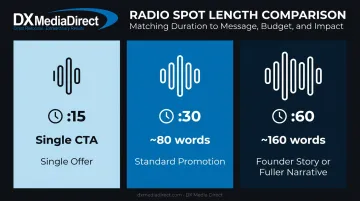
Unlike live reads, produced spots are pre-recorded, professionally voiced, and run consistently across one or more stations. Length shapes what the spot can accomplish:
- :15 spots fit one offer plus a single call to action, nothing more
- :30 spots run roughly 80 words, based on Voices.com's radio ad scriptwriting guidelines
- :60 spots allow for a fuller story or founder narrative, at closer to 160 words
Sponsorships & Mentions
Beyond individual spots and reads, sponsorship packages bundle produced spots, live endorsements, and sometimes non-audio perks (event tie-ins, naming rights) into one deal. They deliver a high share of voice, which makes them effective for building brand awareness rather than driving an immediate action.
Short mentions, usually 5 to 10 seconds, work differently. Their goal is to reinforce recall for a brand that's already advertising elsewhere, not to spark an immediate response on its own.
Best Examples of Radio Ads and What Makes Each One Work
Some radio ads stick in your head for decades. Others disappear the moment the next spot starts. The difference almost always comes down to a single, well-executed technique, not a mashup of five ideas crammed into thirty seconds.
Humor & Relatability
Humor works on radio because it breaks listener autopilot. There's no visual to carry the joke, so the writing has to do all the work.
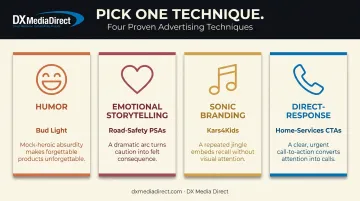
Bud Light's "Real Men of Genius" is a textbook example. Created by DDB Chicago and launched in the late 1990s, the campaign used mock-heroic exaggeration. A dead-serious narrator and a bombastic backup singer celebrated absurd everyday characters, like the tribute to "Mr. Edible Underwear Inventor," with the grandeur normally reserved for actual heroes.
The reversal, treating trivial behavior like legendary achievement, was the entire joke, and it landed for years. By 2006, the campaign had picked up more than 100 advertising awards, including back-to-back Cannes Radio Grand Prix wins.
Emotional Storytelling
Story-driven radio ads build a short narrative arc in seconds and let the listener's imagination fill in the visuals. That imaginative participation tends to create a stronger bond than a straightforward pitch ever could.
Public-service and road-safety campaigns lean on this technique heavily, since fear and consequence translate well to audio-only storytelling. Dubai's Road and Transport Authority won a Clio Silver award in 2015 for its radio work in this category, proof that judges recognized real narrative craft in the execution.
The takeaway for advertisers: a tight audio narrative, built around tension and a clear stake, can outperform a direct pitch when the goal is emotional connection rather than an immediate transaction.
Memorable Jingles & Sonic Branding
A simple, repeatable melody attached to a brand name sticks in memory far longer than a spoken slogan. This isn't just a hunch. A joint Audacy-Veritonic study found that broadcast-radio ads with sonic branding produced 17% higher ad recall and 6% higher purchase intent than ads without it.
Kars4Kids is the clearest proof point. The jingle repeats the toll-free number, "1-877-Kars4Kids," as its central hook, paired with the line "Donate your car today." It's been running for years, gotten parodied on SNL, and survived a legal challenge, yet the melody still triggers instant recognition. That's sonic branding doing exactly what it's supposed to do.
Direct-Response & Clear Call-to-Action Ads
Response-driven radio spots follow a formula:
- State the brand name early and often — don't bury it in the middle
- Focus on one offer, not a feature list
- Repeat the action step (a URL or phone number) at least twice before the spot ends
Home-services brands rely on this structure constantly. RAB research on the category found that :30 spots were the most effective length, driving a 3% lift in web traffic for advertisers, according to Inside Radio's reporting. Steve's Pest Control, which has advertised on AM/FM radio since 1988, is a long-running example of a service brand built almost entirely on this repeat-the-number approach.
The Strategic Formula Behind High-Performing Radio Ads
Here's the part most advertisers skip: the same script can perform completely differently depending on where and when it runs. Station format and daypart shift who's listening and how much attention they're paying.
A few principles matter more than most advertisers expect:
- Daypart and station selection change the audience composition entirely. A financial spot during morning drive on a news-talk station reaches a different mindset than the same spot at midnight on a music station.
- Flight length drives recognition. A few airings over two weeks rarely move the needle. Consistent repetition over a longer flight builds the recall needed for a response.
- Attribution has to be built in before launch. Dedicated landing pages, unique promo codes, and trackable phone numbers separate radio-driven response from every other channel running at once.
Campaigns go wrong when underperformance gets misdiagnosed. A weak media mix gets blamed on the creative, while a strong script gets buried in the wrong daypart and never gets a fair shot.
Telling the two apart takes pattern recognition. That skill only comes from running enough campaigns across enough product categories to recognize what a real signal looks like.
This is where an experienced direct-response media partner earns its fee. DX Media Direct has spent 35+ years building relationships with network reps rather than submitting insertion orders through a portal.
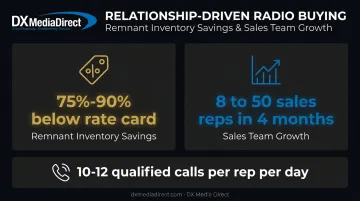
That access opens up remnant inventory, unsold slots stations need to move, often at 75% to 90% below rate card pricing. In one financial services case, that kind of targeted radio strategy delivered results like this:
10 to 12 qualified calls per sales rep per day, helping the client grow from 8 sales reps to 50 in four months.
That kind of granular, relationship-driven adjustment is exactly what automated buying can't replicate. A programmatic platform optimizes against an algorithm; it doesn't get a call from a rep about a Tuesday-morning slot that needs to move by Thursday.
How to Apply These Radio Ad Lessons to Your Own Campaign
Turning these examples into a working campaign comes down to a few decisions, made before the ads start airing.
- Pick one technique. Humor, emotion, a jingle, or a direct offer, not all four stitched together. Radio's short format rewards a single clean idea, not a crowded one.
- Budget for a real test window. Measure the flight in weeks, not days, and have a trackable CTA (a dedicated number or URL) in place before judging results.
- Separate creative problems from media problems. If a campaign underperforms, the fix might be the script, the placement, or both, and guessing wrong wastes budget.
Businesses unsure which lever to pull can get a free, no-obligation consultation with a DX Media Direct specialist to diagnose what's actually holding a campaign back.
Frequently Asked Questions
What are the different types of radio ads?
The four core formats are live reads/host endorsements, produced spots, sponsorships, and short mentions. Each suits a different goal, from trust-building to pure brand awareness to short-term recall reinforcement.
What are some examples of radio ads?
Bud Light's "Real Men of Genius" (humor), road-safety PSA campaigns (emotional storytelling), Kars4Kids (jingle-driven), and home-services :30 spots (direct-response) each represent a distinct, proven technique.
What are some famous radio ad campaigns?
Motel 6's decades-long partnership with Tom Bodett, running over 30 years by 2017, and Bud Light's "Real Men of Genius" both became iconic through longevity and consistent, recognizable format.
How long is a typical radio ad script?
A :30 spot runs roughly 75 to 85 words, and a :60 spot runs about 150 to 170 words. Shorter formats force advertisers into a single, focused message rather than multiple claims.
Is radio advertising still effective compared to digital and streaming audio?
Yes. Radio reaches 87% of U.S. adults weekly and holds roughly 86% of in-car ad-supported listening time, according to Edison Research, well ahead of most ad-supported streaming platforms in total listening time.
How is success measured for a radio ad campaign?
Common attribution methods include dedicated URLs, trackable phone numbers, promo codes, and post-campaign lift studies. Measurement should be planned before launch, not added after results come in.