This is the daily reality for local service brands: skippable, blockable, ignorable digital advertising. Many assume digital out-of-home (DOOH) is off-limits, either too expensive or reserved for national consumer brands with Super Bowl-sized budgets. Others dismiss it as "just billboards" with no way to prove it drove a single phone call.
Neither is true. This guide breaks down what DOOH actually is, why it fits service brands better than most people assume, real campaign examples, typical formats and costs, and how to turn screen visibility into tracked calls and booked appointments.
Key Takeaways
- DOOH screens update remotely, targeting by location, weather, or time of day
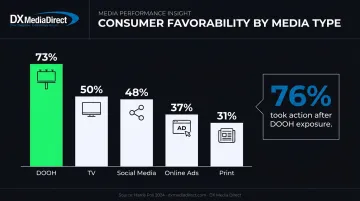
- Consumers report 73% favorability toward DOOH, beating TV, social, and print
- Geo-targeting focuses spend on specific zip codes, cutting wasted reach
- DOOH costs vary, but venue-based pricing can rival connected TV CPMs
- QR codes, tracking numbers, and promo codes turn DOOH visibility into leads
What Is Digital Out-of-Home (DOOH) Advertising?
Digital out-of-home advertising refers to ads shown on digital screens in public spaces, where the content can be changed remotely using digital technology, according to the Out of Home Advertising Association of America.
Traditional OOH, by contrast, means printed billboards or posters booked for a fixed run, with creative that physically has to be swapped out by hand.
That distinction matters more than it sounds. A traditional billboard locks you into one message for weeks. A DOOH screen can show a different message at 8 a.m. than it does at 6 p.m., or swap creative entirely if it starts raining.
DOOH isn't the same thing as digital signage. Signage is the physical screen infrastructure sitting in a mall or medical building. DOOH is the advertising layer: how brands buy time on those screens to reach an audience.
DOOH environments range widely:
- Massive digital billboards towering over a city intersection
- Screens embedded in elevators, waiting rooms, or gas station pumps
- Small displays positioned exactly where a buying decision happens
That range is exactly what makes DOOH workable for a service brand with a modest, localized budget, not just a national retailer.
Why DOOH Advertising Works So Well for Service Brands
Service brands rarely sell impulse purchases. Nobody sees a billboard and immediately calls a divorce attorney. What that billboard does is build the familiarity someone needs before they trust a name enough to pick up the phone weeks later. Repetition and visibility do the heavy lifting that a single search ad can't.
It's unskippable, and consumers respond. There's no skip button on a screen at a gas pump. A 2024 Harris Poll of over 1,000 US adults found that 73% viewed DOOH favorably, well ahead of TV (50%), social media (48%), online ads (37%), and print (31%). The same study found 76% of respondents took some action after recent DOOH exposure, according to OAAA's research summary.
For brands whose entire model depends on generating calls and bookings rather than passive brand awareness, that's a meaningful signal.
Hyperlocal targeting cuts wasted spend. Most service brands operate within a defined radius. A roofing company doesn't need impressions in the next state. DOOH lets advertisers concentrate spend on specific zip codes, neighborhoods, or even single intersections, avoiding the bleed that comes with buying broad regional or national reach.
Contextual triggers match real demand. Screens can pull in live data to swap creative automatically. Examples that fit service categories well:
- HVAC companies triggering "AC tune-up" ads during a heat wave
- Tax-prep services running ads only during filing season
- Insurance or roofing brands switching to storm-damage messaging after severe weather
- Healthcare providers promoting flu-shot clinics as cold and flu season approaches
Proximity placement hits the moment of decision. Placing screens near hospitals, courthouses, or financial districts puts a message in front of someone at the exact moment they're already thinking about that category of service. That's a level of contextual relevance a billboard on a random highway simply can't offer.
Common DOOH Formats and Where Service Brands Should Place Them
Not every format suits every service category. Here's how the main formats map to service-brand goals.
Large-Format Billboards and Urban Panels
These digital bulletins rotate messages among several advertisers throughout the day and dominate high-traffic corridors. They're best suited for brand-building campaigns from healthcare systems, law firms, or financial institutions seeking broad local name recognition rather than an immediate response.
Place-Based and Venue Screens
Screens in gyms, medical offices, elevators, and gas stations reach a captive, contextually relevant audience. This is where visual-cue targeting becomes powerful: a screen in a building lobby can adjust its message based on who's likely walking past it. It's a natural fit for:
- Dental or vision clinics targeting waiting rooms in medical buildings
- Financial advisors placing ads in office building elevators
- Home services brands using gas station pump screens in target neighborhoods
Transit and Mobile DOOH
Bus shelters and rideshare car-top screens offer geo-targeted, cost-efficient reach without buying separate placements for every location. For a local service business with a defined service radius, this format covers the same ground as multiple fixed buys, often at a lower blended cost.
DX Media Direct negotiates these placements directly with media owners, applying the same relationship-based buying that secures preferred rates across TV and radio to outdoor and DOOH inventory.
Real-World Examples of DOOH Advertising for Service Brands
Seeing how other brands, especially service brands, have executed DOOH makes the strategy far less abstract.
LASIK MD's Elevator Targeting
LASIK MD placed elevator screens that used visual detection to identify riders wearing glasses and tailored the ad copy toward them in real time.
The campaign generated over 11 million impressions and a reported 17% increase in engagement among glasses wearers, according to a case study covered by the U.S. Chamber of Commerce. It's a clear demonstration of how contextual precision beats generic messaging.
Betterment's Awareness-to-Intent Lift
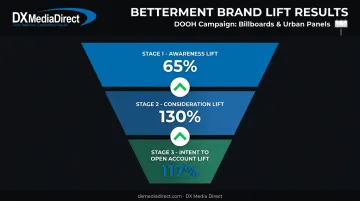
Financial services brand Betterment ran DOOH billboards and urban panels with data-driven audience targeting.
A brand-lift study reported a 65% lift in awareness, a 130% lift in consideration, and a 117% lift in intent to open an account. This is one of the strongest documented examples of DOOH moving a service-category audience from noticing an ad to considering action.
McDonald's Waze Integration
Geofenced billboards triggered in-app navigation prompts on Waze, reaching 1.9 million unique users and generating over 8,400 accepted navigations to nearby locations during an eight-week campaign. Service brands with physical locations, think urgent care clinics or auto repair shops, can borrow this exact playbook to drive verified navigation traffic.
FreshDirect's Shoppable Subway Screens
FreshDirect's NYC subway campaign used QR codes linking directly to recipes and purchase pages, turning a passive video ad into an immediate action point. Service brands should replicate this mechanic directly: scan-to-book a consultation, scan-to-get-a-quote, or scan-to-schedule an appointment.
Weather-Triggered Creative as a Template
The same FreshDirect campaign adjusted creative based on real-time local weather. Home repair, roofing, and insurance brands can apply this identically: swap in storm-damage or emergency-repair messaging the moment weather conditions change in a target zip code.
How Much Does Digital Out-of-Home Advertising Cost?
There's no single DOOH price tag. Cost depends on:
- Screen format and market size
- Audience reach and location quality
- Campaign duration and time of day
- Direct, agency-negotiated, or programmatic buying method
One useful benchmark: venue-based DOOH runs roughly $9 to $32 CPM, compared to $23-$32 CPM for connected TV and $5-$19 for mobile video, according to the OAAA venue video buyers guide. That figure covers venue screens specifically, not every billboard or transit buy. Even so, it shows DOOH can hold its own against channels many service brands already budget for.
Given that range, rather than committing to a large market-wide buy on day one, start smaller:
- Select a handful of screens in one target zone
- Run creative for a defined test window
- Track response before expanding spend to additional zones
This validates both placement and creative before real money is on the line.
Turning DOOH Visibility Into Measurable Revenue: A Direct-Response Approach
Here's the mistake most service brands make: they buy DOOH purely as awareness media, then have no way to connect it to a booked appointment or a phone call. That's an expensive gap for any brand whose survival depends on leads, not just impressions.
Layer Direct-Response Tracking Onto Every Buy
DOOH's own data is aggregated and contextual, not tied to individual identifiers. But you can still measure results by adding:
- Dedicated tracking phone numbers unique to each screen or zone
- QR codes linked to UTM-tagged landing pages for attribution
- Unique promo codes redeemable by phone or online
- Front-desk or call-center scripts that ask, "Did you see our ad on [location]?"
None of these require expensive new tech. They just require building measurement into the buy from the start, not bolting it on afterward.
Why Relationship-Based Buying Beats Self-Serve Platforms
Once tracking is in place, the next question is where to buy that inventory. Self-serve programmatic DOOH platforms are convenient, but they rarely offer the negotiated rates or premium placement access that come from long-standing network relationships. For a smaller service brand testing a new local market, that difference in rate and placement quality can make or break a first campaign's results.
This is where DX Media Direct's 35 years of direct-response media buying becomes directly relevant. Decades of pattern recognition across dayparts, networks, and categories translate into knowing which placements, timing, and inventory actually drive results, whether the channel is broadcast TV or a local DOOH screen.
Test in One Zone, Then Scale What Works
With the right media partner secured, the next step is proving the approach before scaling it. A structured test-and-scale approach, similar to how a 90-day media test proves out a TV buy, applies just as well to out-of-home:
- Run DOOH in a single target zone for a defined period
- Track call and lead volume against that specific placement
- Refine creative or screen selection based on what the data shows
- Expand the winning formula into additional zones
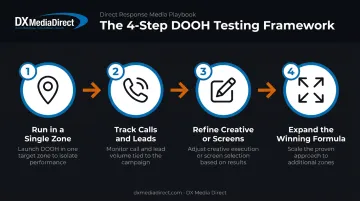
This approach is far more disciplined than betting an entire local budget on one untested billboard.
If your service brand is ready to build a media mix, out-of-home included, that ties directly to booked calls and appointments rather than vague impressions, help is available. DX Media Direct offers a free, no-obligation consultation to map out that strategy.
Frequently Asked Questions
What does digital out-of-home advertising mean?
DOOH refers to advertising on digital screens in public spaces where the content can be updated remotely. Unlike traditional static billboards, DOOH creative can change by time, location, or audience in real time.
What is an example of a digital out-of-home ad?
LASIK MD's elevator screens that identified glasses wearers and adjusted messaging accordingly is one example. Transit screens with QR codes linking to a booking page, like FreshDirect's subway campaign, are another.
How much does digital out-of-home (DOOH) advertising cost?
Cost varies based on screen format, market size, campaign length, and whether you buy directly, through an agency, or programmatically. There's no fixed industry-wide rate.
Is DOOH advertising effective for small or local service businesses?
Yes. Geo-targeting and place-based formats let brands concentrate spend on a specific service radius instead of paying for wasted national reach, making it scalable for local budgets.
How is DOOH different from traditional out-of-home advertising?
Traditional OOH requires physically swapping printed creative and locks you into one message for the full booking period. DOOH content updates remotely and can be scheduled to change by time, weather, or audience.
Can DOOH advertising be tracked like digital advertising?
DOOH itself relies on aggregated, contextual data rather than individual identifiers. Adding QR codes, dedicated tracking numbers, and promo codes lets service brands measure real calls and bookings tied to specific placements.