Podcast listening looks a lot like DRTV did decades ago: a trusted voice, an engaged audience, and a clear call to action. U.S. podcast ad revenue hit $2.86 billion in 2025, and the audiences behind that spend are not passively scrolling. They're leaning in.
This guide breaks down podcast ad formats, real costs, and measurement tactics through a direct-response lens. No fluff about "brand lift." Just what converts, what it costs, and how to track it.
Key Takeaways
- Podcast ads drive measurable action, not just awareness, when tracked like DRTV spots
- Mid-roll, produced spots give DR offers the best mix of scale and testability
- Promo codes, vanity URLs, and pixels best link downloads to revenue
- As a DRTV complement, podcasts excel at reaching cord-cutting audiences
Why Podcast Ads Are a Direct-Response Powerhouse
Nearly half of the country is already listening. In 2024, 47% of Americans age 12 and older listened to a podcast at least monthly, according to Edison Research's Podcast Consumer report. That's not a niche audience anymore. It's mainstream media with DR potential most advertisers haven't tapped.
What makes podcasts different from social feeds or programmatic display is attention. Listeners typically tune in during commutes, workouts, or chores, activities that don't compete for visual focus. There's no feed to scroll past and no mute button reflex. Ads get heard.
Five Reasons Podcast Ads Convert for Performance Marketers
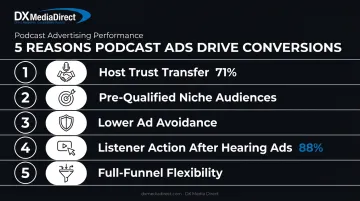
Host trust transfers to the brand. Nielsen found that host-read podcast ads generate a 71% brand-recall rate, per Nielsen's research on podcast audience engagement. This is the halo effect of a familiar voice vouching for your offer.
Niche shows deliver pre-qualified audiences. A listener tuning into a personal-finance podcast is already primed for a fintech offer. You're not building interest from zero.
Ad avoidance runs lower than digital or CTV. Listeners can't scroll past a mid-roll spot the way they skip a banner ad. The ad plays whether they like it or not, with no visual mute button in sight.
Listeners act after hearing an ad. In an Edison Research study commissioned by Acast, 88% of listeners said they took action after hearing a podcast ad. Of those, 57% visited the advertiser's website and 41% made a purchase, according to Acast's 2024 listener action study.
Full-funnel flexibility. The same 60-second read can build brand familiarity for a cold audience and close a sale for someone already searching for a solution, much like a well-placed DRTV spot does across dayparts.
Podcast Ad Formats & Placement Strategy
Not all podcast ads are built the same, and picking the wrong format wastes budget fast.
Host-Read vs. Produced Spots vs. Native Segments
| Format | Trust/Engagement | Scalability | Typical Cost |
|---|---|---|---|
| Host-read | Highest, listener treats it like a recommendation | Low, tied to one show's schedule | Higher CPM, often $24-$26 for a 60-second baked-in spot |
| Produced spot | Moderate, professional but less personal | High, easy to run across many shows via DAI | Lower CPM, roughly $12-$15 for programmatic delivery |
| Native segment | Deepest, fully woven into episode content | Lowest, custom production per show | Project-based, negotiated per deal |
For DR campaigns, start with produced spots. They're cheap enough to test multiple offers and creative angles across several shows at once. Once a show proves it converts, shift budget into a host-read placement on that specific program to squeeze out higher response rates.
Once you've settled on a format, the next decision is where in the episode your ad actually runs.
Ad Placement: Pre-Roll, Mid-Roll, Post-Roll
Mid-roll placements captured 63% of U.S. podcast ad revenue in 2022, compared to 31% for pre-roll and just 6% for post-roll. Buyers favor mid-roll, and it makes sense for DR advertisers: listeners are already committed to the episode, making it the right spot for a detailed offer with a specific CTA.
- Pre-roll: Best for quick brand reinforcement or urgency-driven CTAs ("offer ends Friday")
- Mid-roll: Ideal for the full pitch, benefit breakdown, and promo code delivery
- Post-roll: Cheapest slot, useful as a closing reminder for listeners who stuck around
Placement decides when listeners hear your offer; delivery method decides how much control you keep over it once it's live.
Dynamic Ad Insertion vs. Baked-In Ads
Dynamic ad insertion (DAI) now delivers 92% of podcast ad revenue, up from just 48% in 2019. DAI lets you swap creative or offers mid-campaign without re-recording anything, the audio equivalent of rotating DRTV creative on the fly.
Baked-in ads trade that flexibility for permanence. Once a host reads your ad into an episode, it's part of that file forever. Use baked-in placements only after you've already validated the message through DAI testing.
Podcast Ad Costs & Buying Options
Podcast CPMs vary more than most digital channels because format, niche, and spot length all move the price.
Recent industry benchmarks show:
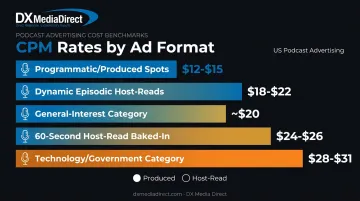
- 60-second host-read baked-in spots: roughly $24-$26 CPM
- Dynamic episodic host-reads: roughly $18-$22 CPM
- Programmatic/produced spots: roughly $12-$15 CPM
- Category swings: technology and government podcasts often run $28-$31 CPM, while general-interest categories sit closer to $20
Where you buy matters as much as what you pay, and three main paths exist for buying podcast placements:
- Ad networks and agencies: best for advertisers who want scale across many shows without managing individual host relationships
- Self-serve platforms: good for smaller budgets and quick tests, but you're working with published rates and limited negotiation
- Direct-to-host buys: best once you've identified a proven show and want maximum authenticity, though it takes more manual coordination
Here's the part most advertisers miss: posted rate cards rarely reflect what buyers actually pay. Networks and hosts negotiate based on volume, relationship, and how badly they need to fill inventory that week.
This is where agencies with existing relationships tend to land better rates than a first-time buyer working from a rate sheet. DX Media Direct, for instance, negotiates directly with network reps to secure rates below the card.
Tracking Performance: Metrics That Matter for DR Advertisers
Podcast listening happens largely offline, which makes attribution harder than pulling a report from a search or social platform. Still, DR advertisers have workable tools.
- Promo codes — the simplest method; tie a unique code to each show or episode and track redemptions directly
- Vanity URLs — a memorable, easy-to-recall landing page (think "yourbrand.com/podcastname") borrowed straight from traditional DR media playbooks
- Conversion pixels — capture on-site actions when listeners click through from show notes or a linked landing page
- RSS-level tracking — measures downloads and delivery through server logs, confirming your ad reached listeners even though it can't verify an actual purchase
For setting expectations, Magellan AI's Q1 2026 benchmark report offers a useful baseline for DR podcast campaigns:
| Metric | Benchmark |
|---|---|
| Response rate (site visits within 30 days) | 2.29% |
| Lead conversion | 9.74% |
| Purchase conversion | 5.22% |
These figures track visitors to an advertiser's site within a 30-day window, then measure how many convert to leads or purchases.
Layer in post-purchase surveys or media mix modeling when possible. Asking new customers "how did you hear about us" catches conversions that promo codes and pixels miss entirely, especially from listeners who searched for your brand later instead of clicking straight through.
Podcast Ads vs. DRTV: Where Podcasts Fit in a Performance Media Mix
DRTV still owns mass reach and decades of proven playbooks. Nielsen's TV universe covers roughly 125 million U.S. households, and linear TV remains a scalable channel with well-understood daypart economics. Podcasts don't replace that. They complement it.
Meanwhile, cord-cutting keeps accelerating. The largest U.S. pay-TV providers lost roughly 5 million net subscribers in 2023 alone, part of a five-year decline exceeding 20 million. Podcasts help advertisers reach exactly the audience drifting away from linear TV, without abandoning the DR discipline that makes DRTV work.
Pattern recognition matters more than platform access here. DX Media Direct has spent 35 years identifying which networks, dayparts, and show categories actually convert for a given offer, then negotiating rates that programmatic platforms structurally can't match.
That same relationship-based approach carries over to podcasts:
- Show selection: Distinguishing shows that convert from ones that just look good on paper
- Rate negotiation: Securing placements at costs programmatic buying can't reach
- Cross-channel testing: Applying DRTV's 90-day test discipline to podcast placements
If you're weighing whether podcasts belong in your media mix alongside DRTV, a free consultation is a low-risk way to find out before committing spend.
Getting Started: Building a Podcast Test Campaign
Treat your first podcast buy like a media test, not a full launch.
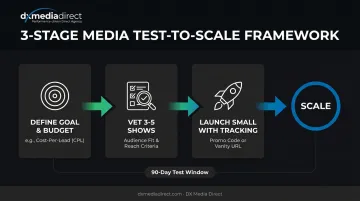
- Define one measurable goal and a contained budget. Pick a single KPI, such as cost per lead, cost per sale, or site visits, and cap your test spend before you start vetting shows.
- Vet 3-5 shows for fit. Check audience demographics, host credibility, and whether the show's tone matches your brand voice. A mismatch here wastes the whole test.
- Launch small with clear tracking in place. Use a promo code or vanity URL from day one, then let the test run long enough to gather real data before scaling. This mirrors the same 90-day test-and-learn approach that works for TV.
Frequently Asked Questions
How much do podcast ads cost?
Podcast CPMs typically range from $12 for programmatic produced spots to $30+ for host-read placements in high-demand categories. Pricing shifts based on audience size, ad format, and niche.
Where can I get ads for a podcast?
You can buy through ad networks and agencies for scale, self-serve platforms for smaller budgets and quick setup, or direct-to-host buys for maximum authenticity on a proven show.
Are there ads on podcasts?
Yes. Podcasts run pre-roll, mid-roll, and post-roll ads in host-read, produced, or native formats, reaching an audience of roughly 47% of Americans monthly.
What are the 5 reasons podcast ads are effective?
Podcast ads work for five key reasons:
- Host trust transfers directly to the brand
- Niche shows deliver pre-qualified, engaged audiences
- Ad avoidance runs lower than on digital or CTV
- Most listeners take action after hearing an ad
- The format performs across the full marketing funnel
What is a good conversion rate for podcast ads?
Recent benchmarks show an average 2.29% site-visit response rate, with purchase conversion around 5.22% among those visitors. Actual results vary widely by niche and offer relevance.
Is podcast advertising better than paid search or social media for direct response?
Podcast ads serve a different purpose than paid search or social media. They build pre-search demand and trust that complements high-intent channels like search, rather than replacing them.