Introduction
If you run an HVAC company, law firm, dental practice, or roofing business, you already know the drill: your phone needs to ring, and it needs to ring often.
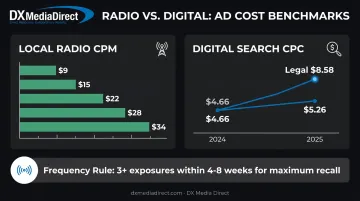
But digital ad costs keep climbing. The average Google Ads CPC hit $5.26 in 2025, up from $4.66 in 2024. Attorneys and Legal Services now pay an average of $8.58 per click, according to a Search Engine Land benchmark covering more than 16,000 campaigns.
Many service businesses assume radio is for national brands chasing awareness, not local companies chasing calls. That assumption is outdated.
Radio can generate trackable, attributable leads at a cost that often beats saturated digital auctions. This article covers why radio works for direct response, how to buy it correctly, what it costs, how to write ads that convert, and how to measure the return.
Key Takeaways
- Radio reaches captive local audiences at a lower cost-per-lead than many digital channels
- Format and daypart choices matter more for lead generation than for brand-building
- Call tracking and cost-per-lead analysis are essential for proving radio's ROI
- Experienced media buyers secure rates and inventory self-service platforms can't match
Why Radio Advertising Works for Lead-Driven Service Businesses
Radio Reaches Ready-to-Buy Local Customers When They Need You Most
Urgent-need categories, think plumbing, HVAC, garage door repair, roadside assistance, personal injury law, benefit from radio's positioning at the exact moment a problem hits. A homeowner with a busted water heater doesn't scroll through search results while standing in a flooding basement. They think of a name they've heard.
Drive-time dayparts amplify this advantage:
- Listeners hear your ad while physically driving past their own neighborhood
- That geographic proximity reinforces recall for hyper-local services
- Repeated exposure during commutes builds the "who do I call" instinct before the emergency happens
Trust Transfers From Host to Business Faster Than Digital Ads
Reaching listeners at the right moment matters, but radio's deeper advantage is trust. Choosing a contractor, dentist, or attorney is a trust decision, not just a price comparison. A live-read endorsement from a local host carries weight a banner ad never will.
In one regional home services campaign, personality-endorsement spots performed 13% above the overall campaign average, compared to standard 30-second brand spots and traffic sponsorships, according to a Radio Advertising Bureau and ANA analysis. That's a meaningful lift for a format that costs little extra to produce.
Radio's Cost-Per-Lead and Built-In Frequency Beat Digital Ad Economics
Advertisers negotiate radio rates directly with a station rep instead of bidding for them through an automated auction. That structural difference matters:
- Local 30-second CPMs run roughly $9–$25 in New York and $18–$34 in Detroit, per Ad Results Media's 2025 rate benchmark
- Meanwhile, Google search CPCs keep climbing across nearly every competitive local vertical
- Negotiated rates give advertisers budget predictability that algorithmic auctions simply don't offer
Those savings compound because radio also delivers something search and social can't guarantee: built-in frequency. Roofing, legal representation, and financial planning aren't impulse buys, and they require multiple exposures before a prospect picks up the phone.
The Radio Advertising Bureau recommends at least three exposures within a purchase cycle spanning 4 to 8 weeks for maximum effectiveness. Radio's scheduled, guaranteed airtime delivers that frequency reliably, something a fluctuating search ranking or algorithm-dependent social feed cannot promise week over week.
How to Advertise on Radio: Formats, Buying Process & Targeting
Choosing the Right Ad Format for Your Service Business
Three formats dominate lead-driven radio campaigns:
- Spot ads – Fully produced, consistent messaging, lower cost than live endorsements
- Live reads/host endorsements – Personality-driven, higher trust transfer, tends to outperform for trust-sensitive services like legal and dental
- Sponsorships (traffic, weather, news segments) – Frequent, brief brand mentions that build passive familiarity
Jingles and short branded audio cues also matter for recurring-need services. A seasonal HVAC tune-up reminder or annual dental checkup nudge benefits from a memorable sonic hook listeners recognize instantly, even months later.
Selecting Stations, Dayparts & Local Targeting
Station format should match your customer profile:
- Talk and news stations skew toward homeowners and business decision-makers
- Country and classic rock formats often reach blue-collar and trade-service audiences
- Match the station's listener demo to your actual buyer, not just your assumed one
Morning and evening drive-time slots cost more, but they deliver the highest reach among time-pressed, in-car service seekers. If your budget only covers one premium daypart, drive time is usually the right call for urgent-need categories.
The Media Buying Process: Rates, Negotiation & Scheduling
Radio rates are typically bought using CPM (cost divided by impressions) or CPP (cost divided by gross rating points, where one point equals 1% of the market population). Rates fluctuate based on market size, season, and station demand.
Common scheduling structures include:
- Run of Station (ROS) – Ads placed throughout the broadcast day at the station's discretion, generally the most budget-friendly option
- Flights – Concentrated bursts of advertising followed by dark periods, useful for seasonal service spikes
- Dominate-a-day – Heavy frequency across a single day to maximize short-term reach
Working with an experienced buyer here isn't optional. Rate cards are starting points for negotiation, not fixed prices, and someone without market relationships will almost always pay more for the same inventory. Agencies with decades-long station relationships, like DX Media Direct, routinely secure rates and remnant inventory that self-serve platforms structurally can't match.
How Much Does Radio Advertising Cost?
Radio pricing varies dramatically by market. Agency benchmarks for 2025, sourced from Ad Results Media, show wide ranges depending on market size and inventory demand:
| Spot Length | Cost Range |
|---|---|
| 60-second | $5 – $750 |
| 30-second | $3 – $525 |
A 30-second unit generally runs 60% to 70% of the 60-second price.
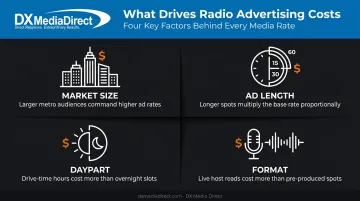
Primary cost drivers for service-business campaigns:
- Market size – A top-10 metro costs far more than a mid-size regional market
- Ad length – 15-second sponsorships cost less than full 30- or 60-second spots
- Daypart – Morning and evening drive command premium pricing; overnight slots are cheapest
- Format – Live host endorsements typically carry a premium over pre-recorded spots
Beyond these cost drivers, production expenses stay comparatively low compared to TV, making radio an accessible entry point for lead-generation budgets. An experienced agency with long-standing station relationships can also secure pricing well below published rate cards, saving budget that would otherwise go toward inflated card-rate premiums.
Crafting Radio Ads That Generate Leads & Measuring ROI
Direct-Response Creative Principles for Radio
Radio ads built for leads look nothing like radio ads built for brand awareness. A few non-negotiables:
- One clear call to action: "Call now" beats three competing asks every time
- Repeat the phone number: two to three times, since a driving listener can't jot down a URL
- Add urgency: a limited-time discount or free estimate offer moves listeners from "interested" to "dialing"
A problem-agitate-solve script structure works especially well for urgent categories. Open with the pain (a leaky roof, a broken AC unit, an unexpected legal issue), agitate it briefly, then deliver the solution and the phone number. This mirrors direct-response principles proven across decades of broadcast advertising, not just radio.
Tracking Calls & Leads From Radio Campaigns
Even the sharpest script falls flat without proof it's converting. You can't optimize what you can't measure, so tracking needs to be built in from day one:
- Dedicated call-tracking numbers per station, daypart, or creative version, so every call gets attributed to the exact placement that generated it
- Vanity URLs and promo codes as secondary tracking layers, especially useful for cross-referencing lead volume against your air schedule
- Cost-per-lead (CPL) calculation (total spend divided by attributed leads), run weekly to spot which stations and dayparts are actually converting
Once you have a few weeks of CPL data by placement, reallocate budget toward what's working and cut what isn't. This is the same discipline that makes digital campaigns performant, applied to a channel most competitors haven't bothered to track properly.
Choosing the Right Radio Media Buying Partner
Self-service and programmatic radio platforms hand you rate-card pricing plus a technology fee. That's the ceiling, not the floor. Relationship-based buyers negotiate below that ceiling because portal-based buying has no leverage built through years of direct station contact.
DX Media Direct has spent 35 years buying direct-response media, executing thousands of campaigns across TV, radio, and other channels. That track record builds pattern recognition. The agency knows which dayparts historically underperform for a given service vertical, and can quickly tell whether a disappointing campaign stems from the wrong media mix or weak creative, rather than guessing.
A few reasons this matters for service businesses specifically:
- Negotiates remnant inventory pricing well below published rate cards
- Unlocks premium daypart access through volume-based buying relationships that individual advertisers can't secure alone
- Draws on long-standing network relationships to secure preferential rates and inventory holds
A free, no-obligation consultation is the lowest-risk way to pressure-test whether radio fits your lead volume goals before committing to a full quarter. If you're weighing radio against another quarter of rising digital costs, that scoped test is far cheaper than a full-scale rollout with no baseline data to guide it.

Frequently Asked Questions
How much does it cost to advertise on the radio?
Weekly costs vary widely by market, typically ranging from a few hundred dollars in small markets to several thousand in major metros. Key factors include market size, daypart, spot length, and whether you use live reads or recorded spots.
How do you advertise on radio?
Define your target audience and lead goals, then pick a format and daypart that matches your customer profile. Negotiate rates, produce the ad, and track results with call-tracking numbers; an experienced buyer speeds up every step.
What type of service business benefits most from radio advertising?
Urgent-need and trust-driven categories perform best: home services (HVAC, plumbing, roofing), legal, healthcare and dental, and financial services. These are purchases people research in advance and remember brand names for before an urgent need arises.
How can I track leads or calls generated from a radio ad?
Use dedicated call-tracking numbers assigned to specific stations or dayparts, vanity URLs, and promo codes. Cross-referencing these against your air schedule shows exactly which placements drive calls.
How long does it take to see results from a radio ad campaign?
Most campaigns need 4 to 8 weeks at minimum to build the frequency required for recall, spanning your typical purchase cycle. Longer tests, closer to 90 days, provide more scalable insight.
Is radio advertising better than digital ads for lead generation?
Radio and digital advertising work best as a combined strategy rather than a either-or choice. Radio often delivers a lower, more predictable cost-per-lead for local service businesses, especially when paired with proper call tracking, while digital captures active searchers already ready to buy.