Introduction
If you run a home services, legal, healthcare, or financial services business, you've probably watched your digital lead costs creep up every quarter. That's not your imagination.
Across 23 major search-ad categories, including legal, dental, home improvement, and healthcare, average cost-per-click rose 10% year over year, while cost-per-lead jumped 25%. That pushed the blended average CPL to $66.69 in 2024, up from $53.52 the year before, according to Search Engine Land's 2024 benchmark report.
Rising costs like these often send business owners searching for alternatives—yet television is usually the first channel they rule out, dismissing it as either a brand-awareness luxury or a budget-buster for national chains.
Neither is true anymore. Direct-response TV is built specifically to generate trackable calls and leads, not just recognition.
This guide breaks down what direct-response TV actually is, why it still works for lead generation, realistic cost ranges, and the exact steps to launch and measure a campaign.
Key Takeaways
- Direct-response TV is built around trackable calls-to-action, not brand recall alone
- Off-peak local and regional TV buys often cost less than owners expect
- A structured 90-day test beats a single ad buy or an open-ended commitment
- Daypart and network selection can make or break your cost-per-lead
- Relationship-based media buying unlocks rates automated platforms simply can't offer
What Is Direct-Response TV Advertising for Service Businesses?
Television advertising covers any commercial or sponsored spot that airs during a scheduled slot, whether that's broadcast, cable, or a streaming platform. Most people picture image-driven brand spots when they think of TV commercials — the moody, aspirational campaigns built purely around recall.
Direct-response TV (DRTV) works differently. Every element exists to trigger one immediate, trackable action: a phone call, a landing page visit, or a form submission. There's no ambiguity about whether the ad worked. You can count the responses.
Key Components of a Lead-Gen TV Ad
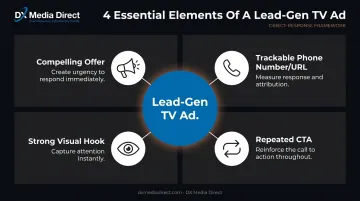
A lead-gen TV spot typically includes:
- A compelling offer, a discount, free consultation, or limited-time incentive that gives viewers a reason to act now
- A trackable phone number or dedicated URL, unique to that specific spot, network, or airtime
- A strong visual hook in the opening seconds to stop channel-surfing
- A repeated, unmistakable CTA, stated more than once so viewers who tune in mid-spot still catch it
Most short-form DRTV spots run 15, 30, or 60 seconds, with 30 seconds remaining the standard across the industry. That tight format suits service businesses particularly well, since a single roofing job, personal injury case, or financial planning client can be worth thousands of dollars in lifetime value. Even a modest response rate from a regional TV buy can produce a strong return:
- High customer lifetime value means fewer leads need to convert to justify the spend
- Local and regional service areas map naturally onto local and regional TV markets
- Trust-sensitive purchases, such as legal, medical, and financial services, benefit from TV's built-in credibility
"TV" today also spans broadcast, cable, and connected TV/streaming inventory. That gives service businesses flexible ways to reach local audiences, whether through a single metro cable buy or a streaming platform like Hulu or Roku, without paying for national waste.
Why TV Advertising Still Works for Service Business Lead Generation
TV's reach hasn't collapsed. It's redistributed across broadcast, cable, and streaming. Live sports, local news, and prime-time programming still command massive simultaneous audiences that no digital platform replicates at the local level.
The Trust Advantage
High-consideration services such as legal representation, medical procedures, and financial planning require a level of trust that banner ads struggle to build. According to Nielsen's global advertising trust study, trust in paid TV outpaces every other channel:
- Paid TV advertising: 47% trust
- Social network ads: 36% trust
- Online banner ads: 33% trust
- Mobile ads: 26% trust
That gap matters most for the exact industries service businesses represent. A viewer who sees your firm during the evening news associates it with the credibility of that broadcast, a halo effect that's hard to manufacture on a social feed.
Reach and Recall Without the Waste
Buying local or regional TV means paying for a specific market, not a national audience full of households you'll never service. A regional cable or broadcast buy puts your message in front of thousands of in-market households while every viewer sits within your actual service radius.
That targeted reach compounds through repetition: repeated exposure to the same offer and CTA builds recall. When a viewer's water heater fails six weeks after seeing your plumbing ad, that recall is often the reason they dial your trackable number instead of searching cold on Google.
TV Strengthens Your Digital Funnel
One of the most measurable effects of TV exposure shows up on a second screen. An analysis of 1.38 million TV spots from 43 advertisers found that TV accounted for 33% of media-driven sales through paid search and 29% through direct site visits. Those effects showed up within eight minutes of a spot airing, according to Thinkbox's TV response research.
In practice, that means a TV spot often triggers an immediate spike in branded searches, site visits, and PPC clicks. If you're already running paid search or social, TV can make those channels more efficient by feeding them warmer, higher-intent traffic.
How to Launch a TV Ad Campaign for Lead Generation: Step-by-Step
Launching a lead-gen TV campaign requires a sequence of decisions that narrow your risk with each step, rather than simply grabbing the cheapest spot you can find.
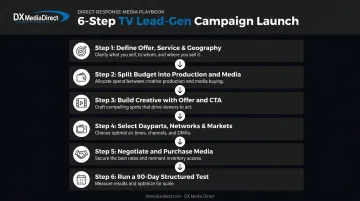
Define your offer, service category, and geography first. Nail down the exact offer, whether that's a free estimate, discounted service call, or consultation, along with the precise geography and demographics you're targeting. This decision shapes both your creative and your media strategy.
Split your budget into two buckets. Separate production costs from media buying costs, and resist spending everything on a single market right away. A smaller regional test tells you more than a full rollout you can't afford to repeat.
Build creative around a clear offer, urgency, and a repeated CTA. Your ad needs a strong hook in the opening seconds, a specific reason to act now, and a call-to-action stated at least twice.
Select dayparts, networks, and markets strategically. This is where pattern recognition pays off. Knowing which shows, times, and networks convert for legal leads, home improvement leads, or insurance leads comes from accumulated data across thousands of campaigns, not guesswork.
Negotiate and purchase your media. You have two paths: self-serve programmatic platforms, where you bid for inventory in a real-time auction, or relationship-based buying, where direct network ties unlock better rates. DX Media Direct has spent 35 years building exactly these relationships, securing remnant inventory that automated platforms structurally can't access and driving down cost-per-lead directly.
Run a structured, time-boxed test. A 90-day pilot gives you enough weekly data points to separate a genuinely bad week from a genuinely bad strategy. Track cost-per-lead weekly, not spot by spot, and use that window to build a scalable playbook before committing more budget.
What Does TV Advertising Cost for a Service Business?
TV costs vary more than most owners expect, and the variables interact with each other.
Core cost drivers:
- Market size - a spot in a top-10 market costs more than the same spot in a mid-size regional market
- Daypart - daytime and overnight inventory typically costs a fraction of primetime or local news
- Network type - broadcast, local cable, and streaming/CTV each price differently, with CTV often sold on a cost-per-thousand basis
- Ad length - 30-second spots remain the standard, though 15- and 60-second versions exist for specific placements
- Production quality - a simple, offer-driven spot costs far less than a cinematic brand film, and for direct-response purposes, simpler often converts better.
Local and regional buys are almost always dramatically cheaper than the national or Super Bowl-level numbers that dominate headlines. A regional cable buy in an off-peak daypart can reach thousands of in-market households for a fraction of what a single national primetime spot costs.
Why the buying relationship matters as much as the rate card.
Two advertisers can buy the "same" inventory and pay very different prices. Automated, portal-based platforms sell whatever inventory happens to be available the moment you log in. There's no negotiation and no remnant access.
Agencies with decades of direct network relationships operate differently. DX Media Direct's 35 years of media buying provides access to remnant inventory and negotiated rates that aren't available through a self-serve dashboard. That access often makes the difference between a profitable cost-per-lead and a wasted budget.
Measuring and Optimizing TV Lead Generation Campaigns
You can't optimize what you can't measure. Every lead-gen TV campaign needs attribution built in from day one, not bolted on afterward.
Standard tracking mechanisms:
- Unique trackable phone numbers assigned per network, daypart, or creative version
- Dedicated landing page URLs that isolate TV-driven traffic from other channels
- Promo codes tied to a specific offer or airtime
- Call-tracking software that logs volume, call duration, and qualified-lead rate
Metrics worth checking weekly:
- Cost-per-lead and cost-per-acquisition, tracked by network and daypart, not just overall
- Call volume broken out by which spot and airtime generated it
- Website traffic spikes matched to actual air times, a delayed but real signal of ad impact
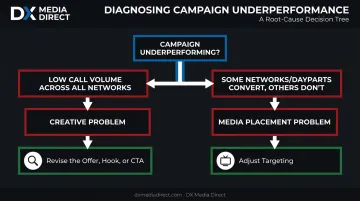
When a campaign underperforms, the fix depends entirely on the cause. If call volume is thin across the board, the creative likely isn't landing, so the offer, hook, or CTA needs revision.
If certain networks or dayparts consistently produce leads while others produce nothing, the problem is placement, not the ad itself.
Getting that diagnosis right before scaling spend is the difference between fixing a small test budget and burning a much larger one on the same mistake. It's the same read DX Media Direct's buyers make before recommending any shift in spend — creative problem or media problem, never both at once.
Frequently Asked Questions
Is television advertising still worth it?
Yes, especially for direct-response and lead-gen campaigns. TV consumers trust it more than social or display ads, and local/regional buys deliver measurable, trackable leads at a fraction of national pricing.
What is the best way to advertise on television?
Build an offer-driven direct-response ad with a clear, repeated CTA. Choose dayparts and networks based on where your target customer actually watches, then run a structured test before scaling spend.
What is television advertising?
Television advertising refers to commercials or sponsored content aired during scheduled slots on broadcast, cable, or streaming platforms to promote a product or service to viewers.
How much does TV advertising cost for a small or local service business?
Costs vary by market size and daypart, but local and regional buys are typically far more affordable than national spots. See the cost breakdown above for the specific variables that drive your price.
How do I track leads generated from a TV ad?
Use a unique trackable phone number, a dedicated landing page URL, and promo codes tied to your specific offer. Call-tracking software ties every response back to the exact spot that generated it.
How long does it take to see results from TV advertising?
Plan for a structured test period, typically around 90 days, to gather enough weekly data to judge performance reliably rather than reacting to a single good or bad week.