Many advertisers struggle to budget for radio because rates shift by market, daypart, and how the airtime gets sold. Add in the fact that AM/FM now competes directly with streaming audio for ad dollars, and pricing models are evolving fast.
This article breaks down 2026 radio ad pricing by market size, the factors that push rates up or down, hidden costs beyond airtime, and how to negotiate a rate that doesn't waste your budget.
Key Takeaways
- Weekly costs range widely: $200–$2,000 in small markets, $2,500–$8,000+ in major metros
- Morning Drive costs the most; overnight and remnant slots cost the least
- Buying model matters: CPM, CPP, flat-rate, and sponsorship deals suit different goals
- Production and agency fees add to airtime costs, in some cases doubling the total spend
- Negotiation and remnant inventory can cut costs by 50% or more without killing reach
Radio Advertising Pricing Overview for 2026
Radio ad costs are never one-size-fits-all. They hinge on three things: the size of the market, how popular the station is with listeners, and how the station packages its airtime.
A station's rate card reflects its audience delivery. Pricing tools like CPM (cost per mille) measure the cost to reach 1,000 listeners, calculated as schedule cost divided by gross impressions, times 1,000.
There's no single published national CPM average for 2026. Every station calculates it from its own Nielsen audience data, so expect your CPM to come from an actual station quote rather than a generic benchmark.
Common budgeting mistakes to avoid:
- Underestimating production costs and assuming airtime is the only expense
- Buying only peak dayparts without testing whether off-peak slots deliver similar ROI at a lower cost
- Ignoring frequency requirements, since a single ad rarely builds the recall needed to drive action
- Skipping a clear call-to-action, which leaves listeners unsure what to do next
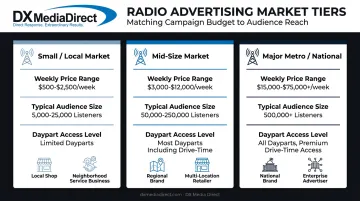
These pitfalls aside, actual costs still hinge on market size. Here's how pricing breaks down across the three tiers:
Small/Local Market Radio Ads
Small-market stations typically sell weekly spot packages with limited daypart access, often bundling a set number of spots across a few time slots rather than guaranteeing premium placement every time.
This tier works best for:
- Local retailers running promotions
- Service businesses (plumbers, HVAC, dental practices)
- Grand openings or one-time local events
Expect lower total costs, but also lower audience scale. You're trading reach for affordability.
Mid-Size Market Radio Ads
Mid-size markets offer broader daypart access and moderate frequency deals: multiple spots per week across Morning and Afternoon Drive, not just leftover inventory.
This tier suits:
- Regional brands expanding beyond one city
- Multi-location businesses needing consistent local presence
- Advertisers ready to commit to frequency, not just a single test buy
- Companies coordinating radio with local TV or digital buys for combined reach
Major Metro / National Radio Campaigns
Major metro and national buys unlock premium dayparts, sponsorship add-ons (think "weather brought to you by..."), and multi-station reach across a region or the country.
Best fit for:
- National brands needing scale
- Direct-response advertisers who need volume to hit statistically meaningful response rates
- Campaigns layering radio with TV or streaming for combined reach
Key Factors That Affect Radio Advertising Costs
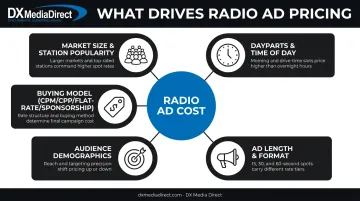
Radio pricing comes down to a handful of interrelated forces: how many people a station reaches, when your ad airs, how long your spot runs, who's listening, and how much competition exists for that same slot.
Market Size and Station Popularity
Nielsen ranks radio markets by Metro 12+ population, not by the DMA labels used for TV. New York leads with roughly 16.6 million listeners age 12+, followed by Los Angeles at 11.3 million and Chicago at 8 million. Bigger audience pools mean stations can charge more, and top-rated stations within a market command a further premium over lower-rated competitors in the same city.
Dayparts and Time of Day
Not all airtime is priced equally. Historically, drive-time hours have carried the highest rates because they capture commuters as a captive audience.
That said, afternoon radio has emerged as a genuine power daypart: one in three Americans now name it their primary listening period, with afternoon's audience share climbing 21% over three years. Don't assume morning is automatically your best (or most expensive) buy. Request quotes across dayparts:
- Morning Drive: traditionally premium, still competitive
- Afternoon Drive: rising fast, sometimes comparable pricing with strong reach
- Midday: moderate cost, steady listenership
- Evening: lower cost, more available inventory
- Overnight: cheapest, best for remnant or testing budgets
Ad Length and Format
Longer spots cost more airtime, and that shows up on the invoice. Industry guidance from the Radio Advertising Bureau notes that a 15-second spot generally runs about half the cost of a 60-second spot. Most local advertisers default to :30 spots as the sweet spot between message depth and cost efficiency, while :60s suit storytelling-heavy or direct-response campaigns needing a full offer and call-to-action.
Audience Demographics and Targeting
Stations targeting business owners, young professionals, or other high-value niche demographics often price above general-audience stations with similar total listenership. A station's format and the demographic makeup of who's actually tuning in both play into the quote you'll receive. That's why two stations with similar reach numbers can post very different rate cards.
Buying Model (CPM vs CPP vs Flat-Rate vs Sponsorship)
| Model | How it works | Best for |
|---|---|---|
| CPM | Cost per 1,000 impressions delivered | Brand-awareness, broad-reach campaigns |
| CPP | Cost per rating point in your target demo | Campaigns targeting a specific audience segment |
| Flat-rate | Fixed price per spot or package, no ratings math | Advertisers wanting predictable, simple budgeting |
| Sponsorship | Branded segments (news, weather, traffic) | Building association and recall over time |
Each model shifts risk and reward differently. CPM and CPP reward efficient reach; flat-rate and sponsorship reward guaranteed visibility. Agencies with long-standing network relationships can often negotiate below published rate cards or tap into remnant inventory, flexibility that's harder to come by through self-serve, programmatic buying.
Cost Breakdown of Radio Advertising: Beyond Airtime
The quoted spot rate is only part of your total investment. A realistic radio budget accounts for four categories.
Airtime Costs
This is the recurring, largest line item in most radio budgets. It scales directly with frequency (how many spots you run), daypart (when they air), and market size. Buying more spots per week almost always lowers your per-spot cost, even though total spend rises.
Production Costs
Production is a one-time cost per creative asset, covering:
- Scriptwriting
- Voice-over talent
- Sound engineering and mixing
- Music licensing
Costs here range from a few hundred dollars for a simple, template-style spot to several thousand for a fully produced ad with professional talent and original sound design.
Agency or Media-Buying Fees
Agencies typically charge a percentage of ad spend, which can feel like an added cost until you consider what it offsets.
A full-service agency with decades of network relationships can often secure rates and inventory access that self-service or programmatic platforms structurally can't reach. DX Media Direct, for example, brings 35 years of direct-response media buying experience, often paying for its fee through savings elsewhere.
Campaign Testing and Optimization Costs
Smart advertisers budget for recurring testing, not just a one-and-done buy. A 90-day test comparing creative variations or media mix combinations builds a data-backed playbook instead of guessing at what's working.
Low-Cost vs High-Cost Radio Ads — What's the Difference?
Budget remnant buys and premium prime-time placements represent two distinct strategies, each built around different goals and budgets.
- Reach & Frequency: Lower-cost buys trade guaranteed prime exposure for volume, often filling unsold inventory at a discount. Higher-cost buys guarantee a specific audience size and daypart placement.
- Production Quality: Budget campaigns often lean on in-house or template scripts. Premium campaigns invest in professional voice talent and sound design, which strengthens brand credibility with listeners.
- Trackable ROI: Well-produced campaigns paired with proper attribution (unique promo codes, vanity URLs, or dedicated tracking phone lines) generate clear profit-column results. Cheap, unmeasured spots offer no way to tie airtime to response.
The cheapest option isn't automatically the best value. A remnant spot with no tracking tells you nothing about performance.
How to Negotiate Better Rates and Avoid Costly Mistakes
The first quote a station gives you is rarely their final offer. Walking in with a defined goal, target audience, budget, and timeline gives you real negotiating leverage, because it signals you've done your homework.
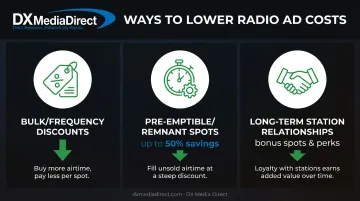
Proven tactics that lower costs:
- Bulk or frequency discounts: committing to more spots per week typically lowers your per-spot rate
- Pre-emptible or remnant spots: accepting unsold, moveable inventory can cut costs by 50% or more
- Long-term station relationships: advertisers who stick with a station over months or years often earn added-value perks like bonus spots or event mentions
The most common budgeting mistake? Chasing the lowest airtime rate while ignoring production quality, media mix fit, and measurement. A dirt-cheap spot that nobody remembers, or one you can't track, wastes money regardless of its low price tag.
This is where experience matters. Agencies with a long track record across dayparts and product categories bring valuable pattern recognition to campaigns. DX Media Direct, for example, has run thousands of such campaigns and can pinpoint whether an underperforming result stems from media mix or creative, then fix the right piece instead of guessing.
Frequently Asked Questions
How much money does a 30 second radio ad make?
Revenue depends entirely on response rate, offer strength, and how you track it. Direct-response campaigns typically measure success through cost-per-response using discount codes, unique URLs, or call tracking, not a fixed dollar figure per airing.
What's a realistic minimum budget to start with radio advertising in 2026?
Most advertisers need roughly $1,500–$2,500 per month on a single station to build meaningful frequency. Going lower usually means too few spots to generate recall.
Is radio advertising still effective for small businesses in 2026?
Yes. AM/FM radio represented 66% of daily ad-supported audio time among US adults in Q2 2025, still outpacing streaming audio for reach, especially with local audiences.
How much does a 60-second radio ad cost compared to a 30-second ad?
Longer spots typically cost more due to added airtime demand, though the exact ratio varies by station. Request quotes for both lengths to compare directly.
What's the difference between CPM and flat-rate radio pricing?
CPM prices your ad based on impressions delivered per 1,000 listeners, rewarding efficient reach. Flat-rate locks in a fixed price for a guaranteed time slot, trading efficiency for predictability and control.
How can I lower my radio advertising costs without sacrificing results?
Focus on remnant inventory, bulk frequency deals, and off-peak dayparts that still reach your audience. Rates vary by market, format, and daypart, so a media-buying partner with established network relationships can secure terms unavailable on public rate cards.