But "how much does a billboard cost" doesn't have one answer. A static board in a small town might run a few hundred dollars a month. A digital spectacular in Times Square can top $50,000. Many businesses struggle with the same problem: they get one quote, assume it's the market rate, and either overpay or pick a board that barely gets seen.
This guide breaks down 2026 pricing by market tier and format, the hidden costs most quotes leave out, and how to budget without overspending.
Key Takeaways
- Billboard costs range from $250/month in rural markets to $25,000+/month in major metros, with spectaculars topping $50,000
- Traffic volume and impressions, not just board size, drive the real cost-per-view
- Digital billboards cost more upfront but eliminate reprinting fees when creative changes
- Static boards cost less per cycle but add printing costs with every creative swap
- Contract length, season, and negotiation leverage all move the price — sometimes by a lot
How Much Does a Billboard Cost? (2026 Pricing Overview)
There's no fixed "going rate" for a billboard. Price depends on market tier, format, board size, and how long you commit. Two boards on the same highway can carry wildly different price tags if one sees triple the traffic.
Before diving into numbers, watch for these budgeting mistakes:
- Underestimating production and installation costs on top of the quoted rental fee
- Choosing the cheapest board without checking its actual traffic count
- Ignoring renewal-rate increases that kick in after your first flight
Cost by Market Tier
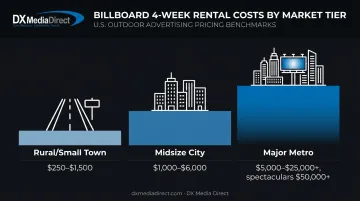
Operators like Clear Channel and OUTFRONT price boards based on geography, audience density, and availability rather than publishing a flat rate card. That said, typical 4-week rental costs cluster into these tiers:
| Market Tier | Example Cities | Typical 4-Week Cost |
|---|---|---|
| Major metro | NYC, LA, Chicago, Miami | $5,000–$25,000+ (premium spectaculars $50,000+) |
| Midsize city | Tampa, Charlotte, Indianapolis | $1,000–$6,000 |
| Rural/small town | Local highways, small towns | $250–$1,500 |
Most brokers and independent OOH sellers report national averages in the low-to-mid thousands per 4-week cycle. Your actual quote depends heavily on the board's traffic count and location.
Static vs Digital Pricing at a Glance
Format changes the math within any market tier. Digital boards rotate ads among 6–8 advertisers every 6–8 seconds, so you're sharing the screen but paying less than a full buyout. Static boards give you the whole board, all the time, but only after you've printed and installed vinyl.
| Format | Typical CPM | Trade-off |
|---|---|---|
| Static bulletin | $2–$9 | Full board, all the time, but printing and installation costs come first |
| Digital billboard | $5–$18 | Shared with 6–8 advertisers, but skips print costs and swaps creative instantly |
Price Range Breakdown
- Entry-level: Rural static boards with basic vinyl print, a 4-week placement, and no share-of-voice competition. A common starting point for local businesses testing outdoor advertising.
- Mid-range: Midsize-city static boards or shared digital rotation slots, where share-of-voice pricing applies to digital formats. Regional brands with a wider footprint typically land here.
- High-end: Major metro digital or premium placements with guaranteed share-of-voice, prime sightlines, and the highest impression counts, suited to national brand campaigns and product launches.
Key Factors That Affect the Cost of a Billboard
Billboard pricing depends on a combination of location, format, physical specs, and contract terms working together.
Location and Traffic Volume
The industry standard metric is CPM, or cost per thousand impressions: campaign cost divided by (impressions ÷ 1,000). It's how you compare boards that look similar but perform completely differently.
Here's why the cheaper option isn't always the better deal:
- Board A: $2,000/month, 400,000 weekly impressions → CPM of roughly $1.25
- Board B: $1,200/month, 150,000 weekly impressions → CPM of roughly $2.00
Board A costs more upfront but delivers a lower cost per view. Always ask for traffic count data before assuming the lower sticker price wins.
Format: Static vs Digital
Static means one printed image for the entire flight, locked in until you pay to swap it. Digital means shared rotation through share-of-voice slots, which costs more per cycle but lets you change creative, daypart your messaging, and test multiple ads without reprinting. A typical digital loop might rotate eight advertisers per minute, giving each about 7.5 seconds of airtime.
Size and Board Type
Board type changes both your footprint and your price:
| Format | Typical Size |
|---|---|
| Junior poster | 6' x 12' |
| Poster | ~12' x 25' |
| Bulletin | 14' x 48' (10' x 40' variants also common) |
| Spectacular | Larger than 14' x 48', custom-built |
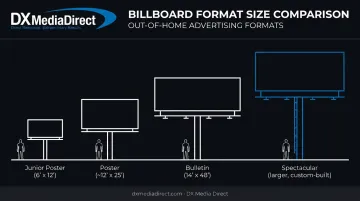
Bulletins and spectaculars command the steepest premiums due to size, location quality, and (for spectaculars) custom engineering.
Contract Length and Seasonality
Longer commitments unlock better rates. Many operators discount 12-plus week contracts, while short-term, last-minute bookings often carry the opposite: rush pricing. Peak seasons like Q4 and tourist-heavy markets also push prices up as demand rises. On the flip side, unsold seasonal inventory sometimes gets discounted heavily just to fill the board. Agencies with established network relationships, like DX Media Direct, often secure this discounted remnant inventory for clients.
Full Cost Breakdown: What's Beyond the Rental Fee
The quoted rental rate is just one line item. Here's what else typically factors into your total investment.
Design and Creative
This is typically a one-time cost (or periodic, if you change creative), and some operators, including Lamar, include design services at no extra charge for standard campaigns. If you go independent, expect to pay for professional billboard-specific design.
Keep copy tight: drivers only get about 4–5 seconds to register your message, so Lamar recommends seven words or fewer.
Printing and Production (Static Only)
This is a one-time cost per creative swap: a standard 14' x 48' bulletin covers 672 square feet. Vinyl printing costs scale with that footprint, so budget for a meaningful print bill every time you change the creative — this is one of the biggest hidden costs of running static boards long-term.
Installation and Setup
This is a one-time fee: operators typically charge a service fee for wall installations and for material or copy changes after the initial posting. Ask for this number upfront; it's rarely included in the headline rental quote.
Digital Platform or Programmatic Fees
This is a recurring cost: digital media is priced on CPM, but programmatic digital-out-of-home buys can also carry onboarding or technology fees layered on top. Real-time bidding for these buys happens in roughly 100 milliseconds, which is efficient, but direct buys still tend to offer better guarantees for full takeovers.
Static vs Digital Billboards — Which Costs More Long-Term?
The short answer: it depends on how often you change your message.
| Factor | Static Billboard | Digital Billboard |
|---|---|---|
| Upfront cost per cycle | Lower base rate | Higher base rate |
| Cost to swap creative | New printing and installation fees each time | No reprint costs, swap instantly |
| Best for | One long-running campaign | Frequent offers, dayparting, and creative testing |
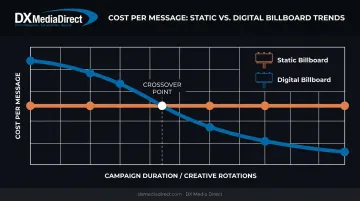
| Cost-per-message trend | Stays fixed regardless of rotation | Drops the more you rotate messages |
Running one long campaign for six months usually favors static, since its fixed cost undercuts digital's base rate over that stretch. Weekly offer testing flips that math, though, since digital's flexibility pays for itself fast. DX Media Direct's media buyers can model both scenarios against your campaign calendar, so you're not guessing which format saves more.
How to Budget Smart and Avoid Overspending on Billboards
The "right" cost balances traffic quality, format, and what your campaign actually needs to accomplish, not simply the lowest price.
Before signing anything:
- Calculate CPM on every quote, not just the sticker price
- Request traffic and impression data plus sightline photos for the exact board
- Compare renewal rates, not just the introductory offer
Common mistakes that blow budgets:
- Underbudgeting for production and installation
- Booking a premium spectacular when a standard bulletin would do the job
- Signing without checking what renewal pricing looks like after month one
These same budgeting traps compound quickly once outdoor is just one piece of a bigger media plan that also includes TV, radio, or streaming.
DX Media Direct has spent 35 years negotiating direct-response media rates and building relationships across networks and outdoor operators, access that self-service booking portals and programmatic platforms can't replicate. A free, no-obligation consultation can help you build a realistic, multi-channel budget instead of guessing at a single board's price in isolation.
Frequently Asked Questions
What is the average cost of a billboard ad?
There's no single published national average, but a static board's 4-week rental typically runs anywhere from a few hundred dollars in rural areas to several thousand in midsize cities. Digital rotations and premium metro placements push the range much higher.
How much is a 30-second ad in Times Square?
Operators price Times Square boards by rotation slot or duration commitment, not by the second. A shared digital slot costs far less than buying out a full spectacular for exclusive use.
Are billboards worth the money?
According to a 2023 OAAA/Morning Consult study, 69% of adults noticed a billboard in the past 30 days, and 60% saw one in the past week. Visibility isn't the issue — ROI depends on placement quality and whether you track results using promo codes or a vanity URL.
How much does it cost to rent a billboard for one month?
Expect roughly $250–$1,500 in rural markets, $1,000–$6,000 in midsize cities, and $5,000–$25,000 or more in major metros for a standard 4-week flight.
What's the cheapest way to advertise on a billboard?
Look at rural static boards, remnant or off-peak inventory that operators discount to fill unsold space, and multi-month bundles that lower your per-cycle rate.
Can I negotiate billboard pricing?
Yes, especially for long-term contracts or multiple boards. Working with an experienced media negotiator often secures better rates and placement quality than booking solo through a self-service platform.