Radio's ROI reputation gets debated constantly in theory. In practice, its value only shows up when campaigns are measured, structured, and tested properly, the same way you'd hold any other channel accountable.
This article breaks down how radio ROI actually gets calculated, what makes it competitive with (or ahead of) TV and digital, and how to get more out of every dollar spent going forward.
Key Takeaways
- Radio ROI is measurable with formulas like ROAS and CPA, not just reach and frequency
- Low CPM is one of the biggest structural drivers behind radio's strong returns
- Trust and recall from radio's live, local format convert listeners into buyers faster
- Layering radio into a broader TV/digital mix often lifts total campaign ROI
- Clear goals, consistent frequency, and attribution from day one speed up ROI
What Is Radio Advertising ROI (and How Is It Calculated)
Radio ROI measures the financial or behavioral return generated by ad spend, not the size of the audience that heard it. It's the gap between "how many people did this reach" and "how many people actually did something because of it."
ROI gets evaluated two ways:
- Campaign level: a single station or flight, measured against its own spend and results
- Plan level: a full multi-market schedule, measured in aggregate across stations and dayparts
ROAS and CPA, Defined
ROAS (Return on Ad Spend) = Revenue Attributable to Radio Ads / Total Radio Ad Spend
According to Nielsen's sales effect study, returns range from $3 for every dollar spent in quick-service restaurants to $17 for department stores. That spread is wide enough that category context matters more than any single "good ROAS" number you'll see quoted online.
CPA (Cost Per Acquisition) = Total Ad Spend / Number of Attributed Actions
Actual CPA ranges vary too much by category, market size, and offer to trust a universal benchmark. Treat any source claiming a fixed CPA range for radio with caution. The honest answer is that it depends on your specific business.
ROI vs. Reach, Frequency, and Cume
Reach, frequency, and cume describe how many people were exposed to a message and how often. They're audience metrics, useful for planning a buy.
ROI describes what happened as a result: revenue, calls, leads, foot traffic. Awareness numbers justify the media plan; ROI justifies the renewal. You need both, but only one shows up in the profit column.
How Attribution Actually Works
Radio can't attach a pixel to a listener the way display ads can, but it isn't a black box. Standard attribution tools make ROI measurable in practice:
- Dedicated call-tracking numbers per station or flight
- Unique promo codes or dedicated landing pages
- Web traffic lift tracking timed around air times
- Foot traffic attribution for retail and local locations
These tools turn "we think radio worked" into a documented number you can compare from one campaign to the next.
Key Advantages of Radio Advertising That Drive Strong ROI
These advantages tie to concrete, trackable outcomes, cost, conversion, and total campaign lift, rather than abstract brand-building claims.
Cost-Efficient Reach at Scale
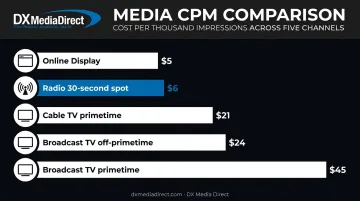
Radio's cost-per-thousand-listeners stays low compared to broadcast TV. Per Solomon Partners' June 2025 media CPM comparison:
| Medium | CPM |
|---|---|
| Radio (30-second spot) | $6 |
| Cable TV, primetime | $21 |
| Broadcast TV, off-primetime | $24 |
| Broadcast TV, primetime | $45 |
| Online display | $5 |
Radio isn't the cheapest impression on this list (online display edges it out), but it beats every TV tier by a wide margin. Lower cost-per-impression pulls down blended CPA directly, which matters most for budget-constrained or local advertisers trying to compete against bigger-spending national brands.
KPIs it moves: CPM, blended CPA, impressions-per-dollar.
High Trust and Recall That Convert
Radio's live, local, personality-driven format builds a kind of listener trust other channels struggle to replicate. That trust shows up strongest through the recency effect, when ads air close to a decision moment.
Nielsen's Radio (Re)Discovered study found that a spot heard within 90 minutes of a televised sporting event raised tune-in conversion among exposed men from 27% to 53%. That's a tune-in example, not a purchase, but it illustrates the mechanism: proximity to a decision moment lowers a listener's response threshold. More people act per exposure. ROAS improves as a result.
KPIs it moves: recall, response rate, ROAS. Where it matters most: time-sensitive offers, event promotion, sales-driven campaigns.
Multiplier Effect in a Multi-Channel Mix
Radio's biggest ROI advantage often comes from its effect on the entire media plan, not just its standalone performance.
Marketing-mix modeling across national and local campaigns often ranks broadcast radio as a strong contributor to blended ROI once it carries enough weight in the plan to register its effect. Adding radio to a TV or digital-heavy mix tends to raise total reach and frequency without a proportional cost increase, up to a point, before returns level off.
At DX Media Direct, radio gets layered into TV and digital plans for this exact reason: it's evaluated on what it contributes to the whole account, not just its own line item. Channels get reviewed weekly, so an underperforming radio buy gets caught and adjusted before it drags down the blended number.
KPIs it moves: total campaign ROI, blended reach, cross-channel CPA.
What Happens When Radio ROI Isn't Tracked or Optimized
Campaigns launched without defined goals or attribution can't be evaluated, only guessed at. That guesswork gets expensive fast.
Three specific problems show up when tracking is missing:
- No benchmark, no improvement. Without a documented baseline, there's nothing to measure the next flight against, so the same mistakes repeat.
- Budget follows attribution ease, not actual return. Digital's easier tracking pulls dollars away from radio even when radio's real returns are competitive or stronger. Attribution difficulty and performance are two different things.
- Diagnosis becomes impossible. Weak results could mean the wrong stations, the wrong dayparts, or weak creative. Without structured tracking, nobody can tell which, so the fix gets applied to the wrong problem, over and over.
Untracked radio often gets blamed for poor performance when the real issue is a lack of measurement. That's a different problem, and it demands a different fix.
How to Maximize the ROI of Your Radio Advertising
Getting strong returns from radio isn't about luck or budget size. It comes down to structure.
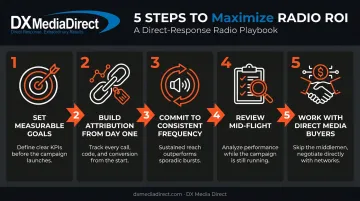
- Set measurable goals before launch. Tie targets to a real business outcome such as calls, site visits, or promo code redemptions, not a vague awareness number.
- Build attribution in from day one. Dedicated tracking numbers, promo codes or landing pages, and a documented baseline let you measure against a real benchmark instead of estimating after the fact.
- Commit to consistent frequency. Repetition over time compounds recall and conversion. Radio Advertising Bureau planning guidance points to roughly three exposures within a purchase cycle over four to eight weeks as a reasonable target, with adjustments by message and category.
- Review results mid-flight, not just after. Weekly or biweekly check-ins catch an underperforming station or daypart while there's still time to fix it, instead of finding out after the budget's spent.
- Work with media buyers who negotiate directly. DX Media Direct runs structured 90-day test flights and negotiates directly with network reps instead of relying on portal-based insertion orders. That combination produces a repeatable ROI playbook, separates a media-mix problem from a creative one, and secures rates automated platforms structurally can't match.
None of this requires a massive budget. It requires a plan, a way to measure it, and someone reviewing the results.