Introduction
Businesses will pour more than $1.14 trillion into advertising in 2025 alone, according to WPP Media. Yet ask ten marketers what "media buying" actually means, and most will describe boosting a Facebook post or launching a Google Ads campaign.
That's not media buying. It's a fraction of it.
Programmatic platforms have made buying feel like something anyone can do from a laptop: no phone calls, no negotiation, just a dashboard and a credit card. The catch? Self-serve platforms often leave advertisers with less visibility into where their money actually goes, weaker effective rates, and campaign data too thin to act on with confidence.
This guide breaks down what media buying really is and walks through the buying process step by step. It also explains why the strategy you choose, direct or programmatic, can determine your entire return on ad spend.
Key Takeaways
- Media buying means purchasing ad space or airtime across TV, streaming, radio, and digital channels
- Planning sets the strategy; buying executes it through negotiation and placement
- Direct buying and programmatic buying serve different goals, budgets, and levels of transparency
- Strong media buying blends audience research, rate negotiation, and constant performance tracking
What Is Media Buying?
Media buying is the strategic purchase of advertising space and time — TV spots, radio slots, streaming pre-rolls, billboard faces, print pages — so a brand's message lands in front of the right audience at the right moment. It sounds simple. It isn't.
A buyer's job is securing that placement at the most efficient cost possible, because every dollar saved on media is a dollar that can fund more reach, more frequency, or more profit. That link between placement cost and campaign profitability is the entire reason media buying exists as its own discipline.
Core responsibilities of a media buyer include:
- Researching outlets and networks that match target audience data
- Negotiating rates and terms with vendors or network representatives
- Managing budgets across channels, markets, and dayparts
- Tracking performance and reallocating spend mid-campaign
This isn't a minor line item. Paid media now consumes 30.6% of the average marketing budget, according to Gartner's 2025 CMO Spend Survey. Get the buying wrong, and nearly a third of the marketing budget underperforms.
Media Buying vs. Media Planning
Media planning is the strategy phase: audience research, setting objectives, choosing channels, allocating budget across them. Media buying is what happens next, the tactical execution of negotiating, placing, and optimizing.
In smaller shops, one person often handles both. That works fine for simple campaigns. But for direct-response work, especially TV, the buying side (negotiated rate, daypart selection, network access) frequently swings cost-efficiency more than the plan itself. A great plan executed with weak negotiation still bleeds budget. A national furniture retailer, for instance, ran the same 90-day TV test through two different buyers: the negotiated version cost 40% less for an identical spot count.
Why Media Buying Directly Impacts Profitability
Every decision made during the buying phase (which network, which daypart, what rate) feeds directly into cost per acquisition. Two advertisers can run identical creative to an identical audience and land wildly different results, based purely on what they paid for the media.
Consider the math: rate-card pricing means paying full market price. Negotiated remnant inventory, unsold slots networks need to move before airtime, typically comes in 75% to 90% below rate card. A $500,000 budget at rate-card price buys $500,000 in airtime. The same $500,000 negotiated at remnant rates can secure $2 million to $5 million in equivalent airtime value.
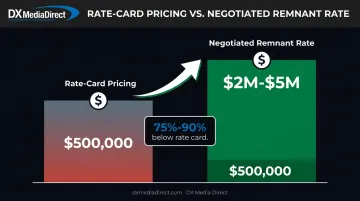
That's the difference between a campaign that breaks even and one that returns 4:1, before the creative even changes.
Types of Media Buying: Direct vs. Programmatic
Advertisers generally choose between two buying models, and the choice shapes everything downstream: rates, transparency, and how quickly you can act on results.
Direct Buying
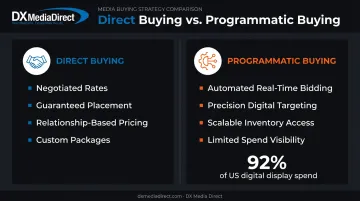
Direct buying means a media buyer negotiates space or airtime directly with a publisher, station, or network sales representative. No auction, no bidding war, just a conversation and a deal. This opens up:
- Custom packages built around specific budgets and goals
- Guaranteed placement instead of "maybe" impressions
- Relationship-based pricing that tends to improve the longer a buyer works with a given rep
In practice, that tenure can translate into rates 15-20% below published card prices, savings an algorithm has no way to negotiate.
Programmatic Buying
Programmatic buying automates the entire process. Demand-side platforms connect to supply-side platforms and ad exchanges, bidding on inventory in real time, often in the milliseconds it takes a webpage to load. It's built for scale and precision targeting.
Programmatic now accounts for roughly 92% of US digital display ad spend, per eMarketer. But scale comes with a tradeoff: advertisers often can't see exactly where their money went, which sites, which fees along the way, earning programmatic the nickname "black box" among media buyers.
That opacity is exactly where direct relationships still have an edge. Relationship-based negotiation gives experienced buyers access to preferential inventory and rates that automated, portal-based systems are structurally unable to offer. When a station has unsold Tuesday-morning slots that need to move by Thursday, a rep's direct call to a buyer creates a deal no algorithm can find on its own.
This shows up most clearly in direct-response TV testing. A 90-day DRTV test built on direct buying relationships tends to produce clearer, more actionable performance data than programmatic attribution, which is often muddled by walled gardens and multi-touch models. Tracking response network by network, daypart by daypart, against a known negotiated rate tells you exactly what worked.
This is the advantage that 35 years of network relationships buys you. DX Media Direct has built pattern recognition across dayparts, networks, and product categories over thousands of executed campaigns, the kind of institutional knowledge no self-serve dashboard can replicate.
The Media Buying Process: Step-by-Step
Buying media follows a defined sequence, and skipping steps is usually where budgets go to waste.
- Review the media plan - Understand campaign goals, target audience, timeline, and total budget before making any buying decision.
- Research the market - Compare outlets, dayparts, and audience data to shortlist the networks or platforms that actually fit the campaign.
- Negotiate and finalize - Lock in rates and inventory for direct buys, or set targeting and bidding parameters for programmatic buys. Either way, an insertion order confirms placement and pricing before anything airs.
- Launch the campaign - Coordinate creative delivery and tracking setup so results can be measured from day one, not week three.
- Monitor performance in real time - Watch impressions, response rates, and cost per acquisition closely, then shift spend away from placements that aren't pulling their weight.
- Reconcile and report - Match actual spend against budget, document results, and turn that data into a playbook rather than filing it away as a one-off test.
Buyers who treat each campaign as a standalone bet miss the bigger opportunity: every buy generates data that makes the next one sharper.
Key Media Buying Terms to Know
Vendors love rate cards. Buyers who know the vocabulary negotiate from strength instead of taking the first number offered.
| Term | What It Means |
|---|---|
| CPM | Cost per thousand impressions delivered |
| CPP | Cost per rating point, common in TV/radio buys |
| Reach | The number of unique people an ad reaches |
| Impressions | The total number of times an ad is displayed, including repeat views to the same person |
| Dayparting | Scheduling ads for specific times of day to hit target audiences |
| Avails | Available ad slots or inventory a network is offering |
| Insertion Order (IO) | The formal document confirming placement details and pricing |
Understanding these terms turns a vendor proposal from a black box into something you can evaluate line by line, and negotiate against.
Why Partner With an Experienced Media Buying Agency
DIY media buying, especially through self-serve programmatic platforms, often leads to wasted spend. Without negotiation leverage or years of pattern recognition, advertisers pay closer to rate card and miss the inventory that never shows up on a public dashboard.
DX Media Direct is a full-service, direct-response advertising agency with over 35 years of experience executing thousands of campaigns across TV, CTV, radio, outdoor, digital, and podcast channels. The approach relies on relationship-based media negotiation with network representatives, securing rates and inventory access that portal-based insertion orders can't match.
That experience also means diagnosing why a campaign underperforms. The root cause could be:
- The wrong network for the target audience
- A mismatched daypart or time slot
- An audience segment misaligned with the offer
- Weak creative that fails to convert, even with the right media mix
Fixing the wrong variable wastes another budget cycle. Businesses wanting to test a direct-response TV strategy with measurable, trackable revenue results can start with a free, no-obligation consultation.
Frequently Asked Questions
What is an example of a media buying strategy?
A direct-response brand might negotiate specific cable dayparts to test an offer before scaling nationally, while a retailer uses programmatic display to retarget past site visitors. Both are media buying, just executed through different models.
What are the 5 M's of media buying strategy?
The 5 M's are Mission, Money, Message, Media, and Measurement. Together they define why you're advertising, what you can spend, what you're saying, where it runs, and how you'll know if it worked.
What's the difference between media buying and media planning?
Planning defines the strategy, who you're targeting, where, and when. Buying executes that strategy by negotiating and purchasing the actual placements.
Is programmatic or direct media buying better?
It depends on the goal. Programmatic suits scale and precision digital targeting, while direct buying suits negotiated rates, niche audiences, and TV or direct-response campaigns.
How much does media buying typically cost?
Costs vary widely by channel, daypart, and negotiation leverage. Experienced buyers with strong network relationships can secure rates 75% to 90% below standard rate-card pricing.
What skills does a media buyer need?
Strong media buyers combine negotiation, audience research, budget management, and performance analysis, plus the pattern recognition that only comes from running many campaigns over time.