Many advertisers write off broadcast TV as outdated or assume it's priced out of reach for anyone without a national brand budget. That assumption costs businesses real opportunities. Broadcast rates vary wildly by daypart, market, and negotiation skill, meaning a strategically bought campaign can outperform far pricier digital alternatives.
This guide breaks down what broadcast advertising actually means in 2026, the formats available, what it costs, and how savvy media buyers still generate measurable returns from a channel plenty of people have prematurely buried.
Key Takeaways
- Broadcast still reaches mass audiences via national networks and 210+ local DMAs.
- Rates vary by daypart and market; premium sports spots can top $1 million per 30 seconds.
- Unique numbers, promo codes, and URLs make broadcast ROI measurable, not just brand awareness.
- FCC rules govern content decency and political access; FTC/FDA regulate product claims separately.
- Blending broadcast reach with streaming precision outperforms picking one channel alone.
What Is Broadcast Advertising?
Broadcast advertising is a paid commercial message delivered over the airwaves through television and radio networks like ABC, CBS, NBC, and FOX during scheduled programming breaks. It's distinct from cable, streaming, and digital ads: broadcast signals travel free to anyone with an antenna or a local affiliate feed, no subscription required.
The format has been around since July 1, 1941, when Bulova Watch Co. aired the first legal TV commercial on New York's WNBT before a Brooklyn Dodgers game. The airtime reportedly cost $9.
Broadcast has since adapted through color television, the cable era, and streaming's rise. The core model, networks and affiliates selling scheduled ad time, hasn't changed.
How Broadcast Advertising Works
Broadcast inventory splits into two distinct buying tracks:
- National distribution: Networks sell primetime and national slots, so every viewer nationwide sees the same ad (think NFL Sunday Night Football or a network drama premiere).
- Local distribution: Regional affiliate stations sell inventory tied to local news, weather, and community events. Nielsen tracks 210 Designated Market Areas (DMAs) across the U.S., so real local rollouts mean planning market by market.
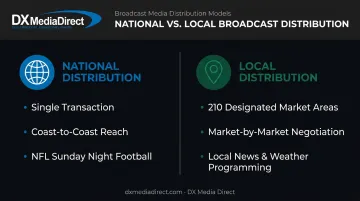
A national spot for a brand running during Thursday Night Football reaches viewers coast to coast in one transaction. Rolling that same campaign into just the top 25 DMAs means negotiating with dozens of individual affiliate stations, each with its own rate card and programming quirks.
Beyond how inventory is bought, the ad units themselves follow familiar conventions. Spot lengths remain standardized at 15, 30, and 60 seconds, with 15-second spots now the most common length aired, according to Nielsen research.
There's no blanket federal rule dictating commercial break length for general adult programming. The FCC only sets hard limits for children's programming, capping commercial time at 10.5 minutes per hour on weekends and 12 minutes per hour on weekdays.
Types of Broadcast Advertising in 2026
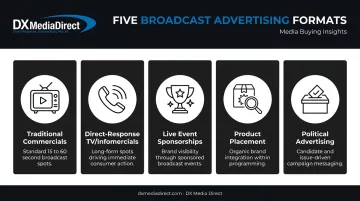
Broadcast advertising isn't just the standard 30-second spot anymore. Five formats dominate networks and local affiliates today, each suited to different goals.
Traditional commercials. Standard 15, 30, or 60-second ads running during scheduled breaks remain the backbone of broadcast buying, built for reach and repetition across broad audiences.
Direct-response TV (DRTV) and infomercials. These longer-form ads, ranging from a few minutes to full 30-minute infomercials, are built around a specific call-to-action rather than pure brand awareness. A DRTV spot asks viewers to act immediately: call a number, visit a URL, or scan a QR code.
Agencies that specialize in direct response, like DX Media Direct, build these campaigns around trackable mechanisms from day one. Every dollar spent on air can then be tied to a lead or sale downstream.
Live event sponsorships. Sports broadcasts and award shows offer brand integration beyond a standard commercial break, from sponsored segments to on-screen graphics. Live audiences skip ads far less than time-shifted viewers, making these placements valuable. That captive attention comes at a price, though: premium live-event inventory routinely commands the highest rates on the broadcast rate card.
Product placement. Rather than interrupting a show, this format weaves a brand organically into the storyline, a character drinking a specific soda or driving a specific truck. It sidesteps ad-skipping entirely because it's part of the content, not a break from it.
Political advertising. Candidate and issue-based ads operate under a different rulebook than commercial advertising. Two FCC rules set political spots apart:
- Equal opportunity access: Stations must give legally qualified federal candidates reasonable airtime access, and opposing candidates can request equal opportunities, generally within seven days.
- Lowest unit charge: During the 45 days before a primary and 60 days before a general election, candidates qualify for a station's lowest unit rate, a rate protection commercial advertisers don't get.
Broadcast Advertising Costs, Media Buying & Regulations in 2026
Broadcast rates don't follow a single price list. Four factors drive what you'll pay for a spot:
- Daypart: Primetime and live sports command premium pricing; overnight and daytime slots cost far less.
- Program popularity: A top-rated show delivers more eyeballs per dollar, and stations price accordingly.
- National vs. local buy: National placements reach the whole country in one transaction; local buys price market by market.
- Audience size and composition: Advertisers targeting a specific demographic pay more for programming that over-indexes with that audience.
At the extreme end, a 30-second spot during NBC's Sunday Night Football averaged $1,008,746 for the 2024-25 season, up 14% from the year before. Most local and regional buys run nowhere near that, but the example shows how far the range stretches.
Regulatory Oversight: More Than Just the FCC
The FCC governs broadcast licensing, content decency, and political ad access. Indecent material can't air between 6 a.m. and 10 p.m., and children's programming caps commercial time at 10.5 to 12 minutes per hour. But the FCC doesn't approve every ad claim.
- Pharmaceutical ads fall under FDA rules requiring the major statement to be presented clearly and neutrally.
- Financial and credit ads can trigger FTC, CFPB, SEC, or FINRA review depending on the product.
- Networks run their own vetting, too. ABC and NBCUniversal both maintain Standards and Practices teams that clear ad creative before it airs, separate from any government requirement.
Buying Broadcast Media: Negotiation vs. Self-Serve Portals
Traditional broadcast buying means negotiating directly with network or station sales reps for rates, avails, and added value like bonus spots. Self-serve, portal-based insertion orders offer fixed or auction-based pricing with no room to negotiate. Agencies with established network relationships, such as DX Media Direct, negotiate rates and bonus inventory that self-serve platforms are structurally unable to offer.
That negotiation dynamic gets more complex at scale: a national buy might be a single transaction, but rolling the same campaign across the top 25 DMAs can mean managing dozens, sometimes hundreds, of individual station relationships, each with different avails and rate cards.
Measuring Results: GRPs vs. Direct-Response Tracking
Traditional measurement relies on reach, frequency, and gross rating points (GRPs), useful for gauging awareness but not attribution. Direct-response advertisers instead assign unique phone numbers, promo codes, or dedicated landing page URLs to specific air times, tying revenue directly back to when and where a spot ran.
Advantages of Broadcast Advertising
Three strengths keep broadcast relevant even as viewing habits fragment.
Mass reach and trust. Broadcast still delivers large, diverse audiences in a single buy, and it benefits from a halo effect, borrowed credibility from association with trusted local news and network programming.
In a 2025 TVB study of over 3,100 respondents conducted with GfK/NIQ, 95% said access to local news on their TV station was important. Notably, 72% said they'd seek another provider if their local stations were dropped.
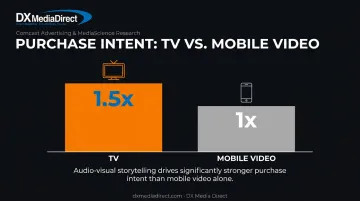
Audio-visual storytelling. Sight, sound, and motion working together drive stronger recall than static formats. Comcast Advertising and MediaScience found TV generated nearly 1.5 times the purchase intent of mobile video in a controlled study, evidence that the combined format still moves people.
Cost-effectiveness when bought strategically. Rate cards vary enormously by daypart and market. A skilled negotiator can secure premium exposure, sports adjacencies, high-rated local news, at a fraction of published rate-card pricing.
Remnant inventory, unsold slots discounted as air dates approach, adds another lever. Agencies with established network relationships, like DX Media Direct, access those discounts routinely, while a self-serve advertiser typically never sees them.
Broadcast vs. Streaming/CTV Advertising in 2026
Viewing habits have shifted, but not as dramatically as headlines suggest. In May 2025, Nielsen's Gauge measured streaming at 44.8% of total TV use, compared to 20.1% for broadcast and 24.1% for cable. Streaming has pulled ahead in overall share, but broadcast still commands a meaningful slice of total consumption, especially around live sports and appointment programming.
The bigger difference comes down to precision:
| Broadcast | Streaming/CTV | |
|---|---|---|
| Targeting | Broad demographic and daypart | Granular audience-level targeting |
| Measurement | Reach, frequency, GRPs | Real-time impression-level analytics |
| Best for | Mass awareness, live-event context | Precision targeting, retargeting |
| Buying model | Negotiated rates, avails | Auction-based, self-serve or managed |
Broadcast wins when a brand needs to reach a large, diverse audience fast, especially during a live event where skipping is minimal. Streaming wins when a brand needs a narrowly defined audience segment with granular reporting.
The most effective 2026 media plans don't pick one over the other. Agencies like DX Media Direct build these blended strategies by pairing negotiated broadcast rates for scale with CTV retargeting layers for viewers who've cut the cord entirely. That combination also hedges against measurement gaps: GRPs estimate who was likely exposed, while streaming's impression data confirms it.
Why Media Buying Experience Matters More Than Ever
Programmatic and self-serve platforms are structurally limited to rate-card and auction-based pricing. They can't call a network rep and negotiate a bonus spot, and they don't carry decades of relationship equity. Agencies with long-standing network relationships can access preferential rates and inventory that never show up in a portal.
That's the gap DX Media Direct closes. Rather than relying on inconclusive self-serve data, the agency runs structured 90-day TV tests before scaling spend further. The goal: a clear, scalable media playbook, a repeatable plan for which networks, dayparts, and formats actually move the needle for a specific product category.
Thirty-five-plus years of pattern recognition across dayparts, networks, and product categories also means DX Media Direct can diagnose why a campaign underperforms:
| Buyer Type | When a Campaign Underperforms |
|---|---|
| Self-serve buyer | Limited levers: adjust bid, adjust targeting, or wait |
| Experienced buyer | Isolates whether the issue is media placement, creative execution, or both, then fixes each side accordingly rather than guessing |
That distinction matters. Fixing the wrong problem wastes another testing cycle and another chunk of budget. Beyond diagnosing performance issues, the agency's volume relationships open access to remnant inventory, discounted unsold slots that can stretch a modest budget across premium dayparts otherwise out of reach.

For businesses trying to figure out whether broadcast fits their direct-response goals, DX Media Direct offers a free, no-obligation consultation to walk through the options before committing any budget to air.
Frequently Asked Questions
What is a broadcast advertisement?
A broadcast advertisement is a paid audio or visual commercial aired on television or radio networks during scheduled programming, designed to promote a product, service, or idea to a broad audience.
What are the 4 types of broadcasting?
The main mediums are terrestrial/over-the-air TV, radio, cable, and satellite. OTA and radio transmit free signals, cable distributes via wired systems, and satellite reaches subscribers nationally through a receiving dish.
How much does broadcast TV advertising cost?
Cost depends on daypart, program popularity, and whether you're buying local or national inventory. Prime-time slots and major live sports command the highest rates, sometimes exceeding $1 million for a single 30-second spot.
Is broadcast advertising still effective in 2026?
Yes. Broadcast still delivers strong reach, borrowed trust from local news and network programming, and measurable purchase influence. This holds especially true when it's paired with direct-response tracking and strategic buying rather than rate-card pricing.
What's the difference between broadcast and cable advertising?
Broadcast airs over-the-air through networks and local affiliates, reaching anyone with an antenna for free. Cable is distributed via subscription and typically offers more narrowly targeted programming genres for advertisers.
How do I measure ROI on a broadcast advertising campaign?
Tools like unique phone numbers, promo codes, and dedicated landing page URLs let advertisers connect specific air times to calls, leads, and sales. This turns a broadcast spot into a measurable revenue driver.