High recall doesn't automatically translate into revenue you can point to, though. Many businesses spend thousands of dollars on billboards or transit wraps without a clear sense of what format fits their budget, what a fair price looks like, or how to measure whether the campaign actually moved sales.
This guide breaks down what outdoor advertising is, the formats and price factors you'll run into, and how OOH stacks up against direct-response channels built for measurable results.
Key Takeaways
- Outdoor advertising (OOH) spans billboards, transit ads, and digital public displays.
- OOH can't be skipped or muted, so repeated exposure builds lasting brand recall.
- Pricing varies widely by location, media type, and production quality; there's no flat rate.
- Compare OOH to direct-response TV if you need trackable, measurable revenue attribution.
What Is Outdoor Advertising?
Outdoor advertising, often shortened to out-of-home or OOH, is any promotional message placed in public spaces to reach people while they're moving through the world, not sitting at home in front of a screen. The acronym covers a wide range of formats: billboards, transit ads, street furniture, and digital screens in malls, airports, and city centers.
Unlike TV or digital ads that follow individual viewers, OOH follows locations and traffic patterns. It's built to catch attention during commutes, errands, and everyday movement through a city or neighborhood.
A Brief History of Outdoor Advertising
Outdoor advertising isn't new. Egyptians carved public notices into stone obelisks to announce laws and treaties. The format has evolved steadily since then, according to the Out of Home Advertising Association of America's (OAAA) history of the industry:
- Gutenberg's movable type (1450) and lithography (1796) made printed posters possible.
- The U.S. standardized the modern billboard structure in 1900.
- Two predecessor associations merged to form OAAA in 1925.
- The Highway Beautification Act (1965) introduced federal controls on roadside signage.
- The first digital billboards appeared in 2005, kicking off the shift toward digital out-of-home (DOOH) advertising.
That last shift, from printed vinyl to programmable screens, is the biggest change the medium has seen in a century.
Why Outdoor Advertising Still Works in a Digital World
Ad blockers, mute buttons, and the skip-ad countdown don't exist for a billboard on the interstate. That's a structural advantage digital channels simply can't replicate.
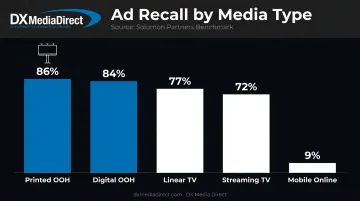
A 2022 Solomon Partners benchmark cited by OAAA aggregated ad-recall studies across media types and found:
- Printed OOH: 86% recall
- Digital OOH: 84% recall
- Linear TV: 77% recall
- Streaming TV: 72% recall
- Mobile online: 9% recall
These are aggregated estimates, not a guarantee for every campaign, but the gap is wide enough to matter. Commuters on the same route see the same billboard dozens of times a month. That repetition builds brand memorability even when no one clicks anything, which is exactly why national brands still buy highway boards alongside performance-driven digital campaigns.
Types of Outdoor Advertising
Outdoor advertising isn't just billboards. The category runs from static highway signs to unconventional installations built for social sharing. Six formats show up most often:
- Billboards: Static vinyl boards stay in place for weeks or months, while digital billboards rotate multiple advertisers' creative every few seconds on the same screen. Both dominate highways and high-traffic corridors.
- Transit advertising: Wraps on buses, trains, and taxis, plus posters inside shelters, reach commuters who are literally stuck looking at them. Works especially well in dense urban markets.
- Street furniture advertising: Bus stop panels, benches, and kiosks put your message at eye level in pedestrian-heavy areas, ideal for local businesses chasing walk-in traffic.
- Digital Out-of-Home (DOOH): Screens that display dynamic, often data-triggered content and can be bought programmatically, similar to digital display ads online. The IAB defines DOOH as digital media that delivers dynamic or interactive advertising outside the home.
- Guerrilla and experiential advertising: Unconventional installations, projections, and pop-up displays designed to get people talking and sharing on social media rather than blending into the background.
- Vehicle wraps and mobile billboards: Branded wraps on company vehicles or dedicated mobile billboard trucks carry your message directly into neighborhoods, events, or areas without fixed ad inventory.
Most campaigns don't rely on just one format. A retail brand, for example, might pair static highway boards for reach with street furniture near its storefronts for local walk-in traffic.
How Much Does Outdoor Advertising Cost?
There's no universal price tag for outdoor advertising. What you pay depends on where the ad sits, what it's printed or displayed on, and how long you keep it up.
What Drives the Price
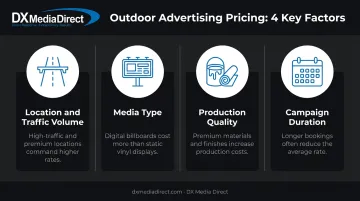
- Location and traffic volume: A highway billboard with 100,000 daily vehicle passes costs far more than a similar board on a rural two-lane road, and major interchange spots command the highest rates in the country.
- Media type: Static billboards, city lights, and digital or LED screens all carry different cost structures, with digital boards costing more upfront but letting several advertisers rotate content on one screen.
- Production quality: Weatherproof vinyl and durable mounting hardware raise the upfront bill but hold up through a full campaign without fading.
- Campaign duration: Short-term placements (a few weeks) cost more per week than long-term contracts running six to twelve months, which lock in lower monthly rates.
The Bigger Picture
These variables explain why two boards a few miles apart can carry very different price tags. Zooming out, the broader market shows where OOH spending is headed: U.S. out-of-home advertising revenue hit a record $9.46 billion in 2025, up 3.6% year over year, with digital OOH now accounting for more than a third of total spend. That growth signals two things: advertisers keep finding room in their budgets for OOH, and digital formats are absorbing a growing share of it.
There's no single "average billboard price" that applies nationwide. A location's audience delivery and asking rate vary too much from market to market to publish a reliable benchmark. Agencies with direct relationships with media owners, like DX Media Direct, can often secure rates below what's listed on a published rate card. Get quotes for your specific corridor before locking in a budget.
Outdoor Advertising vs. Direct-Response Advertising: Which Fits Your Goals?
Billboards are excellent at making a brand feel familiar. What they're not built for is a direct line from impression to sale.
Traditional OOH runs on exposure and frequency. You're paying for eyeballs on a highway or transit platform, and the payoff shows up as brand awareness, not a coded response you can trace to a purchase.
Even OAAA's own research reflects this limit. A 2024 Harris Poll cited by OAAA found that 76% of recent digital OOH viewers took some action, such as searching online or visiting a store, after seeing an ad. That's a meaningful survey-reported result, but it's not the same as a uniquely tracked lead or sale.
Direct-response advertising, including direct-response TV (DRTV), is built the opposite way. Every creative includes a specific call to action, a phone number, promo code, or URL, so you can trace a dollar spent to a dollar earned.
A well-structured DRTV campaign tracks response by network, daypart, and even specific airing, giving you a level of attribution traditional billboards can't match.
Blending Both Channels
Plenty of brands run both at once:
- OOH for broad visibility across a target market or neighborhood
- Direct-response TV or digital for conversions you can put in a spreadsheet
- Sequential campaigns that pair an outdoor impression with a trackable digital or DRTV follow-up
Figuring out the right mix for your budget is exactly the kind of question DX Media Direct fields regularly. With 35 years of direct-response media buying experience, our team helps businesses decide where OOH fits alongside trackable channels like DRTV.
We offer a free, no-obligation consultation to walk through the options for your specific goals.
Legal Considerations for Outdoor Advertising Campaigns
Outdoor advertising doesn't get a free pass just because you've paid for the space. It's regulated at multiple levels simultaneously.
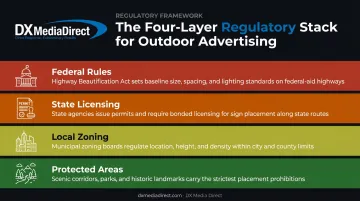
- Federal rules: The Highway Beautification Act controls signs within 660 feet of interstates and federal-aid highways, limiting new signage along covered routes to specific categories like directional and on-premise signs.
- State licensing: Most states require a separate outdoor-advertising license and a permit for each individual display, plus proof of property-owner consent.
- Local zoning: Cities regulate sign size, lighting, and spacing, and many require additional building permits before installation.
- Protected areas: Scenic highways and historic districts often carry extra restrictions or outright bans on new signage. Safety and content standards also prohibit hazardous or offensive material.
Skipping any of these steps risks fines or a forced teardown after you've already paid for production and placement. Before locking in a location, check with your local planning department or transportation agency. Requirements vary enough by city and state that assumptions from one market rarely hold up in another.
Frequently Asked Questions
What is outdoor advertising?
Outdoor advertising, or OOH, is any promotional message displayed in public spaces to reach broad, on-the-go audiences. Common formats include billboards, transit ads, street furniture, and digital screens.
How much does outdoor advertising cost?
Costs vary based on location, traffic volume, media type, and production quality; there's no fixed price point. A rural static billboard and a digital screen in a major city land in very different price ranges.
What are the main types of outdoor advertising?
The main formats are billboards, transit advertising, street furniture, digital out-of-home (DOOH), and guerrilla or experiential installations. Vehicle wraps and mobile billboards round out the category.
Is outdoor advertising still effective compared to digital ads?
Yes. OOH ads can't be blocked, skipped, or muted, and multiple industry studies show OOH consistently outperforming TV, radio, and online formats for ad recall.
What's the difference between outdoor advertising and DOOH?
DOOH is the digital, screen-based subset of outdoor advertising. It covers dynamic or programmatically bought screens, while traditional OOH also includes static formats like printed billboards and posters.
How can businesses measure the ROI of an outdoor campaign?
OOH ROI is harder to track directly and is often measured through brand lift or recall studies. Direct-response channels like TV offer clearer, revenue-based attribution when measurable results are the priority.