Introduction
Audio advertising is splitting into two distinct lanes in 2026, each built for a different job. Radio still reaches 87% of U.S. adults every week, or roughly 225 million people, according to Radio Advertising Bureau data citing Nielsen. Podcasts, meanwhile, have built a multibillion-dollar ad category, with over half of Americans tuning in monthly, according to Edison Research's Infinite Dial report.
Marketers are asking a sharper question this year: which channel actually converts?
That question comes down to budget pressure: digital CPMs keep climbing, budgets are stretched thinner, and finance teams want cost-per-acquisition numbers, not just impressions. Radio and podcasts sit at opposite ends of the audio spectrum. One is built for mass reach, the other for niche precision.
This guide breaks down real cost structures, audience data, and use cases for each. Then it shows how a disciplined test-and-measure approach can turn audio spend into trackable revenue instead of a guessing game.
Key Takeaways
- Radio wins on sheer weekly reach across every age group and income bracket.
- Podcasts win on niche targeting, listener trust, and built-in trackability.
- Podcast CPMs run $12-$26 depending on format; radio needs a market-specific quote.
- A blended radio-plus-podcast strategy, tested and measured, often beats picking just one.
Radio vs. Podcast: Quick Comparison
Here's the side-by-side breakdown advertisers need before setting a 2026 budget.
| Factor | Radio | Podcast |
|---|---|---|
| Cost/CPM | Varies by market size and daypart; no standardized rate card | $12-$30 CPM depending on ad type |
| Weekly/Monthly Reach | 87% of adults 18+ weekly (~225M) | 40% weekly, 55% monthly (age 12+) |
| Targeting | Geographic and daypart-based | Niche, interest-based, listener-data driven |
| Engagement | Passive; harder to track without promo codes | Host-read trust drives stronger recall and action |
| 2026 Growth | Broadcast revenue flat; digital radio up ~9.5% | Ad revenue up ~8%, nearing $2.56 billion |
Cost Breakdown by Ad Type
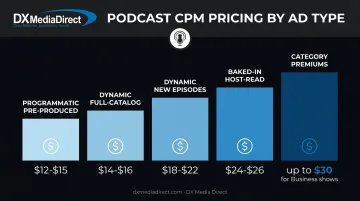
Podcast pricing is far more transparent than radio's. Per Libsyn's 2026 podcast advertising benchmarks:
- Programmatic, pre-produced: $12-$15 CPM
- Dynamic, full-catalog placement: $14-$16 CPM
- Dynamic, new episodes only: $18-$22 CPM
- Baked-in host-read (60-second): $24-$26 CPM
- Category premiums: Business shows run around $30 CPM; Health and Fitness near $27; Technology and Education near $26
Radio doesn't work this way. Rates depend on station reach, spot length, frequency commitments, and available inventory, none of which are published in a standardized public rate card. That's exactly why agencies with direct network relationships, rather than a self-serve portal, tend to land better numbers than a business calling a station cold.
What Is Radio Advertising?
Radio advertising means audio spots aired through AM/FM broadcast, satellite (think SiriusXM), or streaming simulcasts like iHeartRadio. It remains one of the fastest ways to build mass brand awareness, and it still works for direct response when tracking is set up correctly.
Why it still matters in 2026:
- Scales brand awareness quickly across an entire region or metro
- Targets commuters through drive-time dayparts (morning and evening rush)
- Costs far less than television for local and regional campaigns
Terrestrial AM/FM, satellite radio, and streaming radio apps each buy and price differently. Satellite tends to offer national reach with less local granularity, while streaming apps allow some digital-style targeting layered on top of traditional audio.
Use Cases of Radio
Radio rarely runs alone in a smart media plan. It's most effective layered alongside direct-response TV, reinforcing brand recall during the exact hours people are driving and not watching a screen.
Industries where radio still dominates:
- Auto dealers
- Home services
- Legal services
- Local retail
- Political campaigns
Beyond industry fit, one question comes up constantly: can radio even be measured? The data pushes back on the idea that it's untrackable. LeadsRx attribution studies, analyzed by daypart, weekday, and format, found that radio drove an average 14% increase in website traffic, matched by exposure timing rather than promo codes alone. That's a meaningful signal for advertisers who assumed radio was a black box.
What Is Podcast Advertising?
Podcast advertising places ads inside pre-recorded, on-demand shows, delivered as pre-roll, mid-roll, or post-roll spots. The ad can be read live by the host or produced separately with professional voice talent.
Why advertisers are shifting budget here:
- Precision targeting by show category and listener data
- Higher trust because listeners feel like the host is recommending, not selling
- Built-in trackability through promo codes and vanity URLs
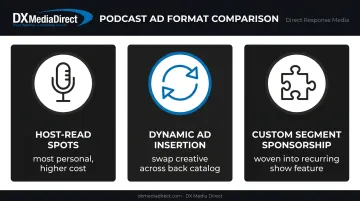
These advantages play out differently depending on the ad format. Host-read spots feel the most personal and typically cost more. Dynamic ad insertion lets brands swap creative across an entire back catalog without re-recording anything. Custom segment sponsorships go even further, weaving a brand into a recurring show feature.
Where Podcast Advertising Fits Best
Podcasts fit best when the target audience is younger, more affluent, or defined by a specific interest rather than a zip code. That's a different targeting logic than radio entirely.
Common industries leaning into podcast ads:
- Direct-to-consumer brands
- SaaS and tech companies
- Personal finance products
- Wellness and health brands
This industry pattern lines up with the data on listener trust. Research from Sounds Profitable found podcast ads achieve 86% recall among the medium's most active listeners, with 80% saying they trust podcast ads. That trust translates into action, which is exactly why niche-matched sponsorships tend to outperform generic mass-market placements in this channel.
Radio vs. Podcast: Which Is Better for Your Direct-Response Campaign in 2026?
There's no universal winner here. The right channel depends on four things: budget size, your target demographic, your actual campaign goal, and what's already running in your media mix.
Choose radio when:
- You need fast, broad reach across an entire market or region
- You're already running direct-response TV, since dayparts and network relationships can be combined together for reinforced recall
- Your target demo skews broad, not niche
Choose podcasts when:
- Your audience is younger, digitally native, or defined by a specific interest
- You need granular attribution tied directly to sales, not just impressions
- Host trust matters more than raw reach
Or blend both. Radio builds the awareness layer at scale; podcasts add trackable, niche engagement on top. Many of the strongest media plans we've built at DX Media Direct do exactly this, running radio for reach while podcasts pick up the audience segments radio can't isolate.
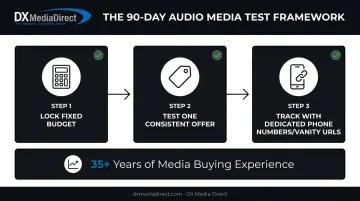
The key is discipline. A structured 90-day test, similar to the media-testing approach long used in direct-response TV, applies just as well to audio.
Before spending a dollar, lock in:
- A fixed budget for the full test period
- A single offer, tested consistently across every channel
- Clean tracking, using dedicated phone numbers or vanity URLs per channel
Over 35 years of buying media across TV, radio, and podcasts, we've found that daypart selection and network relationships matter almost as much as the creative itself. Self-serve platforms simply don't have access to the rate negotiations or pattern recognition that come from decades of running these tests.
Real-World Case Study & Conclusion
New Balance faced a familiar challenge: reaching Gen Z basketball fans who barely engage with traditional broadcast advertising. Mass-reach channels weren't cutting it for a demographic that lives inside niche digital content.
The brand shifted budget toward podcast and sports-talent advertising, placing ads with hosts and creators whose audiences already cared about basketball culture. The results were measurable:
- New Balance saw a 342% return on ad spend, as reported in IAB's audio media planning research
- STOK Coffee posted an 18-point jump in aided awareness and a 14-point lift in usage intent from a separate podcast campaign
Neither case runs a true side-by-side against radio, and that's the honest answer: a clean, published head-to-head test between the two channels doesn't exist yet publicly. But the pattern is clear enough. Podcasts perform when the audience niche is tight and the product fits naturally. Radio performs when the goal is fast, broad reach paired with a trackable response mechanism.
If you're weighing this decision for your own budget, the smartest move is testing both under controlled conditions rather than guessing. Schedule a free consultation with DX Media Direct to structure a radio and podcast media mix test built around your actual sales numbers, not just reach estimates.
Either way, there's no single "winner" between radio and podcast advertising in 2026. The right channel depends entirely on your audience, your goal, and your budget, and pretending otherwise leads to wasted spend. What matters is tying the decision back to measurable outcomes: lower cost-per-acquisition, higher conversion rates, and campaigns you can actually defend with hard numbers in the profit column.
Frequently Asked Questions
How much does radio and podcast advertising cost?
Podcast CPMs typically range from $12 to $26 depending on ad type and show category. Radio pricing varies by market size, daypart, and spot length, so it requires a direct quote rather than a fixed rate card.
Is radio a good way to advertise?
Yes, radio remains effective for broad, fast-reach brand awareness and works especially well layered alongside a direct-response TV campaign during commute hours.
What is the best way to advertise a podcast?
Use host-read ads, match the show's niche closely to your target audience, and include a promo code or vanity URL so results are trackable from day one.
Which platform delivers better ROI for direct-response campaigns, radio or podcasts?
ROI depends heavily on your measurement setup, not just the channel. Testing both with dedicated tracking (promo codes, vanity URLs, call tracking) is the only reliable way to know what works for your specific product.
Can I run radio and podcast ads together in the same campaign?
Yes, a blended approach is common and often works better than either channel alone. Full-service agencies like DX Media Direct build these blended plans, combining radio's broad reach with a podcast's niche, trackable engagement.
Is podcast advertising better than radio for reaching younger audiences in 2026?
Podcasts generally skew younger and more affluent, making them strong for Gen Z and Millennial targeting. Radio still reaches broader, all-age audiences at a scale podcasts can't match.