This shift creates confusion. Advertisers hear "addressable," "programmatic," "CTV," and "linear" used almost interchangeably, and many aren't sure which term describes a targeting method, a delivery channel, or a buying mechanism. That confusion leads to mismatched budgets and campaigns that add cost without adding revenue.
This guide breaks down what addressable TV actually is, how it technically works, how it differs from linear, CTV, and programmatic advertising, and whether it's the right fit for a direct-response strategy.
Key Takeaways
- Addressable TV serves different ads to households watching identical content, based on data signals, not program or timeslot
- This targeting capability spans linear, satellite, and streaming environments, not a single channel
- Reduced waste and stronger ROI are real benefits, though limited inventory and platform fragmentation add operational cost
- Relationship-based direct-response TV buying can match or beat addressable ROI without the structural markups
What Is Addressable TV Advertising?
Addressable TV advertising is a method of delivering different commercials to different households watching the exact same show, at the exact same time, on the exact same network. Instead of everyone in a broadcast area seeing one ad, the ad itself changes based on data tied to the household, such as demographics, geographic location, or purchase intent.
The core distinction from traditional TV comes down to what the delivery is tied to:
| TV Type | Delivery Tied To |
|---|---|
| Linear TV | The program or timeslot |
| Addressable TV | The household |
Two neighbors on the same street, watching the same football game, can see completely different 30-second spots.
This isn't a niche tactic anymore. Advertiser sentiment around addressable TV has been climbing steadily. A 2024 study from Go Addressable and Advertiser Perceptions found that nearly two-thirds of nonusers planned to start running addressable campaigns in 2025, with more than half of current users calling it a "must-buy" in upfront negotiations.
Why the momentum? Addressable TV blends two things that historically didn't overlap: the emotional storytelling and trust that broadcast television has always delivered, combined with the audience segmentation and measurability that digital advertisers expect.
One important clarification: addressable TV isn't a single channel you buy. It's a capability that can be layered onto multiple environments, including cable, satellite, or streaming, depending on which distributor and platform an advertiser is working with.
How Does Addressable TV Advertising Work?
Addressable TV relies on the ability to identify a household (or a device tied to that household) and swap in a specific ad creative for that impression. The mechanics differ depending on whether the delivery happens through a set-top box or an internet connection.
The Technology Behind Household-Level Targeting
Set-top boxes, smart TVs, and connected streaming devices are what make household-specific ad serving technically possible. Without a way to identify who's watching, there's no way to serve them something different.
Linear addressable TV works through partnerships with major MVPDs, including Comcast, DirecTV, DISH, and Charter. These providers use dynamic ad insertion (DAI) to swap ads into a limited number of local avail slots, based on subscriber data tied to that set-top box. FreeWheel, for example, powers real-time decisioning on traditional linear QAM boxes for Comcast's Effectv platform.
CTV and streaming addressability works differently. Because delivery happens over IP, platforms can target based on device ID, linked streaming accounts, or household viewing behavior. There's no need for a traditional commercial break at all.
Three types of data typically power this targeting:
- First-party CRM data: an advertiser's own customer and prospect records
- Third-party demographic/behavioral data: purchased audience segments
- Contextual content data: signals based on what's being watched
Privacy safeguards matter here. Data clean rooms let advertisers and distributors match household-level data for targeting without either party seeing the other's raw records. Consent frameworks like IAB Tech Lab's Global Privacy Platform carry privacy signals through the ad-tech chain.
The Campaign Workflow
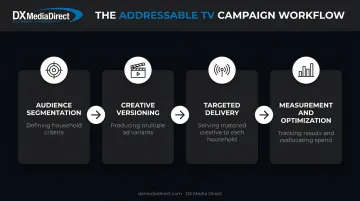
A typical addressable campaign follows a predictable sequence:
- Audience segmentation: defining which households qualify for which creative
- Creative versioning: producing multiple ad versions tailored to each segment
- Targeted delivery: serving the right version to the right household
- Measurement and optimization: tracking results and reallocating spend
Frequency capping plays a bigger role here than in traditional linear buying. It prevents oversaturating addressable households while national linear ads continue reaching the broader audience. This means addressable typically complements a national buy rather than replacing it outright.
Addressable TV vs. Linear TV, CTV, and Programmatic Advertising
This is where most of the confusion happens, largely because these four terms answer different questions entirely.
- Linear TV answers "what's being watched": a single ad goes to everyone tuned into that feed
- Addressable TV answers "who receives the ad": different households get different creative within the same program
- CTV answers "how it's delivered": an internet-connected device rather than a traditional broadcast signal
- Programmatic answers "how the ad is bought": an automated transaction mechanism, not a targeting method
CTV deserves a specific clarification. It's nearly always technically addressable, since IP delivery makes household-level targeting possible by default.
But whether a CTV impression is actually addressable depends on whether an advertiser is using targeting data at all. Buying broad CTV inventory without segmentation isn't addressable; it's just linear-style reach delivered over the internet.
| Format | Targeting Method | Typical Reach | Measurement Depth | Best-Fit Use Case |
|---|---|---|---|---|
| Linear TV | Program/timeslot, not household | Broad, mass-market | Panel-based, aggregate | Brand awareness at scale |
| Addressable TV | Household/segment-level data | Moderate (~40% average reach per campaign data) | Household-level, matched to outcomes | Data-rich advertisers with defined segments |
| CTV | Device/IP-based, if data is applied | Fragmented across platforms | Varies by platform, often stronger short-term | Streaming-first audiences |
| Programmatic | N/A (a buying method) | Depends on inventory bought | Depends on inventory bought | Automating existing direct or auction buys |
The common mistake: advertisers assume addressable and programmatic are the same thing, then buy "programmatic TV" expecting household-level precision and get disappointed when it's really just automated buying of undifferentiated inventory.
The two can overlay: you can programmatically buy addressable inventory, but one doesn't guarantee the other.
Benefits and Challenges of Addressable TV Advertising
Addressable TV's biggest selling point is waste reduction. When you're not paying to show a mortgage refinance ad to renters, the effective cost per outcome drops. Comcast Advertising reported in 2025 that its addressable campaigns delivered at least 15% lower effective CPMs than non-targeted strategies (a provider benchmark, though directionally consistent with the broader logic of targeted delivery).
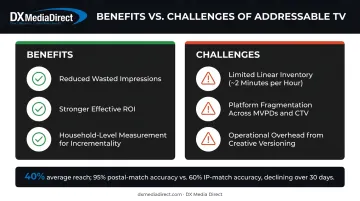
Real benefits include:
- Reduced wasted impressions on households outside the target segment
- Stronger effective ROI compared to blanket linear buys
- Household-level exposure that can be matched against conversion data for incrementality analysis
These efficiencies come with real trade-offs, though.
Real challenges include:
- Limited linear inventory: addressable avails on linear TV run roughly two minutes per hour, varying by distributor
- Platform fragmentation: MVPDs, CTV platforms, and programmers each require separate integrations and, often, separate contracts
- Operational overhead: running multiple creative versions means coordinating media, data, and creative teams simultaneously, a cost many businesses underestimate before their first campaign
These operational hurdles show up in performance data, too. A 2024 CIMM/Go Addressable study analyzing 145 campaigns found average addressable reach around 40%, with postal-address matching starting at 95% accuracy but IP-based CTV matching starting at only 60%, then dropping further over 30 days. Identity persistence, not just initial targeting, is a real operational challenge.
Is Addressable TV the Right Fit for Your Direct-Response Strategy?
Addressable TV works best under specific conditions. It's the right tool when an advertiser has:
- Clearly defined, data-rich audience segments (not broad assumptions)
- Budget to support creative versioning across multiple household groups
- Tolerance for coordinating across fragmented MVPD and CTV platforms
Here's the part many advertisers miss: automated addressable and programmatic platforms are typically bought through portals and insertion orders, at rate-card pricing set by the platform. There's no negotiation — you take the listed rate.
That's a structurally different model than relationship-based buying. DX Media Direct has spent over 35 years negotiating directly with network representatives rather than submitting insertion orders through a self-serve portal.
That distinction matters financially. Through those relationships, DX Media Direct has secured remnant inventory at rates reported to run 75% to 90% below rate-card pricing, access that simply isn't available through an automated platform buying at market rate.
The pattern recognition built across thousands of campaigns, spanning dayparts, networks, and product categories, is the other piece automated platforms can't replicate.
An algorithm optimizes toward available inventory. A media buyer with three decades of relationships knows which network reps have flexibility, which dayparts historically overperform for a specific vertical, and when a "sold out" avail actually has room.
A practical next step: rather than guessing between addressable, programmatic, or negotiated linear TV, run a scoped test.
In one recent education-sector campaign, a structured 90-day direct-response TV and radio test tracked performance across every media outlet, cut underperformers, and reinvested in the channels that worked.
The result: a 35% increase in enrollment within 90 days, later supporting the client's expansion into three new campuses. That's a scalable, repeatable playbook.
DX Media Direct offers a free, no-obligation consultation to map out whether addressable, linear, CTV, or a blend fits a specific budget and audience profile.
Frequently Asked Questions
What is addressable TV advertising?
Addressable TV advertising delivers different ads to different households watching the same show, at the same time, on the same network. Targeting relies on data such as demographics, location, or purchase behavior, not the program itself.
How does addressable TV differ from programmatic and connected TV?
Programmatic is the automated buying method. CTV is the internet-connected delivery environment. Addressable is the targeting capability that can apply within both — none of the three are interchangeable.
Is addressable TV advertising more expensive than traditional TV?
Sticker-price CPMs for addressable inventory are often higher than standard linear rates. However, effective CPMs can be lower due to reduced waste, though added creative and data costs can increase the total budget.
Do I need a large budget to run an addressable TV campaign?
Addressable campaigns can scale down to regional or vertical-specific budgets rather than requiring national spend. That said, platform minimums and creative versioning costs vary significantly by provider.
What kind of data is used to target addressable TV ads?
Targeting typically draws on first-party CRM data, third-party demographic or behavioral data, and contextual content signals tied to what's being watched. Consent frameworks and data clean rooms handle privacy compliance by limiting raw data access.
Is addressable TV better than traditional linear TV for direct-response campaigns?
It depends on audience data availability and budget for creative versioning. Many direct-response advertisers achieve strong, measurable ROI through expertly negotiated linear buys without addressable's added complexity and cost.