That shift has also made airtime far more accessible. Most business owners picture Super Bowl-level price tags when they think about TV ads. The reality for local spots is very different, and remnant inventory has only widened that gap.
Cost still varies widely by market size, daypart, show popularity, ad length, and whether you buy direct or through an experienced agency. This guide breaks down 2026 pricing ranges, the factors driving cost up or down, a full budget breakdown, how local TV stacks up against other channels, and the mistakes that quietly inflate most advertisers' bills.
Key Takeaways
- Local spot costs range from a few hundred dollars to $50,000+ in top-10 markets during high-demand periods
- Market size, daypart, ratings, ad length, and seasonal demand are the five biggest cost levers
- Small-market test campaigns can realistically launch for a few thousand dollars
- Scaling proven creative into bigger markets requires five-figure-plus budgets
- Relationship-based media buyers routinely access rates that self-serve platforms structurally cannot offer
How Much Does Local TV Advertising Cost in 2026? (Pricing Overview)
There's no single rate card for local TV. Cost is a blend of media buy and production, and both move depending on your market and timing. Advertisers usually get burned in three specific ways:
- Underbudgeting for frequency — assuming one airing will move the needle when TV works through repetition
- Buying at rate-card price instead of negotiated or remnant rates
- Ignoring production costs until after the media budget is already locked
Typical Cost Range by Market Size
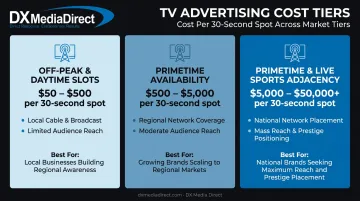
| Market Tier | Typical Cost Per 30-Second Spot |
|---|---|
| Small markets | $200–$1,500 |
| Mid-size markets | $2,000–$10,000 |
| Top-10 markets / high-demand programming | $5,000–$50,000+ |
These figures reflect general planning benchmarks used across the industry. Actual station rates require direct quotes, since services like SQAD gate exact pricing data behind subscriptions. They also cover airtime only, excluding production, agency fees, and add-ons like tracking numbers or CTV overlay.
Agencies with direct network relationships, such as DX Media Direct, typically negotiate below these published benchmarks, a rate advantage self-serve and programmatic platforms structurally can't match.
Small Market Tier
- What's typically included: off-peak to daytime slots, local news, syndicated programming
- Best for: local service businesses and first-time TV testers
Mid-Market Tier
- What's typically included: a mix of dayparts including some primetime, plus regional cable options
- Best for: multi-location businesses and regional brands scaling creative that's already working
Top-10 Market / Premium Tier
- What's typically included: primetime, high-rated local news, live sports adjacency
- Best for: brands with larger budgets prioritizing reach and brand-building over cost efficiency
Key Factors That Affect Local TV Advertising Costs
Geographic, scheduling, content, and production variables shape pricing together, not any single number.
Market Size, Demographics, and Daypart Timing
DMA population sets your baseline CPM. A bigger market means a bigger built-in audience, and stations price accordingly. But population alone doesn't tell the whole story: a smaller market with an affluent, niche demographic can still command higher rates than a larger, less targeted one.
Timing matters too. Primetime (8–11 PM) carries the highest premium simply because more people are watching, while early morning, daytime, overnight, and weekend slots offer meaningfully lower, budget-friendly rates, often where first-time TV advertisers get their footing.
Show Popularity and Ratings
Highly-rated local news, live sports, and finale episodes command a ratings premium. Local news specifically remains a strong buy: 95% of viewers consider access to local station news important, per a 2025 TVB study reported by TVNewsCheck. Lower-rated or niche programming, meanwhile, offers lower cost with more targeted reach.
Ad Length, Frequency, and Seasonal Demand
Ad format and timing also affect price:
- 15-second spots typically cost 25–50% less than 30-second spots
- 60-second spots can nearly double the cost of a 30-second spot
- Longer flight lengths (say, 90 days) tend to lower cost-per-view versus short, one-off bursts
Seasonal demand compounds these effects. Q4 holiday season and major events like elections or championship games can push rates up 30–50%, while off-peak seasons and remnant inventory remain where the real cost efficiency lives, particularly for agencies with direct network relationships instead of programmatic-only buying.
Cost Breakdown of a Local TV Campaign
Total investment goes well beyond the media buy itself. It includes production, buying and negotiation, and add-ons that many advertisers forget to budget for until it's too late.
| Cost Component | Frequency | What It Covers |
|---|---|---|
| Production | One-time | Script, talent, filming, editing. DIY-style spots run $1,000–$5,000; professional 30-second commercials typically run $10,000–$50,000 |
| Media Buying (Airtime) | Recurring, per flight | The CPM-based cost of running your spot; local CPMs vary widely by market and daypart |
| Agency / Negotiation Fees | Recurring | Cost of expert media buying, offset by access to discounted remnant inventory |
| Add-Ons (Talent, Music, Tracking) | Periodic | Licensed voiceover/music fees, plus attribution tools like trackable numbers and promo codes |
| Upgrades / Scaling | Periodic | Expanding frequency, adding markets, or layering in CTV once initial results prove out |
The agency line item deserves a closer look, because it's where the real savings tend to live. Relationship-based negotiation and access to discounted remnant inventory can lower your effective rate well below rate-card pricing.
DX Media Direct's approach illustrates why. Instead of buying at market rate through automated systems, a buyer with 35 years of network relationships can secure last-minute unsold inventory. Those rates are ones self-serve platforms structurally can't reach.
Consider the difference in practice:
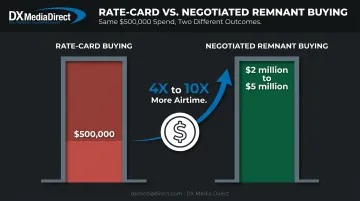
- A $500,000 budget bought at rate card buys $500,000 in airtime
- The same budget negotiated through remnant channels has secured the equivalent of $2 million to $5 million in airtime for past campaigns
- Same programming, same audience — just a fraction of the sticker price
Local TV vs. National TV, Streaming & Digital: Cost Comparison
Local vs. National TV Local buys keep total spend lower and let you focus geographically, though CPMs can run higher than national due to smaller audience pools. National buys require far bigger budgets, often $25,000+ per flight, with average 30-second primetime units hovering around $92,000 in recent upfronts.
Broadcast upfront CPMs for 2025-26 tell a similar story of scale:
| Ad Type | Avg CPM (2025-26 Upfronts) |
|---|---|
| Broadcast | $43.50 |
| Cable | $19.35 |
| Streaming | $27.25 |
These figures, from MediaPost's coverage of the 2025 upfront market, offer useful context, but they're no substitute for a local station quote.
Local vs. Streaming/CTV CTV typically commands a higher CPM than linear local TV, but it delivers digital-style targeting and measurement. Many advertisers now blend both: linear TV reaches the broader audience, while CTV pinpoints specific households within it. This layered approach fills coverage gaps that linear-only or CTV-only buys tend to leave.
Local vs. Digital/Social Ads Digital platforms post lower CPMs and offer granular tracking. Local TV builds the kind of broad brand trust that digital alone often can't replicate. For most local businesses, blending the two beats picking one exclusively.
Common Cost Mistakes Local Advertisers Make
- Paying full rate-card price: Skipping negotiation or remnant inventory can cost thousands more per flight, sometimes the gap between breakeven and a 4:1 return.
- Underinvesting in tracking: Without unique phone numbers, URLs, or promo codes, results can't be tied back to spend, leaving you guessing if the campaign worked.
- DIY media buying without network relationships: Self-serve and programmatic tools buy at or near rate card. They lack a rep who knows when a station has unsold inventory to move by Thursday.
The right local TV budget in 2026 balances market reach, frequency, and measurable ROI for your specific business, rather than simply chasing the cheapest or priciest option available. A free consultation with an experienced media buyer at DX Media Direct can usually clarify that number faster than weeks of guesswork.
Frequently Asked Questions
How much does a 30-second TV ad cost?
Local 30-second spots range from roughly $200–$1,500 in small markets up to $50,000+ in top-10 markets. National spots cost far more, and price depends heavily on daypart and show ratings.
How much of a 30-minute TV show is commercial?
Commercials typically fill 8-9 minutes of a standard 30-minute broadcast slot, split across multiple ad breaks throughout the program.
What's the minimum budget needed to start local TV advertising in 2026?
A modest test campaign combining low-cost production with off-peak or remnant airtime can start around $2,000–$5,000, especially in smaller markets.
Is local TV advertising still worth it with the rise of streaming?
Local news and live sports still command large, loyal audiences. Blending local TV with CTV often outperforms either channel used alone.
How can I get discounted TV ad rates?
Remnant inventory and agency-negotiated rates, built on long-standing network relationships, often deliver substantial savings versus paying rate-card price.
How do I track ROI from a local TV campaign?
Use unique trackable phone numbers, custom URLs, and promo codes to connect ad exposure directly to leads and sales. Without them, attribution is guesswork.