That shift matters more than ever. Ad-blockers strip banners from browsers, and streaming platforms let viewers skip commercials entirely. Outdoor advertising can't be blocked, muted, or skipped past — which is exactly why brands keep pushing it further.
This post breaks down 10 of the most inventive OOH campaigns ever run, and what marketers can actually learn from each one.
Key Takeaways
- Outdoor advertising remains one of the few genuinely "unblockable" media channels available today
- The strongest OOH campaigns pair a sharp location insight with a sensory hook: touch, smell, sound, or motion
- These 10 examples span static, digital, and fully experiential formats from global brands
- Creative brilliance alone won't move revenue: it needs a trackable, measurable media strategy behind it
Overview of Outdoor Advertising Today
Out-of-home advertising is promotional messaging placed in public, high-traffic spaces to build broad, unavoidable brand exposure. Think billboards, transit wraps, street furniture, and increasingly, digital screens.
The category is expanding, and the numbers back it up. US OOH revenue hit $9.46 billion in 2025, up 3.6% year-over-year, according to OAAA's 2026 industry report.
Digital out-of-home (DOOH) is driving much of that momentum. It grew 12.9% in a recent quarter and now accounts for over a third of total OOH revenue.
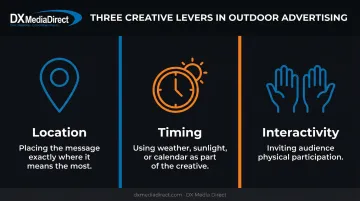
Here's the catch: "innovative" doesn't mean biggest budget or biggest board. The strongest campaigns use one of three levers:
- Location: placing the message exactly where it means the most
- Timing: using weather, sunlight, or the calendar as part of the creative
- Interactivity: inviting the audience to physically participate, not just observe
The 10 campaigns below were chosen because each represents a distinct creative approach — functional, sensory, experiential, humorous, or cause-driven. Every brand can borrow something from at least one of them.
10 Innovative Outdoor Advertising Campaigns to Know
These weren't picked for shock value. Each one teaches a specific, repeatable marketing lesson.
Coca-Cola's Drinkable Billboard
During the 2015 Final Four in Indianapolis, Coca-Cola and Ogilvy built a 26-by-36-foot billboard that actually dispensed Coke Zero. A 4,500-foot tubing system carried real product from the display straight into cups for passersby.
The takeaway: Turning a passive ad into a literal product trial builds instant goodwill — and gives people something worth filming and sharing.
IKEA's Full-Size Bathroom Installation
For Milan's Salone Internazionale del Mobile in 2012, IKEA and agency 1861 United installed a fully functional, 200-square-foot bathroom inside what looked like a public chemical toilet on a busy street. Hidden cameras captured the reactions of people who opened the door expecting a porta-potty.
The takeaway: Demonstrating real-world product use at true scale builds credibility no photo or floor plan could match.
Adidas' Interactive World Cup Billboard
During the 2018 FIFA World Cup, Adidas India worked with Carat and Posterscope on a billboard that required teamwork: passersby had to physically pull a rope together to move a giant "O" into place, spelling "GOAL."
The takeaway: Interactivity converts bystanders into active participants, which extends dwell time and turns a glance into a shared moment.
Tropicana's Orange-Powered Billboard
In France, DDB Paris and production house UNIT9 wired roughly 2,500 real oranges together with copper and zinc spikes, creating a functioning battery. After three months of testing, it powered a neon sign reading "Natural Energy" alongside the Tropicana logo.
The takeaway: Tying the physical medium itself to the product story (in this case, natural energy) reinforces the brand promise without needing a single line of copy.
KitKat's "Phone Break" Campaign
Launched in Czechia in April 2025 by VML, this campaign swapped smartphones for KitKat bars in familiar "reach for your phone" moments: bus stops, waiting rooms, queues. No slogan. No logo. Just the shape of the bar doing all the talking.
The bet paid off. VML reports the campaign reached more than 2.63 million people online without spending a cent on digital media, and it won the 2025 Cannes Lions Outdoor Grand Prix.
The takeaway: Strong brand recognition means an idea can carry the entire message without any text at all.
Ariel's Clothes Pin Billboard
For its "Super Soft Billboard" campaign in the UAE, Saatchi & Saatchi Dubai built a minimalist board using nothing but physical clothes pins arranged to convey the product message. Zero copy. Zero product shot.
The takeaway: Extreme simplicity can be more memorable than a busy, information-heavy design, especially on a medium people only glance at for a few seconds.
HOKA's Desert-in-Manhattan Installation
In May 2025, HOKA and agency Jellyfish Global transformed a Manhattan city block into an immersive desert trail environment for the Mafate X launch. Real terrain, native plants, simulated wind, controlled heat, and a treadmill buried into the display let runners experience the shoe against a digital Joshua Tree backdrop for 48 hours straight.

The takeaway: Large-scale experiential OOH can turn a product launch into a shareable event that generates its own press coverage, no media buy required.
Billie's Scratch-and-Sniff Billboard
In April 2025, Billie and OOH partner Pearl Media installed eye-level "armpit" billboards across New York City with a scratch-and-sniff surface that let people sample the deodorant's scent directly off the board. The stunt won Fashion & Beauty honors at the 18th Annual Shorty Awards.
The takeaway: Multi-sensory formats like touch and smell create a "had to be there" moment that drives organic social sharing on their own.
McDonald's Sundial Billboard
Leo Burnett Chicago built this 2007 installation so its physical shadow moved across the day, pointing toward whichever menu item made sense for that hour: breakfast items in the morning, lunch items by midday. It won a One Show Merit award and later a Clio Hall of Fame Gold.
The takeaway: Environmental context, such as sunlight, time of day, and location, can be engineered directly into the creative for added utility beyond the message itself.
Canva's "Make the Logo Bigger" Billboards
In June 2025, Canva and Stink Studios took over 14 billboards at London's Waterloo Station, turning relatable creative-industry complaints into copy. "Make the logo bigger" appeared in exaggerated, oversized physical builds that anyone who's worked in design instantly recognized.
The takeaway: Speaking directly to a niche audience's inside jokes builds instant relatability and brand affinity, even without showing the product once.
How These Campaigns Were Chosen
We evaluated every campaign on this list against three filters:
- Creative originality: does the idea do something OOH hasn't done before, or does it just look expensive?
- Cultural or industry impact: did it earn organic press coverage, social sharing, or award recognition?
- A teachable principle: can another brand apply the underlying lesson to a completely different product?
Budget size wasn't a factor. A common mistake brands make is chasing shock value or sheer scale without a clear strategic idea behind the execution. That approach might generate a viral moment, but it rarely produces long-term brand recall.
Award recognition (Cannes Lions Outdoor, One Show, Clio, and the Shortys among them) marked genuine creative merit. Unpaid media pickup and organic social sharing confirmed real audience impact across every campaign on this list.
Bold Creative Still Needs a Media Strategy Behind It
Innovative outdoor advertising works because it turns an unavoidable public medium into something people actually want to remember and share. That's the creative side of the equation.
But creative brilliance alone doesn't guarantee revenue. A billboard that goes viral on social media can still fail to move a single buyer if there's no way to track whether it actually worked.
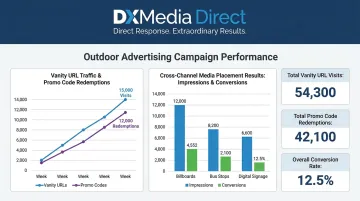
Measurement is where most OOH campaigns fall short, even when the creative idea is strong. Simple tracking methods turn a bold visual into a trackable channel instead of a guessing game:
- Vanity URLs that isolate billboard-driven traffic
- Unique promo codes tied to a specific placement
- Coordinated media planning across complementary channels
DX Media Direct has spent 35 years pairing creative media placements, including outdoor and billboard campaigns, with direct-response strategy that ties spend to actual results, not just impressions. If you're weighing a bold OOH idea against your budget, a free, no-obligation consultation can help you evaluate whether your current media mix is set up to prove it worked.
Frequently Asked Questions
What are examples of outdoor advertising?
Common formats include traditional billboards, transit ads, street furniture, digital out-of-home (DOOH) screens, and experiential installations. Campaigns like IKEA's bathroom build or HOKA's desert installation show how far the category extends beyond a printed board.
What is the 3 second rule for billboards?
There's no formally codified "three-second rule" from industry bodies like OAAA. The consistent guidance, though, is that copy should be readable in a matter of seconds. Clear Channel recommends seven words or fewer for maximum legibility.
What makes an outdoor ad "innovative" rather than just creative?
Innovation typically involves interactivity, sensory elements, or a clever use of location and timing, not just a striking visual. A well-designed billboard can be creative; one that dispenses product or releases scent is doing something functionally different.
How much does it typically cost to run an outdoor ad campaign?
Costs vary widely by format, market, and duration. In the US, static billboards can run anywhere from $250 per month in small markets to $15,000 or more in major metro areas. Digital boards typically price 20–50% higher.
How is outdoor advertising effectiveness measured?
Common metrics include Geopath-rated audience impressions, brand-lift studies, foot traffic analysis, and mobile location data tied to store visits. Social shares and earned media pickup add a secondary, less standardized layer of proof.
Can outdoor advertising work alongside TV or direct-response campaigns?
Yes. OOH is strong at building broad brand awareness, while direct-response TV can be structured with trackable phone numbers, URLs, or offers to capture measurable conversions. This makes the two channels genuinely complementary when planned together.