Last-click reporting hands 100% of the credit to that Friday search. The TV spot that built awareness? Ignored. The display ad that kept the brand top of mind? Invisible.
This is the core problem cross-channel attribution tries to solve. Marketers routinely overspend on channels that are easy to measure, like paid search, while quietly starving the upper-funnel channels, TV, display, email, that actually drove the sale.
This article breaks down what cross-channel attribution actually means, why it matters for budget decisions, the models marketers use (and their limits), why execution is still messy, and how direct-response TV testing offers a more concrete alternative when digital modeling hits a wall.
Key Takeaways
- Cross-channel attribution credits every touchpoint, not just the final click
- Poor attribution can lead brands to cut assisting channels like TV and display
- No attribution model is perfect; each trades accuracy for simplicity
- Direct-response TV testing offers trackable, non-probabilistic data digital models miss
What Is Cross-Channel Attribution?
Cross-channel attribution is the process of tracking and crediting every marketing touchpoint, across platforms, devices, and channels like TV, search, social, and email, that contributes to a conversion.
Instead of asking "what was the last thing this customer clicked before buying?" it asks a bigger question: what combination of exposures actually moved this person from stranger to customer?
This differs from single-touch models:
- First-click attribution credits only the initial discovery point
- Last-click attribution credits only the final interaction before conversion
- Cross-channel attribution spreads credit across the entire journey, weighted by whatever model a brand chooses
Channel vs. Touchpoint: A Common Mix-Up
These two terms get used interchangeably, and that's a mistake. A channel is the medium itself: TV, paid search, email, social.
A touchpoint is a specific exposure within that channel: a specific 15-second spot that aired at 8 p.m. on a Tuesday, or one particular retargeting ad a user saw on their phone.
Attribution operates at the touchpoint level, then rolls results up to the channel level for reporting. Confuse the two, and you'll misread which spot worked and assume the entire channel is the reason.
Attribution also differs from cross-channel marketing strategy. Marketing strategy is the coordinated campaign itself, the creative, timing, and sequencing across channels. Attribution is the measurement layer underneath it. One explains what you built; the other explains what actually converted customers.
Example of Cross-Channel Attribution in Action
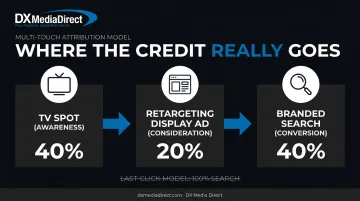
Go back to the mattress buyer. Here's how credit could be distributed instead of dumped entirely on search:
- TV spot (awareness) gets partial credit for sparking initial interest
- Retargeting display ad (consideration) gets partial credit for keeping the brand visible
- Branded search (conversion) gets partial credit for closing the sale
A last-touch model would say search drove 100% of that sale. A cross-channel view might say TV contributed 40%, display 20%, and search 40%, reflecting the actual role each touchpoint played. That distinction matters enormously once you're deciding where next quarter's budget goes.
Why Cross-Channel Attribution Matters
Get attribution wrong, and you end up making budget decisions based on what's easy to track rather than what's actually working.
Accurate ROI measurement protects the channels that assist conversions but rarely land the final click. TV and upper-funnel display are the usual victims. They generate awareness and consideration, then get written off as "unmeasurable" and cut, even when they're quietly doing most of the heavy lifting.
Once you understand which channels genuinely influence decisions, budget allocation gets a lot more rational. You're funding what moves customers, not just what's convenient to report on.
Attribution also surfaces behavioral patterns worth knowing:
- How people first discover your brand
- Which channels they return to before purchasing
- How long the research phase typically runs
- Where creative messaging needs to shift by touchpoint
That insight feeds directly into sequencing and creative decisions down the line.
There's also a trust dimension: clean attribution replaces guesswork with defensible numbers when you're reporting to a CFO or a client. That distinction shows up in industry data too.
In IAB's 2025 Outlook Study, cross-platform measurement ranked as the top solution focus among 200 U.S. ad-investment decision-makers, with 64% planning to focus more on it in 2025. At the same time, 44% named executing cross-channel measurement a top concern. Marketers know attribution matters. They're still struggling to execute it well.
Common Cross-Channel Attribution Models
There's no universal "best" attribution model. Each one trades precision for simplicity in a different way, and the right choice depends on your sales cycle, data volume, and how many channels are actually in play.
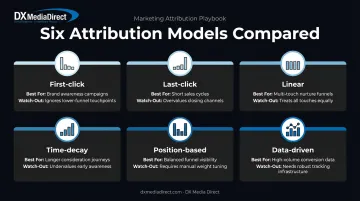
- First-click credits the first recorded interaction. Good for measuring top-of-funnel discovery; ignores everything that happens afterward.
- Last-click credits the final interaction before conversion. Simple and widely used for short, high-intent funnels; ignores demand created earlier in the journey.
- Linear splits credit equally across every touchpoint. Gives a broad view of the whole journey but assumes every touch mattered equally, which is rarely true.
- Time-decay weights recent touchpoints more heavily than earlier ones. Works well for time-sensitive offers and shorter sales cycles.
- Position-based (U-shaped) weights the first touch and a middle "lead creation" touch most heavily, splitting the remainder across other touches. Useful when both discovery and conversion matter most.
- Data-driven/algorithmic uses actual account data to assign credit based on estimated contribution rather than a fixed rule. More accurate in theory, but it requires enough clean data to work.
| Model | Credit Distribution | Best For | Watch-Out |
|---|---|---|---|
| First-click | 100% to first touch | Measuring discovery channels | Ignores conversion drivers |
| Last-click | 100% to final touch | Simple, short funnels | Undervalues upper-funnel work |
| Linear | Equal across all touches | Long consideration journeys | Assumes equal impact, rarely accurate |
| Time-decay | Weighted toward recent touches | Time-sensitive promotions | Underweights early awareness |
| Position-based | Weighted toward first + lead touch | Balancing discovery and conversion | Middle-funnel touches get diluted |
| Data-driven | Algorithmic, data-based weighting | Teams with high data volume | Needs significant clean data to be reliable |
These rules-based models differ from broader measurement methodologies that use them:
- Multi-touch attribution (MTA) applies these rules at the individual user level using tracked digital interactions.
- Media mix modeling (MMM) analyzes aggregate spend and outcomes across online and offline channels using statistical modeling instead of individual tracking.
- Incrementality testing compares exposed and control groups to measure actual causal lift, rather than allocating credit across observed touches at all.
Here's the structural problem underneath all of it: non-clickable channels like linear TV, radio, and direct mail don't generate the individual-level click data these models depend on. That's exactly where digital attribution starts to break down, and it's the setup for the next section.
Why Cross-Channel Attribution Is Still So Difficult
Even with the right model chosen, execution runs into real obstacles.
Data lives in silos. Ad platforms, CRMs, and analytics tools rarely talk to each other cleanly. Each system sees a slice of the customer journey, not the whole thing, which makes it nearly impossible to stitch together a complete path without significant manual work.
Walled gardens and privacy rules compound the problem. Platforms like Meta and Google restrict how much user-level data flows out, and regulations like GDPR and CCPA further limit tracking.
In IAB's State of Data 2024 study of over 500 U.S. advertising decision-makers, 73% expected a reduced ability to attribute campaign performance, measure ROI, and track conversions going forward.
Then there's the offline problem:
- Linear TV, radio, and direct mail can't be tracked at the individual level the way a digital ad click can
- Without a click to record, attribution models often exclude these channels entirely, not because they underperform, but because they're structurally hard to measure
- This creates a feedback loop where budgets shift away from unmeasurable channels, regardless of actual performance
Finally, inconsistent tracking standards across platforms cause their own mess. If Facebook and Google define a "conversion" differently, or attribution windows don't match, you end up with double-counted or missing credit before you've even chosen a model.
Beyond Digital Modeling: How Direct-Response TV Delivers Attribution Clarity
Digital attribution models work by inference. They observe click paths and estimate contribution. Direct-response TV works differently: it's built for direct measurement from the start.
DRTV has used trackable response mechanisms for decades: unique toll-free numbers, promo codes, dedicated URLs that attribute a response directly to a specific spot, network, and daypart. No probabilistic modeling required. A caller dials a number that aired only during that Tuesday 8 p.m. spot on that specific network, and you know exactly where the response came from.
This isn't a theoretical advantage. Research from Thinkbox and GroupM matched immediate viewer responses to 1.38 million aired TV spots, using an eight-minute window after each spot aired to capture direct response activity. That's attribution grounded in observed behavior, not inferred credit.
At DX Media Direct, this is the foundation of how we approach TV testing. A structured 90-day DRTV test produces a clear, scalable playbook of what's actually driving revenue, rather than the murky, hard-to-interpret output that algorithmic multi-touch models often generate when offline channels are involved.
That clarity depends on knowing what you're looking at. After 35 years of running direct-response campaigns across dayparts, networks, and product categories, we've built the pattern recognition to tell the difference between a media mix problem (wrong network, wrong daypart, wrong audience) and a creative problem (right placement, weak offer or messaging). That distinction matters.

Fixing the wrong one wastes another quarter of budget.
Our recommendation: pair DRTV's directly trackable data with your existing digital cross-channel attribution tools. TV response data fills in what digital models can't see; digital attribution adds the granularity DRTV alone doesn't capture. Together, they build a fuller picture of the customer journey than either approach delivers alone.
If your team is trying to figure out whether TV or display is driving conversions your current attribution setup can't see, DX Media Direct offers a free, no-obligation consultation. We'll walk through what a structured test could look like for your specific goals.
Frequently Asked Questions
What is cross-channel attribution?
Cross-channel attribution is the process of tracking and crediting every marketing touchpoint, across channels and devices, that contributes to a conversion. It replaces single-touch guesswork with a fuller view of the customer journey.
What is an example of cross-channel marketing?
A customer sees a TV ad, later encounters a retargeting display ad, then searches the brand name and buys. Cross-channel attribution would split credit across all three touchpoints instead of crediting only the final search click.
What's the difference between cross-channel attribution and multi-touch attribution (MTA)?
Cross-channel attribution is the broader concept of crediting multiple channels for a conversion. MTA is one specific methodology that uses individual-level tracking to assign that credit across digital touchpoints.
Which attribution model works best for small businesses or simple funnels?
Simpler rules-based models, like last-click or position-based, tend to work well for shorter, high-intent customer paths where data volume is limited. Data-driven models require more traffic than most small businesses generate.
How does TV advertising fit into cross-channel attribution?
TV isn't clickable, but direct-response mechanisms like unique phone numbers, promo codes, and dedicated URLs can still measure its impact. Marketers use these tools to trace responses back to the exact spot, network, and daypart that drove them.
Is cross-channel attribution enough on its own to guide budget decisions?
No single attribution model tells the whole story. Pairing attribution data with incrementality tests, sales feedback, or direct-response tracking gives a more complete, trustworthy basis for budget decisions.