Yet plenty of business owners feel stuck. Audio options have multiplied — AM/FM, streaming platforms, podcasts, HD Radio — and each comes with its own pricing model and sales pitch. Self-serve platforms promise instant setup. Traditional stations promise reach. Neither side explains where the real leverage sits.
This guide breaks down what "commercial radio & audio" actually means today, what a 30-second spot really costs, how buying works behind the scenes, and why experienced media buyers can unlock rates that automated platforms are structurally unable to match.
Key Takeaways
- Radio commands more daily ad-supported audio time in the US than podcasts and streaming combined
- Ad costs split into two buckets, production and media/airtime, and rate cards rarely reflect the final price
- Podcast ads drive measurably higher recall among listeners who heard them than among those who didn't
- Self-serve platforms cap pricing at built-in margins; relationship-based buyers can negotiate past them
- A defined test period with trackable response mechanisms turns awareness into hard revenue numbers
What Is Commercial Radio & Audio?
Commercial vs. Noncommercial Broadcasting
The FCC's definition is simple: commercial stations support themselves through the sale of advertising. That separates them from noncommercial educational stations, which rely on grants and listener donations instead of spot sales.
"Radio" used to mean one thing: AM/FM signals. That's no longer accurate. The IAB's October 2024 guide, Getting Audio & Podcasting on the Media Plan, treats terrestrial radio, streaming audio, and podcasts as one connected planning category, not three separate industries competing for budget.
For advertisers, the question that matters is which mix of formats reaches your customer at the moment they're ready to act — not whether to choose radio or digital audio.
A Brief History of Commercial Radio
Commercial radio keeps reinventing itself:
- 1920 – KDKA in Pittsburgh aired the first scheduled commercial broadcast, covering election returns; the FCC still credits it as the format's origin point
- 1930s–1950s – AM radio became a national mass medium
- 1960s–1980s – FM overtook AM for music listening
- 1990s–2000s – Satellite and early digital signals arrived, followed by HD Radio
- 2010s–today – Streaming apps and podcasts added an on-demand, targeted layer
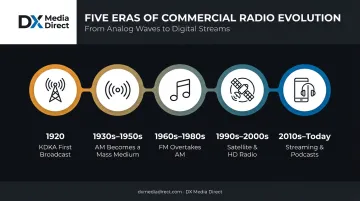
A century later, the throughline hasn't changed: advertisers buy attention, and audio still commands plenty of it.
AM/FM vs. DAB vs. Streaming
These terms get mixed up constantly:
- AM/FM: Traditional analog broadcast, delivered locally by market and station format
- DAB (Digital Audio Broadcasting): A digital radio standard common in the UK, Australia, and Europe — never adopted in the US
- HD Radio: The US equivalent, layering extra digital channels onto existing AM/FM signals
- Streaming/digital audio: Apps and podcast platforms built for demographic and behavioral targeting, not broadcast scale
If a client mentions "DAB radio" in a US context, they almost always mean HD Radio.
Types of Commercial Radio & Audio Advertising
Not every audio format works the same way.
- Traditional AM/FM spot advertising: Standard 15-, 30-, and 60-second spots aired during commercial breaks. Morning and evening drive-time slots command a premium as peak in-car listening hours.
- Streaming/digital audio advertising: Platforms like Spotify and Pandora enable targeting by demographics, location, and listening behavior that terrestrial radio can't match.
- Podcast advertising: Host-read or produced spots woven into episode content. More than half of Americans age 12+ listen to podcasts monthly, and 46% of weekly listeners say they've bought a product after hearing a podcast ad, according to Edison Research's 2024 Podcast Consumer report.
- HD Radio and digital terrestrial options: This hybrid analog/digital signal gives advertisers access to extra channels layered onto a station's main signal, often at lower cost.
| Format | Best For |
|---|---|
| AM/FM | Mass reach, local market dominance |
| Streaming audio | Precise demographic and behavioral targeting |
| Podcasts | Listener trust, contextual fit, strong recall |
| HD Radio | Niche audience extension, lower-cost inventory |
Match the format to your primary goal, then build the media mix from there.
How Much Does a 30-Second Commercial Radio Ad Cost?
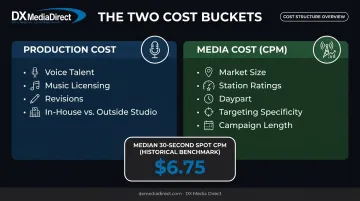
Two entirely different cost buckets get lumped together here, and that's where most sticker shock comes from.
Production Cost: Making the Ad
This covers script writing, voice talent, music, and studio time. A no-frills voice-only read costs far less than a fully produced spot with original music and sound design. Your final number depends on:
- Voice talent selection (station staff voice vs. a hired professional)
- Music licensing and sound design
- Number of revisions and scripts tested
- In-house station production vs. an outside studio
Creative quality drives close to half of an ad's total ROI, according to Nielsen Catalina research reported by Inside Radio. Cheap production that undersells the message can cost more than it saves.
Media Cost: Buying the Airtime
Radio stations and networks price this on a CPM basis (cost per thousand listeners), and the rate swings on:
- Market size: Top-10 markets cost more than mid-size ones
- Station ratings: Higher-rated stations command higher rates
- Daypart: Drive-time carries a premium
- Targeting specificity: Precision on streaming platforms can raise per-listener cost even as total spend drops
- Campaign length: Longer commitments typically earn better per-spot pricing
The median CPM for a 30-second radio spot sat around $6.75 as of early 2022, one of the lowest CPMs across major ad media, per Inside Radio's cost reporting. Treat that as a historical benchmark, not a current quote; ask for a dated proposal before budgeting.
Rate Cards Are a Starting Point, Not the Final Price
Published rate cards and self-serve platform CPMs look transparent, but they're rarely what an experienced buyer actually pays. Rate cards are opening offers. Self-serve platforms bake their margin into the sticker price, with no room to negotiate.
DX Media Direct has spent 35 years building direct relationships with network and station sales representatives: relationships that surface remnant inventory a portal simply can't access. On the television side, that same negotiation philosophy has secured inventory at 75% to 90% below published rate card pricing, and it applies just as directly to radio and audio buying.
Minimum Budgets and Test Campaigns
Run a defined pilot before committing to a full-scale buy. It replaces a guess with real data. In one DX Media Direct education client campaign, combining TV and radio spots with direct-response tracking delivered a 35% enrollment increase within 90 days, a result that shaped a repeatable playbook for scaling further.
Traditional Buying vs. Modern Programmatic Platforms
The Traditional Process
Buying radio the old-fashioned way means:
- Contacting station reps for rate cards
- Negotiating rates and inventory
- Trafficking creative to the station
- Waiting weeks for performance reports
It works, but the pace makes fast testing difficult.
The Programmatic/Self-Serve Process
Self-serve platforms flip the speed equation: set up a campaign, define an audience, and algorithmic targeting places ads within a day. The catch: pricing is capped by the platform's built-in margin. There's no lever to negotiate.
The Third Path: Full-Service Agency Buying
A full-service agency blends both models, combining relationship-based negotiation with performance tracking from day one.
| Agency-Led | Self-Serve Programmatic | |
|---|---|---|
| Setup time | Slower, strategic | Fast, automated |
| Pricing | Negotiated, relationship-based | Fixed, algorithm-driven |
| Reporting | Agency-managed, interpreted | Client-operated dashboard |
| Inventory access | Remnant plus premium, via reps | Limited to platform supply |
Choosing a buying model is only half the equation. Underperformance isn't always what it looks like on the surface: a weak-response campaign could mean the wrong media mix (wrong stations or dayparts for the audience), or it could mean underperforming creative with the right audience but the wrong message.
Fixing the wrong problem wastes budget. DX Media Direct treats media mix and creative as separate diagnostic questions, testing each independently so clients aren't guessing at which lever to pull.
Why Commercial Radio & Audio Still Works for Direct-Response Advertisers
Mass Reach Hasn't Gone Anywhere
Radio remains especially dominant behind the wheel. Nielsen's connected-dashboard research found AM/FM claimed 47% of in-car listening time even among drivers using Apple CarPlay or Android Auto, outpacing streaming audio and satellite radio combined in that group. For a business with local or regional reach, that's a captive audience with nowhere else to look.
The Trust and Attention Advantage
Audio has an intimacy advantage other channels can't replicate: a human voice, direct and uninterrupted. That builds recall in a way banner ads rarely do.
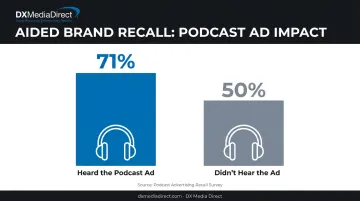
Nielsen's brand-lift research backs this up. Podcast ads generated 71% aided recall, compared to just 50% among people who hadn't heard the ad, according to Nielsen's 2023 podcast brand-impact study. That's one of the clearest recall gaps in advertising research.
Turning "Brand Awareness" Into Hard Numbers
The old radio complaint that "we can't measure it" doesn't hold up anymore. Direct-response tracking makes attribution concrete:
- Unique promo codes tied to specific stations or dayparts
- Dedicated phone numbers per campaign
- Dynamic landing pages that log traffic source
But reach and recall aren't the same as profit. One Audacy-measured candy brand campaign produced a 1.04% sales lift at an $8.09 CPM, yet ROAS landed at just $0.54 per dollar spent. The lesson: track sales, not just impressions, and hold every campaign to a profitability bar, not just a reach number.
DX Media Direct builds this tracking into radio and audio campaigns from day one, so clients see which station, daypart, or format actually drives revenue.
Best Practices for a Successful Commercial Radio & Audio Campaign
Write for the Ear, Not the Eye
- One clear message per spot: don't cram in three offers
- Repeat the brand name two to three times
- Use a single, strong call to action
- Write conversationally; if it sounds stiff read aloud, rewrite it
Give It Time to Work
- Run campaigns for weeks, not days: one week rarely builds enough frequency to register
- Test multiple creative versions before scaling spend on any single script
- Rotate creative periodically so audiences don't tune out from repetition fatigue
Measure Before You Scale
- Assign unique phone numbers, promo codes, or landing pages per station or daypart
- Use a structured test period (such as a defined 90-day media test) before committing full budget
- Judge results against a profitability threshold, not just reach or recall
That structured approach (test, measure, then scale) turns a single campaign into a repeatable playbook instead of a one-off gamble.
Frequently Asked Questions
What is commercial radio and audio?
Commercial radio refers to advertiser-funded AM/FM broadcasting, as defined by the FCC. "Audio" is the broader modern category that adds streaming platforms and podcasts to the mix.
How much does a 30-second commercial radio ad cost?
Costs split into two parts: production and media/airtime. Production typically runs a few hundred to a few thousand dollars depending on talent and studio time, while media/airtime is priced by CPM and varies by market, daypart, and targeting.
What is a DBA radio?
This usually refers to "DAB radio" (Digital Audio Broadcasting), a digital radio standard common in the UK, Australia, and Europe. The US instead uses HD Radio as its terrestrial digital standard.
How long should I run a radio ad campaign to see results?
Plan for a minimum 2 to 4 week flight to build enough frequency for recall. Direct-response optimization often benefits from a longer structured test, closer to 90 days.
Is commercial radio advertising still effective compared to digital channels?
Yes, radio still holds the largest share of daily ad-supported audio time and dominates in-car listening. It works especially well as a reach layer alongside targeted digital campaigns.
What's the difference between buying radio ads through an agency versus a self-serve platform?
An agency negotiates rates through long-standing network relationships and brings strategic insight into media mix and creative. Self-serve platforms offer speed, but pricing is fixed by the platform's built-in margin.