But that dream comes with real financial risk. Many businesses jump into a national rollout without a validated playbook, betting six or seven figures on assumptions nobody's actually tested. The result is often wasted media spend, creative nobody responds to, and a campaign that dies before it proves anything.
This guide breaks down what a national campaign really is, what it costs, the 40/40/20 rule that experienced media buyers swear by, and the best practices that separate a profitable national rollout from an expensive guess.
Key Takeaways
- National campaigns target audiences nationwide via TV, streaming, and digital—not specific regions or DMAs
- Costs vary by channel, production quality, and flight length—relationship buying often beats programmatic rates
- The 40/40/20 rule ranks audience and offer above creative for campaign performance
- Test at a smaller scale first to build a proven playbook and protect your budget before scaling nationally
What Is a National Advertising Campaign?
A national advertising campaign is a coordinated ad effort built to reach audiences across the entire country, rather than a specific region or Designated Market Area (DMA). Instead of buying ad time in Chicago or Dallas individually, a national buy runs on networks or platforms distributed coast to coast, so households everywhere see the same message.
National reach typically comes through three main channels:
- National broadcast TV networks: buys placed on national programming rather than local affiliate inventory
- Connected TV (CTV) and streaming platforms: think Hulu, Roku, Peacock, or Prime Video, delivered over the internet but functioning like TV
- National digital and search: paid media distributed without geographic restriction
There's also a structural difference between two ad types: direct-response ads include a phone number, URL, or specific call-to-action, so campaigns can track the response directly. Brand image spots aim for recall and skip the ask for immediate action. That distinction shapes everything from creative length to how you measure success.
National vs. Local and Regional Advertising
The core differences come down to scope, budget, and consistency:
| Factor | National | Local/Regional |
|---|---|---|
| Audience scope | Entire country | Specific DMAs or regions |
| Budget scale | Higher, fewer placement variables | Lower per-market, more control |
| Message consistency | Same message everywhere | Tailored per market |
| Measurement | Aggregate national performance | Market-by-market attribution |
In practice, marketers often label a campaign "national" when it's really dozens of regional buys stitched together for tailored reach. This hybrid approach lets a brand keep national scale while still adjusting messaging where it matters most.
Brand-Awareness vs. Direct-Response National Campaigns
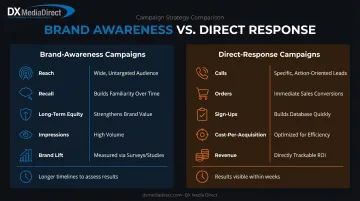
Brand-awareness campaigns optimize for reach and recall. Success looks like more people knowing your name.
Direct-response national campaigns are different. They drive a specific, trackable action, such as a call, an order, or a sign-up, and marketers judge them by hard numbers: cost-per-acquisition, revenue generated, calls logged. There's no room for vague "impressions" as a success metric.
This distinction changes how you plan the whole campaign. Direct response demands rigorous, iterative testing on creative, offer, and media mix. A brand campaign can run longer before you know if it worked. A direct-response campaign tells you within weeks.
Common Objectives of a National Campaign
Most brands pursue a national rollout for one of these reasons:
- Building brand fame or category recognition
- Expanding market share against established competitors
- Launching a new product to a national audience simultaneously
- Generating leads or sales at scale, tracked against a specific CPA target
- Validating and scaling a rollout using data pulled from earlier market tests
How Much Does a National Advertising Campaign Cost?
There's no single answer here, and anyone who gives you a flat number is guessing. Costs depend heavily on the media channel, production quality, flight duration, and which network or daypart you're buying into.
To put the range in perspective, Ad Age's 2024-25 primetime pricing data shows a single 30-second national spot can run anywhere from $5,135 on a lower-tier cable program up to $1,008,746 during NBC's Sunday Night Football. That's not a typo. Program demand and audience size drive the price far more than "national" status alone.
What Goes Into the Budget
A realistic national campaign budget includes:
- Creative and production — filming, editing, voiceover, and post costs, which vary based on brief complexity
- Media buying spend — the actual airtime, streaming impressions, or digital placements
- Testing and pilot costs — smaller-market runs before full national commitment
- Attribution and tracking tools — call tracking, pixel tracking, and reporting dashboards to measure what's working
Flight length and frequency matter too. Longer flights and heavier frequency increase total spend, but they also change your cost math.
Direct-response campaigns budget differently than brand campaigns because they're optimizing toward a target cost-per-acquisition, not just impressions delivered. If your CPA math doesn't work at $50,000 a week, it won't magically work at $500,000 a week either. Scale amplifies the problem, not just the reach.
Why Programmatic and Self-Serve Platforms Aren't Always Cheaper
Programmatic and self-serve platforms look appealing because they're fast and self-directed. But they come with technology fees, markups, and fixed rate cards that don't move regardless of how much inventory a network actually has available.
The ANA's 2026 programmatic transparency benchmark found that only 43.3% of programmatic ad spend produced qualified impressions, meaning fraud-free, viewable, and measurable. The rest was effectively wasted on inefficiency built into the automated supply chain.
Relationship-based media buying works differently. Negotiating directly with network representatives gives access to preferential rates and unsold inventory that automated portals never see.
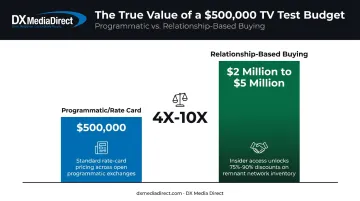
DX Media Direct's 35 years of network relationships illustrate how this plays out in practice. A $500,000 TV test budget, bought at rate card through a programmatic pipe, buys exactly $500,000 worth of airtime.
That same budget, negotiated directly for remnant inventory at 75-90% off rate card, can effectively access $2 million to $5 million in equivalent airtime value. An algorithm doesn't get the phone call when a station has excess Tuesday-morning inventory it needs to move by Thursday. A buyer with decades of relationships does.
The 40/40/20 Rule in Advertising
Direct-response marketing has long leaned on a simple heuristic, often credited to direct-mail pioneers from the mid-20th century: campaign success breaks down roughly as 40% audience or list, 40% offer, and 20% creative execution.
The logic is blunt but useful. You can have the most beautifully produced ad in the world, but if it's aimed at the wrong audience or paired with a weak offer, it's still going to underperform. Creative matters, but it's the smallest lever in the mix.
Why does this matter more at national scale than local scale? Because going national amplifies whichever variable is weakest.
- A poorly matched audience wastes budget across dozens of markets instead of one
- A weak offer gets tested against thousands more impressions before anyone notices the problem
- Creative flaws are the easiest and cheapest thing to fix, comparatively
Experienced direct-response media buyers use this rule as a diagnostic tool. When a campaign underperforms, the first question is rarely about the ad itself.
Instead, it's about audience and offer: who are we targeting, and what are we offering them? Validating that fit before pouring money into creative production helps you avoid finding out the hard way, after the national spend is already committed.
At DX Media Direct, 35 years of campaign pattern recognition helps identify whether a stalled rollout stems from targeting, offer, or creative issues.
Best Practices for a Successful National Campaign
Combine TV and Digital, Don't Pick One
TV builds broad awareness fast. Digital and CTV add precision targeting and retargeting on top of that reach. Using only one leaves money on the table.
Nielsen's cross-media research found that campaigns concentrating more than 85% of budget in a single channel reached, at most, 17% of their target audience. Well-diversified campaigns spread across linear, digital, and streaming reached as much as 90%.
That's not a small gap. It separates a campaign that works from one that underperforms without anyone noticing why.
Tailor Messaging Without Losing National Scale
Even within a nationally-scoped buy, messaging can and should flex by region, season, or audience persona. A national fitness brand shouldn't run the same "beat the heat" spot in Minnesota in January that it runs in Arizona. Wasted impressions on irrelevant messaging add up fast when you're buying at national volume.
Measure Continuously, Not Just at the End
Track daypart efficiency, network-level performance, and creative-level results throughout the flight, not just in a post-campaign report. Cutting underperforming outlets mid-flight and reinvesting in the ones actually driving calls or orders is how a campaign improves while it's still running, not after the budget's already spent.
Test Before You Scale Nationally
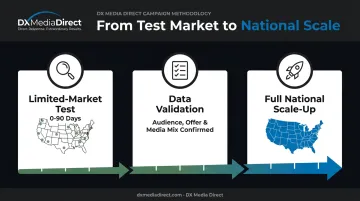
A smaller, time-boxed market test, something like a 90-day direct-response TV run across a handful of markets, builds a data-backed, scalable playbook before you commit to full national spend. It's the difference between guessing and knowing. Skip this step, and you're gambling with a budget that could have told you, cheaply, whether the offer and audience actually work.
Diagnose Media Mix vs. Creative Problems Separately
When a national campaign underperforms, the instinct is often to scrap the creative and start over. Experienced media buyers resist that urge.
They isolate whether the problem is placement strategy (wrong networks, wrong dayparts, wrong audience) or the creative itself, then fix that specific lever. Replacing both is expensive and usually unnecessary. This kind of pattern recognition comes from running campaigns across dozens of networks and product categories over years, not from a single test.
Avoid Common National Rollout Mistakes
Watch for these recurring pitfalls:
- Inconsistent messaging across markets caused by decentralized execution
- Misallocated budget without centralized performance data guiding decisions
- Skipping the testing phase entirely before committing to full national spend
Each of these is preventable. None of them are cheap when they happen.
Frequently Asked Questions
What is a national advertising campaign?
A national advertising campaign is a coordinated effort targeting audiences across the entire country through national TV, streaming, or digital channels, rather than specific regions or DMAs. It's built for consistent messaging at scale.
How much does a national advertising campaign cost?
Costs vary by media channel, production quality, and flight length, with national TV spots ranging from about $5,000 to over $1 million for a single 30-second placement. Relationship-based media buying often lowers these costs compared to programmatic platforms.
What is the 40/40/20 rule in advertising?
It's a direct-response heuristic stating that roughly 40% of campaign success comes from the audience, 40% from the offer, and 20% from creative execution. It matters most at national scale because weaknesses get amplified across more markets.
How long should a national campaign run before you can trust the results?
A time-boxed test period, often around 90 days, gives you enough performance data to validate the audience, offer, and media mix before scaling further. Shorter tests risk drawing conclusions from incomplete data.
What's the difference between national and local advertising?
National advertising delivers one consistent message across the entire country, while local and regional advertising tailors messaging to specific markets. Many "national" strategies combine regional buys for both scale and relevance.
Is it possible to test a national campaign on a smaller budget first?
Yes. Running a limited-market test builds a validated, data-backed playbook you can scale with confidence, rather than committing full national media spend on untested assumptions.