That shift matters because radio still commands attention digital doesn't always earn. Yet many advertisers struggle to know which 2026-specific tactics actually move listeners to act, versus which ones just add to the noise. Testing without a plan burns budget fast.
This article breaks down the radio advertising ideas shaping 2026 campaigns: trackable direct-response mechanics, AI-assisted production, streaming and podcast expansion, hyperlocal sponsorships, and story-driven creative. Each comes with the "why now" behind it, plus what separates a real strategy from a shiny distraction.
Key Takeaways
- AI voice tools cut script-versioning costs across markets and dayparts
- Trackable numbers, promo codes, and landing pages are now radio-buy standards
- Streaming and podcast inventory extend reach beyond AM/FM without replacing it
- Hyperlocal sponsorships and story-driven ads outperform generic spots for recall
- Structured 90-day media tests beat guesswork when it's time to scale a radio budget
Key Trend 1: Direct-Response Radio Built for Trackable ROI
Direct-response radio structures every spot around one measurable action: a call to a dedicated number, a promo code at checkout, or a visit to a specific landing page. Every dollar spent ties back to a specific, trackable outcome rather than general brand awareness.
This shift reflects an industry-wide demand for attribution. Advertisers who track every click on a digital campaign now expect the same clarity from radio, and trackable mechanics are how radio meets that bar.
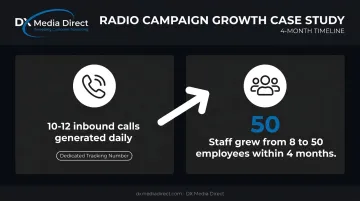
A real-world version of this mechanic: a financial services client built a radio strategy around a single dedicated inbound number. The campaign generated 10 to 12 inbound calls per day, all traceable back to the ad that produced them.
Within four months, the client's sales staff grew from 8 to 50 employees. That's the difference between a media buy and a P&L line item.
Testing Before Scaling
Experienced direct-response agencies rarely commit a full budget to radio on day one. They run a defined test, often around 90 days across a handful of stations and dayparts, before scaling spend. This "test small, scale what works" approach:
- Confirms which stations and time slots actually produce calls or conversions
- Builds a data-backed playbook before larger money is on the line
- Reduces the risk of the bigger campaign that follows
Agencies like DX Media Direct use this model specifically to avoid judging radio's effectiveness off one noisy month of data.
Diagnosing Creative vs. Media Mix
When a campaign underperforms, is it the script, the station lineup, or the daypart? Self-serve platforms can report a drop in response rate, but they typically can't explain why. Experienced media buyers can separate a weak-performing station from weak-performing copy, and fix the actual problem instead of scrapping the whole campaign.
Key Trend 2: AI-Powered and Personalized Audio Production
AI text-to-speech and generative audio tools are changing how radio and streaming ads get made. Instead of booking studio time for every variant, brands generate multiple versions of a script for a fraction of the traditional cost and timeline.
A study reported by Inside Radio in 2025 found 56% of agency respondents had used an AI voice somewhere in the creative process. The technology has moved well past the experimental stage.
What This Unlocks
A single script can now become several regional or dayparted versions without a matching number of studio sessions:
- Different city call-outs for a multi-market campaign
- Offers tested by daypart, such as morning drive versus evening commute
- Faster script rewrites tested against listener response instead of guesswork
Dynamic ad insertion on streaming and podcast platforms adds another layer, swapping messaging by location or time of day within the same audio file. Together, AI production and dynamic insertion remove the production bottleneck that once capped how many creative variants a brand could test in a quarter.
Where Human Judgment Still Wins
AI speeds up production. It doesn't replace media strategy. Negotiating network rates, reading pattern data across dayparts, and knowing which station actually delivers for a specific product category still require judgment built from running thousands of campaigns, not from a script generator. It's the same pattern recognition agencies like DX Media Direct apply when matching a brand's message to the right station and daypart.
Key Trend 3: Streaming and Digital Audio Expansion
Streaming pre-roll, podcast host-read ads, and app-based radio inventory have become standard reach extensions rather than experimental add-ons. Stations increasingly sell streaming inventory separately, priced on a cost-per-thousand-impressions basis, so advertisers can target listeners who split time between AM/FM and apps.
Broadcast, though, still commands the largest share of ad-supported listening. Nielsen's Q3 2025 audio report breaks down adults' ad-supported audio time as:
- AM/FM radio (including its streams): 64%
- Podcasts: 19%
- Streaming audio: 14%
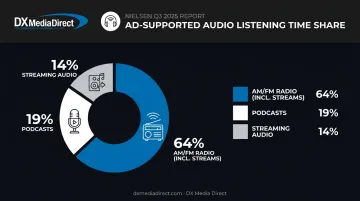
That split matters for budget allocation. Streaming and podcast inventory extend a campaign's reach into moments broadcast can't capture, like car-free commutes or app-only listening. They work best as a supplement to a broadcast plan, not a replacement for it.
Practical takeaway: treat streaming and podcast inventory as an addressable layer on top of a radio buy, not a separate campaign competing with it for budget.
Key Trend 4: Hyperlocal Sponsorships and Story-Driven Creative
Standalone spots still work, but two creative approaches are consistently outperforming generic, repetitive ad reads for listener recall.
Hyperlocal Sponsorships
Instead of buying isolated spots, brands are sponsoring recurring local content: a weekly contest segment, a live remote broadcast from the sponsor's location, or a community series tied to local events. A live remote from a restaurant or dealership gives listeners a reason to show up in person, something a single 30-second spot rarely accomplishes.
Why it works:
- Local trust transfers to the sponsor through the host's credibility
- Recurring association builds familiarity without the fatigue of repeating one script
- Community tie-ins create urgency to act now instead of eventually
- Community tie-ins create urgency to act now instead of eventually
- Extended airtime compounds recognition without added production costs
Story-Driven Creative
The second shift is creative. Brands are moving away from generic pitch copy toward unexpected narrative angles, such as:
- A product narrating its own story instead of an announcer pitching features
- Reverse-dialogue openers that hook attention before revealing the brand
- Serialized, mystery-style campaigns running across several weeks
Each approach succeeds by breaking listener expectations before delivering the sales message. Cannes Lions' Audio & Radio category has recognized exactly this kind of aural storytelling in standout campaigns. But differentiation alone doesn't sell anything. For direct-response advertisers, an unconventional narrative still needs a clear, trackable call to action, or the creativity stays memorable without ever becoming profitable.
What's Driving These Trends, and How the Industry Is Responding
Several forces are converging to reshape radio advertising heading into 2026.
Technology. AI production and programmatic audio tools are lowering the cost of entry, letting even small advertisers test more creative variants than a traditional studio budget once allowed.
Market demand. Advertisers increasingly expect radio to deliver attribution comparable to digital. That expectation is why trackable mechanics have gone from optional to standard.
Cost pressures. Rising production and media costs are pushing advertisers in two directions at once: toward AI efficiencies on the production side, and toward relationship-based media buying for rates. Decades-long network relationships secure pricing that self-service programmatic platforms are structurally unable to match.
Regulatory requirements. Category-specific disclosure rules for gambling, financial services, and food or health claims are shaping script length and content. A shorter AI-generated script doesn't help if it can't legally fit the required disclosure.
Competitive dynamics. A crowded digital ad environment is raising the value of radio's trust advantage. A YouGov survey covered by Inside Radio of nearly 19,000 adults found 45% considered radio advertising trustworthy, a notably strong showing relative to many digital formats.
Operational, Business, and Workforce Impact
These forces are changing how the industry actually runs day to day:
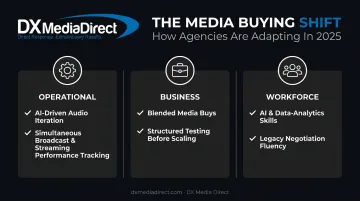
- Operational:
- Production teams iterate multiple audio versions weekly using AI tools
- Media buyers track performance across broadcast and streaming simultaneously
- Business:
- Blended media buys combining spots, sponsorships, and digital packages are replacing single-channel plans
- Structured testing before committing larger budgets is now standard practice
- Workforce:
- Copywriters and producers need AI and data-analytics skills alongside classic scriptwriting
- Media buyers need digital-platform fluency plus legacy network negotiation skills
Future Signals for Radio Advertising Beyond 2026
A few early indicators point to where radio advertising goes next.
- Combined attribution reporting: more advertisers want media proposals to include broadcast-plus-streaming attribution in one report instead of two separate ones
- AI voice localization: expect more advanced tools that translate and localize scripts for different regions without re-recording from scratch
- Voice-assistant formats: smart speakers are starting to support interactive audio calls to action, letting listeners respond by voice instead of a screen
- A swing back to relationships: as programmatic platforms hit rate ceilings, more advertisers are returning to relationship-based buying, where experience still beats an algorithm on price
Conclusion
Radio advertising in 2026 comes down to three things converging at once: measurable direct-response mechanics, AI-assisted production, and a growing digital-audio footprint alongside AM/FM. None of these ideas work in isolation. They work because teams test, track, and refine them against real response data.
The businesses winning with radio right now test structured campaigns first, then scale whatever the data proves works.
DX Media Direct has spent 35 years building the network relationships and pattern-recognition experience needed to turn ideas like these into a scalable, ROI-backed playbook. If you're ready to test what actually converts, schedule a free consultation and find out what a structured radio strategy could do for your business.
Frequently Asked Questions
What should be included in a radio ad?
A strong radio ad needs a quick hook, one clear core benefit, and a trackable call to action, such as a phone number, code, or URL. A consistent audio identity or tagline helps listeners recognize the brand next time they hear it.
What are some good radio advertising ideas?
Testimonials, storytelling, and humor all work well when paired with a trackable response mechanic. The creative approach matters less than making sure every version includes a clear way to measure whether it worked.
What are the current trends in radio advertising?
AI-powered production, direct-response tracking, and streaming and podcast expansion are the biggest shifts shaping 2026 campaigns. Hyperlocal sponsorships and story-driven creative are close behind for listener recall.
How much does a radio advertising campaign cost in 2026?
Costs vary widely by market size, station, and daypart, so there's no single universal number. Relationship-based media buying can often secure better rates than self-service programmatic platforms, especially in smaller and mid-size markets.
What is direct-response radio advertising?
It's radio built around a specific, trackable listener action, such as a call, code, or visit, rather than general brand awareness. That structure lets performance get measured in hard numbers instead of impressions alone.
Is radio advertising still effective in the digital age?
Yes. Radio still commands the largest share of ad-supported audio listening time, and listener trust remains strong compared to many digital formats. Pairing it with measurable mechanics proves that effectiveness campaign by campaign.