Here's the catch: radio ad costs swing wildly. A 30-second spot might run under $25 on a small local station or climb past $1,400 on a major-metro drive-time slot. State, market size, daypart, and format all play a role.
This guide breaks down 2026 radio pricing by market size, the real cost components behind a campaign, the factors that move rates up or down, and how to build a budget that actually delivers results instead of just burning through cash.
Key Takeaways
- Small-market 30-second spots run $25-$300; major-metro buys often reach $800-$1,500+.
- Market size, daypart, ad length, and production quality account for most of the cost variation.
- Local businesses testing radio pay far less than national brands running drive-time or host-endorsed campaigns.
- Premium metro placements justify bigger budgets, while remnant inventory and off-peak slots fit smaller ones.
How Much Does Radio Advertising Cost in 2026? (Pricing Overview)
Radio doesn't have a fixed sticker price. Stations quote costs as CPM (cost per thousand impressions) or CPP (cost per rating point) rather than a flat rate. CPM measures what you pay to reach 1,000 listeners; CPP measures what you pay to reach 1% of your target demographic's audience.
Advertisers commonly misjudge radio budgets in three ways:
- Underestimating production costs and assuming airtime is the only expense
- Assuming every daypart costs the same, when drive-time can run double the price of overnight slots
- Underbudgeting frequency, running too few spots to build any real recall
Typical Cost Ranges by Market Size
Regional station groups like Zimmer Communications publish some of the clearest real-world pricing data available. Their Missouri market data shows 30-second spots ranging from $25 to $300, with monthly local campaign budgets landing between $1,000 and $5,000.
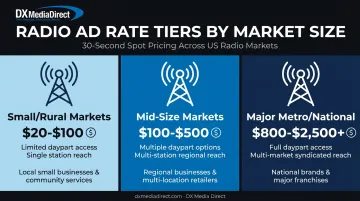
| Market Tier | Typical 30-Second Spot | Notes |
|---|---|---|
| Small/rural markets | ~$20–$100 | Lower end of regional ranges; limited station competition |
| Mid-size markets | ~$100–$500 | Broader reach, moderate daypart demand |
| Major metro/national | $800–$2,500+ | Top-10 metros like New York and Los Angeles command premium rates |
These ranges shift further based on what's included in the package, not just market size. Here's how pricing breaks down across the three tiers below:
Price Range 1: Small-Market/Local Radio
- Typical cost: ~$20–$100 per 30-second spot
- What's included: Off-peak or standard daypart placement on a single local station with limited reach
- Best for: Hyper-local businesses or first-time radio advertisers testing the medium before scaling up
Price Range 2: Mid-Size Market Radio
- Typical cost: ~$100–$500 per 30-second spot
- What's included: Drive-time availability and moderate frequency packages across one or two regional stations
- Best for: Regional businesses and growing brands wanting broader reach without national-level costs
Price Range 3: Major Metro/National Radio
- Typical cost: $800–$2,500+ per 30-second spot
- What's included: Premium drive-time, host endorsements, high-frequency schedules, and potential national syndication
- Best for: Established brands, national retailers, and direct-response advertisers running large-scale campaigns
These figures reflect standard rate-card pricing. Agencies with established station relationships, like DX Media Direct's 35 years of network negotiation, often secure placements below list price.
Key Factors That Affect Radio Advertising Costs
A station's rate card is just a starting point. Market conditions, timing, and format choices reshape the final price just as much.
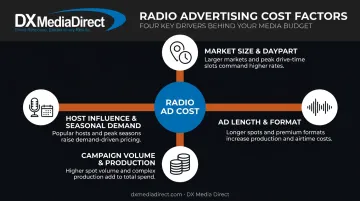
Market Size and Daypart
Population density and station competition create the gap between a top-10 metro and a small rural market. A crowded market with a dozen competing stations behaves very differently than a single-station rural county, and pricing reflects that directly.
Time slot matters just as much. Morning and afternoon drive times carry the highest demand and highest prices. According to RAB frequency planning data, night and weekend spots generally cost about half as much as drive-time or prime-time slots. Midday inventory sits somewhere in between.
Ad Length and Format
Length changes the math fast:
- 15-second spots typically cost 40–60% less than 30-second spots
- 30-second spots remain the industry standard
- 60-second spots command a premium over 30s
- Host-read or endorsed ads cost more but drive stronger attention from listeners
Campaign Volume and Production Costs
Buying more spots or committing to a longer campaign usually lowers your average cost per spot. Stations reward volume with negotiated rates, particularly for advertisers willing to commit to a set dollar amount or a longer flight rather than a one-off buy.
Production adds another cost layer. Professional voice talent, scripting, and studio production add upfront cost. Basic outside production typically runs $300 to $500, while high-end work with custom jingles or multiple voices can run $1,000 or more. Many stations include basic production free with an airtime package.
Host Influence and Seasonal Demand
Popular shows and high-profile hosts raise rates because listeners pay closer attention to them. High-demand periods, such as Q4 retail season or election cycles, also tighten inventory and push prices up. During election windows, federal rules cap what stations can charge legally qualified candidates, which can shift remaining commercial inventory pricing.
Cost Breakdown of a Radio Ad Campaign
The airtime price on a rate card is only one line item. A full radio campaign involves several cost components, and each behaves differently over the campaign's lifespan.
| Component | Recurring or One-Time? | What It Covers |
|---|---|---|
| Airtime/Media Buy | Recurring | CPM/CPP-based cost paid to stations; usually the largest ongoing expense |
| Production | One-time | Scripting, voice talent, music/SFX, and editing — basic runs $300–$500, polished spots $1,000+ |
| Agency/Media Buying Fees | Recurring or retainer | Cost of partnering with a buying agency for negotiation and placement |
| Optional Add-Ons | Variable | Host endorsements, sponsorship packages, syndication |
| Measurement & Creative Refresh | Ongoing | Tracking via promo codes/phone numbers; refreshing creative every 4–6 weeks to avoid wear-out |
Skip any one of these, and the budget you present won't hold up under scrutiny. A campaign quoted at $2,000/month in airtime can easily need another $500–$1,000 upfront for production alone.
Low-Cost vs. High-Cost Radio Advertising: What's the Difference?
Budget local buys and premium metro or national buys aren't the same product wearing different price tags: they deliver genuinely different value.
| Factor | Lower-Cost Radio | Higher-Cost Radio |
|---|---|---|
| Reach & Frequency | Smaller audience, limited weekly frequency | Larger reach, higher frequency, and Gross Rating Points (GRPs) |
| Placement Quality | Off-peak or remnant inventory slots | Guaranteed drive-time or host-endorsed placement |
| Production Value | Basic voiceover, simple audio mix | Professional talent, custom jingles, polished sound |
Neither option is inherently better, since a hyper-local plumbing company doesn't need drive-time on a top-40 station in a major metro. A national retailer launching a Q4 push absolutely does.
How to Estimate the Right Radio Advertising Budget for Your Business
The "right" radio budget depends on your campaign goals and audience fit, not the lowest quote you can find. Weigh these factors before committing spend:
- Target market size — does your customer base sit in one city or span multiple regions?
- Campaign objective — brand awareness needs sustained frequency; direct response needs trackable calls to action
- Frequency required to build recall (a handful of spots per week rarely moves the needle)
- Length of your initial test period before scaling into new markets
Start with a defined market test, something in the 60–90 day range, to gather real performance data before expanding spend. A short test tells you whether your creative, daypart, and station selection are actually working, rather than guessing.
Common mistake: Underbudgeting frequency or grabbing the cheapest daypart without checking whether that audience matches your actual customer.
This is where an experienced media buying partner earns its keep. DX Media Direct has negotiated direct-response radio and TV placements for over 35 years, building direct relationships with station reps instead of relying on automated insertion orders. That kind of access can secure preferential dayparts and rates that self-serve or programmatic platforms simply can't reach.
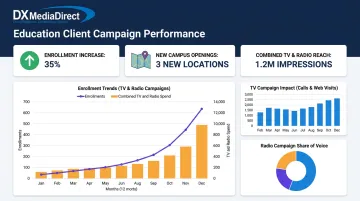
In one combined TV and radio campaign for an education client, this approach helped drive a 35% increase in enrollment within 90 days and supported the opening of three new campuses. The goal is turning spend into trackable, hard-number results in the profit column, not just cheaper airtime.
Frequently Asked Questions
How much does it cost to promote your business on the radio?
Total investment varies widely based on spot length, frequency, and market size—small-market campaigns can start under $1,000 a month, while major-metro campaigns with heavy frequency can reach $10,000+ monthly. Production costs and daypart selection add further variation.
How much does a 30-second radio ad cost?
A 30-second spot typically runs $25 to $300 in smaller and regional markets, climbing to $800 or more in major metros. Daypart choice affects price as much as market size does.
How much does a 60-second radio ad cost?
A 60-second spot typically costs 25 to 50% more than the equivalent 30-second slot, often landing between $40 and $450 in smaller markets and exceeding $1,200 in major metros. The premium covers extra airtime, not added production work.
What's the difference between CPM and CPP pricing for radio ads?
CPM is the cost to reach 1,000 listener impressions. CPP is the cost to reach 1% of your target demographic's audience, calculated from gross rating points. Stations quote one or the other depending on the buy.
Is radio advertising still worth it in 2026?
Yes. AM/FM still reaches the vast majority of U.S. adults weekly and dominates in-car listening time, making it one of the most affordable ways to reach a broad audience alongside digital channels.
How can I lower my radio advertising costs without sacrificing results?
Target off-peak dayparts, ask about remnant inventory, and commit to longer flights to unlock frequency-based discounts. Working with an experienced buying partner also helps secure rates self-serve platforms can't match.