Introduction
Every advertiser eventually lands in the same debate: put the budget into TV, or pour it into digital? It's the question that keeps marketing leaders up at night, because the wrong call doesn't just waste money.
It changes your cost-per-acquisition, your brand's credibility, and whether your ad spend ever shows up as real revenue instead of a line item on a report nobody reads.
The stakes are bigger than most people realize. In 2024, MAGNA forecast total US ad revenue at $369 billion, with $261 billion flowing to digital media and roughly $44 billion going to national TV, split between linear TV and long-form streaming.
Digital wins on raw volume. But volume isn't the same as results.
This guide breaks down what TV and digital actually deliver, where each one wins, and how to decide which channel (or mix) fits your business right now.
Key Takeaways
- TV builds reach and credibility; digital wins on precision and speed
- No channel wins outright: your objective, budget, and timeline decide
- Combined TV and digital campaigns outperform single-channel efforts
- Relationship-based TV buying can beat rising programmatic rates
TV vs Digital Advertising: Quick Comparison
Here's how the two channels stack up across the metrics that actually matter to a business trying to grow revenue, not just impressions.
| Dimension | TV | Digital |
|---|---|---|
| Cost | Higher upfront investment, but negotiated rates and remnant inventory can lower true cost-per-result | Lower entry cost, but CPMs on platforms like Meta and TikTok have been climbing steadily |
| Targeting | Broad demographic and daypart targeting; addressable/CTV adds household-level precision | Granular targeting by behavior, intent, location, and device, refined in real time |
| Measurement | Trackable through unique phone numbers, promo codes, and dedicated landing pages | Built-in attribution dashboards showing clicks, conversions, and spend in real time |
| Trust & Reach | Mass simultaneous reach with high perceived credibility among viewers | Reaches highly specific audiences but competes for attention in crowded feeds |
Neither column wins outright. TV and digital solve different problems, and the smartest advertisers use each channel for what it does best.
What Is TV Advertising?
TV advertising means placing video ads in front of audiences through broadcast, cable, or streaming platforms. It remains relevant for one simple reason: it builds a kind of trust that's hard to replicate anywhere else, and it does so at scale.
Three benefits matter most for revenue-focused advertisers:
- Credibility by association — appearing on a trusted network lends your brand instant legitimacy
- Mass simultaneous reach — a single spot can reach millions of households at once
- High attention rates — viewers who watch a TV ad are far more likely to act on it than someone scrolling past a banner
That last point isn't just a hunch. TVB's 2025 purchase-funnel research found that 82% of respondents said linear TV ads influenced their online-search selections, with linear TV leading overall ad exposure at 68%. That kind of influence turns exposure into measurable action.
The Direct-Response TV Subtype
TV advertising splits into broadcast, cable, and streaming/CTV. But for advertisers who need proof their spend generates revenue, one subtype matters most: direct-response TV (DRTV).
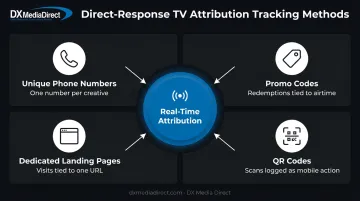
DRTV uses trackable mechanisms baked into the ad itself, including:
- Unique phone numbers assigned per campaign or network
- Promo codes redeemed online and tied back to a specific spot
- Dedicated landing pages that capture every click
- QR codes that remove friction between seeing the ad and responding
Every one of these mechanisms feeds real-time attribution, so you know exactly which spot, channel, and daypart is producing buyers, not just views.
Use Cases of TV Advertising
TV fits two moments in a business's growth: national or regional brand-building, and direct-response offers that need urgency, credibility, and scale all at once.
Industries where TV, and DRTV specifically, dominates include:
- Insurance and financial products
- Subscription services
- Home services and improvement
- Consumer packaged goods
Networks also often discount DRTV inventory well below standard rate-card pricing when it's sold as remnant space, unsold time they need to fill before air. That discount, paired with trackable response tools, is why DRTV remains one of the more cost-efficient paths to revenue for businesses that once assumed TV was out of their budget range.
What Is Digital Advertising?
Digital advertising spans search, social, display, and video across every device your audience owns. Its defining trait is immediacy: you can measure performance down to the click, the hour, and the individual campaign.
Core benefits that matter for business impact:
- Hyper-targeting — reach people by demographic, behavior, location, or purchase intent
- Real-time budget optimization — shift spend toward what's working within hours, not weeks
- Retargeting — bring back visitors who showed interest but didn't convert
Digital's Main Formats
Digital advertising breaks down into a few core formats:
- Paid social — ads on Meta, TikTok, and similar platforms, targeted by interest and behavior
- Programmatic display — automated buying of banner and video ad space across websites and apps
- Paid search — listings placed above organic results based on keyword intent
- Streaming/CTV — a hybrid format that blends TV's screen with digital's targeting and measurement
Most brands blend several formats rather than relying on one, pairing awareness-focused programmatic buys with conversion-focused paid search.
Use Cases of Digital Advertising
That conversion focus is where digital earns its keep, especially in the lower funnel: converting warm leads, retargeting site visitors, and testing creative or offers fast. It's where e-commerce brands, mobile apps, and local service businesses running geo-targeted campaigns tend to concentrate spend.
The conversion numbers back this up. WordStream's 2024 benchmark data found average Google search ad conversion rates of 6.96%, ranging as high as 12.96% for automotive services. Meta's lead-generation ads averaged even higher, around 8.78%.
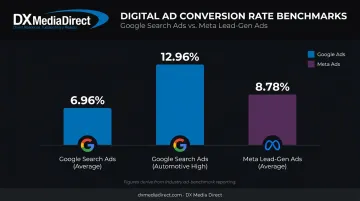
Digital doesn't just reach people. It converts them, and it proves it in the same dashboard.
TV vs Digital: Which Is Right for You?
There's no universal winner here, but there is a clear way to decide. Weigh these four factors:
- Primary objective — brand-building favors TV; direct response favors either, depending on execution
- Available budget — smaller budgets often start digital, but negotiated TV rates can rival digital CPMs
- Speed needs — digital optimizes in hours; TV testing typically shows viability within two weeks
- Measurement capability — can your team track calls and codes, or only clicks?
Choose digital if you need hyper-targeting on a modest budget with fast iteration cycles. Choose TV if you're scaling a proven offer, need mass-market trust fast, or want cost efficiencies that automated platforms simply can't offer through insertion orders alone.
Real-World Example: Direct-Response TV in Action
Consider a representative scenario common among direct-response advertisers: a subscription-based service has spent two years scaling almost entirely through paid social and search. Acquisition costs have crept up quarter over quarter.
The digital media mix has plateaued, and more spend isn't producing proportionally more customers.
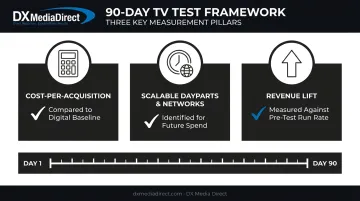
Rather than keep feeding a channel with diminishing returns, the business runs a structured 90-day TV test, buying media through relationship-based negotiation with network representatives instead of a self-serve programmatic portal.
The campaign uses trackable phone numbers and dedicated landing pages, so every response ties back to a specific network, daypart, and spot.
Within the test window, the metrics that matter most include:
- Cost-per-acquisition compared directly against the prior digital-only baseline
- Scalable dayparts and networks identified for future budget concentration
- Revenue lift measured against the pre-test run rate
Here's the real value: decades of pattern recognition across dayparts, networks, and product categories make it possible to distinguish an underperforming media mix from underperforming creative. That distinction determines exactly which lever to fix, rather than guessing.
If your acquisition costs are climbing and your digital mix feels inconclusive, a structured TV test might be worth exploring. DX Media Direct offers a free, no-obligation consultation to evaluate whether that fits your growth plan.
Conclusion
TV and digital aren't competing for the same job. TV builds trust and reach at scale; digital captures intent and proves it instantly. The smartest media mix matches the channel to your objective, your budget, and the stage your business is in right now.
What matters most in the end is what shows up in the profit column. Whether that's a lower cost-per-acquisition or revenue you can trace back to a specific spot on a specific network, the numbers should be trackable, not theoretical. That's the standard every advertising dollar should be held to.
Frequently Asked Questions
Is TV advertising better than online advertising?
Neither is universally better. TV excels at brand trust and mass reach, while digital excels at targeting and speed. The right choice depends entirely on your campaign objective.
Is it cheaper to advertise on TV or social media?
Social media looks cheaper upfront, but rising CPMs on platforms like Meta and TikTok are closing that gap. Negotiated TV rates, especially through remnant inventory, can rival or beat social media cost-per-result.
Should I combine TV and digital advertising, or choose just one?
Combining channels consistently outperforms running either channel alone, particularly for recall and incremental audience reach. Most advertisers see the strongest results from a blended approach rather than an either-or choice.
How do you measure ROI for TV advertising compared to digital advertising?
TV ROI relies on direct-response mechanisms like unique phone numbers, promo codes, and dedicated landing pages. Digital uses built-in attribution dashboards that track clicks and conversions automatically in real time.
Is TV advertising still effective for small businesses?
Yes. Streaming and CTV options, along with negotiated media buying and remnant inventory access, have lowered TV's cost barriers , making it far more accessible than the standard rate card suggests.
What's the difference between direct-response TV and traditional brand-awareness TV advertising?
DRTV centers on trackable, revenue-focused response mechanisms and measurable actions. Brand-awareness TV focuses on long-term recognition and trust, without a direct call to action tied to immediate sales.