Programmatic buying platforms, audience measurement requirements, and a wave of operator consolidation are rewriting how billboard deals get structured. Businesses that sign the same rigid, multi-year agreement they signed in 2019 risk overpaying or losing flexibility just as the market shifts underneath them.
This post breaks down the five trends reshaping billboard contracts in 2026, what's driving them, how they affect your budget and staffing, and what to watch for as the outdoor advertising landscape keeps evolving.
Key Takeaways
- Programmatic DOOH buying is expanding, but it doesn't guarantee lower rates than skilled negotiation
- Contract flexibility, like trial periods or shorter terms, is increasingly negotiable, though not yet standard
- Impression guarantees, like OUTFRONT's 95% delivery threshold, are becoming a real contract mechanism
- Three companies control 57% of the OOH market, raising the stakes in every negotiation
- Local sign ordinances vary wildly by city, making site-specific due diligence essential
Key Trends Shaping Billboard Contracts in 2026
Five forces are actively reshaping how billboard contracts get written, negotiated, and priced this year. Some are backed by hard data. Others are directional shifts worth watching closely.
Trend 1: Rise of Programmatic and Automated OOH Buying Platforms
Programmatic DOOH lets advertisers buy digital billboard inventory through automated platforms, similar to how display ads get bought online. Instead of a rep quoting a rate over email, software matches budget to available screen time in real time.
The growth here is real. Programmatic represented 24% of total US DOOH spending in 2024, and MAGNA projects that share will climb to roughly 65% by 2029, according to OAAA's industry transparency pledge announcement.
That growth comes with a trade-off:
- Speed and flexibility: Campaigns can launch in days, not weeks
- Lower barrier to entry: Smaller advertisers can test OOH without a big commitment
- Loss of negotiated rates: Platform pricing rarely beats a well-negotiated direct deal
- Less human insight: Automated tools don't know which corner location actually gets seen versus which one just looks good on paper
Programmatic is a useful tool. It isn't automatically a cheaper one.
Trend 2: Shift Toward Shorter, Flexible, Trial-Based Contract Terms
Advertisers are asking for shorter commitments before they'll sign long-term billboard deals. Instead of locking into a full year, more businesses want 60- to 90-day windows to see actual performance data first.
A 2026 OAAA/Geopath award-winning case illustrates the logic. Hand & Stone Massage and Facial Spa ran a focused OOH campaign that generated more than 100 new memberships within 30 days. That result was strong enough to convince the client to renew its outdoor investment for the entire 2026 calendar year.
That's the pattern worth copying: prove it works on a small scale, then expand with confidence instead of a guess.
Trend 3: Performance and Data-Driven Contract Clauses
Billboard contracts increasingly read like digital media contracts. Advertisers want guaranteed impression counts, third-party measurement, and reporting built into the deal, not offered as an afterthought.
Geopath remains the industry's audience-measurement standard, and OAAA's impression guidelines push operators toward audited inventory and verified reporting.
OUTFRONT has already codified this into contract language. Where a contract designates impressions as "Guaranteed," the company commits to delivering at least 95% of the agreed impressions during the campaign flight, according to OUTFRONT's posting standards specifications.
That's a meaningful clause. But it guarantees eyeballs, not sales. A 95% impression guarantee doesn't promise foot traffic or revenue. Advertisers should still track their own conversion data separately.
Trend 4: Consolidation Among Major Operators Affecting Negotiation Leverage
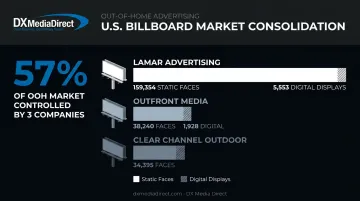
Three companies now dominate US billboard inventory. Lamar, OUTFRONT, and Clear Channel together control 57% of the OOH market, based on OAAA's 2024 OOH Ad Spend Facts and Figures report.
Here's how that inventory breaks down by operator, based on recent public filings:
| Operator | Billboard Faces | Digital Displays |
|---|---|---|
| Lamar Advertising | 159,354 | 5,553 |
| OUTFRONT Media | 38,240 | 1,928 |
| Clear Channel Outdoor | 34,395 | Not reported separately |
When three players own most of the good locations in a given market, your alternatives shrink fast if a negotiation goes sideways. This is exactly where relationship-based negotiation earns its value. Full-service agencies like DX Media Direct bring that pattern recognition, built over 35 years of direct-response media buying across TV, radio, and outdoor channels.
Trend 5: Tightening Regulations and Local Sign Ordinances Shaping Contract Availability
Cities are getting stricter about billboard permits, and the rules differ block by block. Pasadena, Texas enacted a 90-day moratorium on static-to-digital conversion applications in March 2024. St. Cloud, Florida took a different approach, approving a five-static-for-one-digital exchange ratio for a relocation agreement in March 2026.
These aren't abstract policy debates. They directly limit which locations you can even bid on:
- Moratoriums freeze conversion applications mid-negotiation
- Exchange ratios force operators to remove multiple static faces to install one digital board
- Approval timelines stretch out, delaying campaign launches
Fewer available permitted locations means the ones that exist become more valuable. Negotiate early, before a city changes the rules on you.
What's Driving These Contract Trends
A handful of overlapping forces are pushing these changes at the same time.
- Technology advances: Programmatic platforms and real-time bidding tools now handle a growing share of DOOH transactions, giving advertisers more self-serve options
- Rising advertiser expectations: Businesses want the same measurable ROI from billboards that they already get from digital and TV, and they're writing that expectation into contracts
- Budget efficiency pressure: Tighter marketing budgets push advertisers toward shorter, data-validated commitments instead of long-term bets
- Regulatory friction: State and local sign laws are limiting new inventory and stretching out approval timelines in many markets
- Operator consolidation: With fewer companies controlling more inventory, smaller advertisers increasingly turn to full-service agencies with established negotiation relationships and media-buying pattern recognition built over decades of experience
None of these forces operate in isolation. Consolidation makes negotiation leverage matter more, while tightening regulation makes early action more urgent. Advertisers who understand all five pressures at once negotiate from a stronger position.
How These Trends Are Impacting Billboard Contract Negotiations
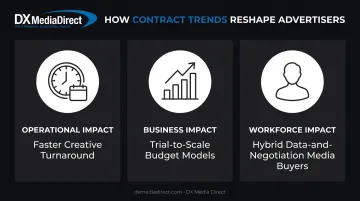
These shifts aren't just changing contract language. They're changing how budgets get allocated and who gets hired to manage them.
Operational impact: Digital billboard contracts now demand faster creative turnaround than static agreements ever required. Approval timelines that used to stretch for weeks on printed vinyl now need to happen in days, since digital faces rotate creative more frequently and often serve multiple advertisers on the same screen.
Business impact: Businesses are reallocating budgets toward hybrid, trial-to-scale campaign models. Test a specific route or market for a defined period, review the real performance data, then commit to a larger multi-location contract once the numbers hold up.
This mirrors how full-service agencies like DX Media Direct test 90-day TV campaigns before scaling to a full annual buy. The same logic applies to outdoor: prove performance small, then scale with confidence instead of a hunch.
Workforce impact: Contracts built around impressions, guarantees, and third-party verification demand a different kind of media buyer. Purely creative talent or programmatic-platform operators aren't enough anymore. What's needed now is someone who can read audience data and negotiate rate and placement terms with an operator directly, a hybrid skill set that's harder to find than either skill alone.
Future Signals for Billboard Contracts Beyond 2026
Contract structures will keep evolving over the next one to three years. Here's what's worth watching, even though none of these are confirmed industry standards yet:
- AI-driven dynamic pricing: Rates that adjust in real time based on traffic and audience data, similar to how airline ticket pricing works today
- Verified third-party impression tracking: Growing pressure for blockchain-style or independently audited billing transparency, building on frameworks OAAA and Geopath already established
- More trial-to-scale contracts: Expect the test-then-commit model to spread further, running alongside tighter municipal conversion ratios that squeeze future inventory
They're simply the direction the pressure points already discussed above are pushing the market.
Conclusion
Programmatic growth, data-driven clauses, operator consolidation, and tightening local regulation are reshaping how billboard contracts get negotiated in 2026. None of these forces are slowing down.
Businesses that build flexible, test-based contract strategies now, and partner with experienced negotiators like DX Media Direct, put themselves in a stronger position to secure fair rates before the market tightens further.
Frequently Asked Questions
Which are the three main types of outdoor advertising?
Billboards, transit advertising, and street furniture make up the three primary OOH categories. Billboards typically involve direct land or lease agreements, while transit and street furniture often run through municipal concessions.
Does outdoor advertising still work?
Yes. A Harris Poll for OAAA found 73% of consumers view digital OOH ads favorably, and 49% said DOOH ads made them likely to take action. High-traffic visibility and brand recall remain outdoor advertising's core strengths.
How long do billboard contracts typically last in 2026?
Terms range from month-to-month arrangements to annual agreements, depending on the operator and market. Shorter 60- to 90-day trial terms are becoming more common as advertisers request proof of performance before committing longer.
What terms should businesses negotiate in a billboard advertising contract?
Focus on placement duration, renewal options, impression or delivery guarantees, and creative change fees. Also confirm who covers installation costs and what happens if a location gets pulled for regulatory reasons mid-contract.
How much does billboard advertising cost per month in 2026?
Costs vary widely by traffic volume, format, and market size, from a few hundred dollars monthly for a small static board to several thousand for a high-traffic digital display. Pricing typically depends on location, season, and duration rather than a fixed rate card.
Can billboard advertising rates be negotiated directly with media owners?
Direct negotiation is possible, but individual advertisers rarely secure the same terms an experienced agency can. Agencies with established relationships and multi-market volume typically negotiate stronger rates than a business could get alone.