Introduction
Radio gets treated like an afterthought in most media plans. Yet AM/FM still captures 61% of all ad-supported audio listening in the U.S., outpacing podcasts and streaming music combined, according to Nielsen's Q4 2025 audio listening report.
Radio works. The real problem is that most advertisers buy it without a plan.
Without a structured approach, brands overspend on the wrong stations, run ads during dayparts nobody's listening, and end up unable to prove what the campaign actually delivered.
This guide breaks down the exact framework professional buyers use: a four-step planning process, the classic "5 M's" strategy checklist, and a real-world example you can adapt for your own campaign.
Key Takeaways
- Radio media planning follows four stages: market analysis, objective-setting, strategy/execution, and evaluation
- The 5 M's (Mission, Money, Message, Media, Measurement) serve as a strategic checklist for every campaign
- Dayparts, frequency, and cost-per-point (CPP) determine how efficiently your budget converts into calls and sales
- Relationship-based buying can secure rates and inventory self-serve platforms structurally can't reach
What Is Radio Media Planning?
Radio media planning is the strategic process of selecting stations, dayparts, formats, and frequency to reach a target audience at the lowest effective cost. It's the research and strategy phase, not the transaction.
Planning answers the who, when, where, and how often of reaching an audience. Media buying is the execution: negotiating rates, purchasing airtime, and managing delivery against the plan. Skip the planning step, and buying becomes guesswork: you're purchasing spots without knowing if they'll reach anyone who matters.
Why Radio Still Belongs in the Media Mix
Marketers often rank radio low on perceived effectiveness, even though it delivers strong ROI compared to many higher-profile channels. Outdated measurement models are undercounting its actual performance.
Radio's case rests on a few hard facts:
- 93% of U.S. adults are reached by AM/FM monthly, including strong reach among Black, Hispanic, and 18-34 audiences
- 87% of AM/FM listening happens on actual radio receivers, not apps or streams — this is still a terrestrial medium
- Radio commands 55% of all in-car audio time, according to Edison Research, making drive-time slots valuable for location-sensitive offers
- It costs less per spot than most broadcast alternatives while carrying higher listener trust than digital-only formats
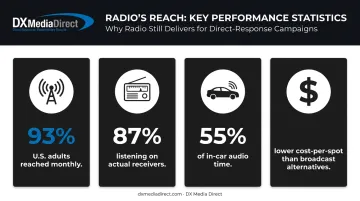
If your digital campaigns are missing older audiences or commuters, radio fills that gap. Rather than competing with digital, it extends reach into places digital-only plans structurally can't go.
The Four Steps of Radio Media Planning
Every solid radio plan moves through four stages. Skip one, and the whole campaign gets shakier.
Step 1: Market & Audience Analysis
Before touching a single station rate card, planners need to understand:
- Who the target listener is (age, income, lifestyle, purchase habits)
- What competitors are already advertising on-air
- Regional listening patterns specific to that market
- Seasonal or event-driven shifts in listening habits, such as holidays or back-to-school periods
This research determines which formats (News/Talk, Country, Urban, Adult Contemporary) actually overlap with your buyer, rather than just "sounding right" for the brand.
Step 2: Setting Media Objectives
Vague goals like "build brand awareness" don't survive contact with a budget review. Objectives need to be SMART: specific, measurable, achievable, relevant, and time-bound.
Better examples look like this:
- Generate 200 tracked calls to a radio-only number within an 8-week flight
- Increase visits to a tagged landing page by 15% within six weeks
- Attribute 100 sales to a specific offer code by campaign end
Step 3: Strategy Development & Execution
This is where the plan gets tactical. Key decisions include:
- Daypart selection: morning drive, afternoon drive, midday, evening, or overnight
- Scheduling pattern: continuity (steady spend), flighting (on/off bursts), or pulsing (baseline spend with periodic spikes)
- Placement negotiation: locking in inventory and spot lengths that match the message
Step 4: Evaluation & Optimization
Once the campaign airs, measurement tools separate what worked from what didn't:
- Promo codes tied to specific stations or dayparts
- Vanity URLs for tracking web traffic by source
- Call tracking numbers unique to each flight
Findings from this stage feed directly back into the next flight, reallocating budget toward what's converting and cutting what isn't.
The 5 M's of Radio Media Strategy
Layered on top of the four-step process, the 5 M's give planners a strategic checklist pulled from Kotler and Keller's advertising framework. Each answers a different question about the campaign.
| M | Core Question | Radio Application |
|---|---|---|
| Mission | What's the objective? | Drive calls, store visits, or brand recall |
| Money | How much can be spent? | Enough budget to hit target reach and frequency |
| Message | What should the ad say? | One clear offer, one clear CTA, built for audio |
| Media | Which stations/dayparts? | Format and inventory matched to the audience |
| Measurement | How will results be judged? | KPIs defined before the campaign launches |
A few of these deserve a closer look.
Message matters more in radio than almost any other medium, because listeners can't scroll back and re-read a spot. Copy needs to be concise, repeatable, and built around a single call to action: a phone number repeated twice or a memorable URL, not three competing offers crammed into 30 seconds.
Media selection benefits from breadth of inventory. DX Media Direct, for instance, brings national buying power and remnant-inventory access across major-market stations, spanning formats from Urban and News/Talk to Spanish-language programming. That range matters because the right format for a 55-plus healthcare client looks nothing like the right format for a 25-34 retail brand.
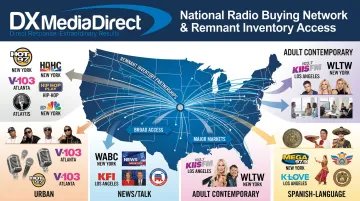
Measurement has to be defined before launch, not after. If you don't know what "success" looks like on day one, you can't tell if the campaign delivered it on day 60.
Radio Media Buying Tactics & Metrics That Maximize ROI
Once the strategy is set, buying efficiency determines how far the budget actually stretches.
Cost-Per-Point and the Reach/Frequency Tradeoff
Cost-per-point (CPP) is the cost of reaching 1% of a target demographic. It's calculated as total schedule cost divided by gross rating points (GRPs), and it's the standard way to compare rates across stations and dayparts fairly.
Reach and frequency pull against each other: reach is the number of unique listeners exposed to your ad, while frequency is how many times each listener hears it.
The Radio Advertising Bureau recommends at least three exposures within a purchase cycle, typically spread across 4-8 weeks. One exposure rarely moves anyone to act. A heavy weekly schedule can push reach past 78%, but that comes at a real cost: chase frequency too hard and you'll saturate a small audience instead of growing it.
Dayparts Shape Both Cost and Audience
- Morning drive (6-10am): Commuters, higher cost, strong reach
- Afternoon drive (3-7pm): Similar commuter value, premium pricing
- Midday: Workplace and errand-running audiences, moderate cost
- Evening/overnight: Cheaper frequency, narrower audience fit
Pattern recognition across past campaigns (which daypart-format combinations actually generated calls for a similar product category) often matters more than any single rate card.
Why Relationship-Based Buying Outperforms Programmatic Radio Buys
Self-serve and programmatic radio platforms operate off rate cards and algorithms. They buy at whatever price the system assigns, with no room to negotiate.
Agencies with long-standing network relationships work differently. DX Media Direct has spent 35+ years building direct relationships with station and network sales reps — the kind of access a portal simply can't replicate. That translates into:
- Negotiated remnant inventory at 75% to 90% below standard rate card pricing
- A $500,000 budget that can deliver the equivalent of $2 million to $5 million in airtime value
- Pattern recognition across thousands of executed campaigns, spotting whether a weak result comes from the media mix or the creative, and fixing both
As one client, Sharon Shalet of Senior Living Advisors, put it: "From choosing a station to creating the spots, they held our hands all the way."
Example of a Radio Media Plan
Here's a simplified plan for a hypothetical local HVAC company aiming to generate calls during peak season.
Campaign snapshot:
- Objective: Generate qualified inbound calls
- Audience: Homeowners 35-64, within a 25-mile service radius
- Format fit: News/Talk and Adult Contemporary stations, matching commuter and homeowner listening habits
Sample flighting approach:
- Peak season (summer): Heavier spend across morning and afternoon drive
- Shoulder months: Reduced frequency, maintaining minimal presence to keep the brand top-of-mind
- Off-peak (winter): Pause or scale back significantly, resuming ahead of the next seasonal push
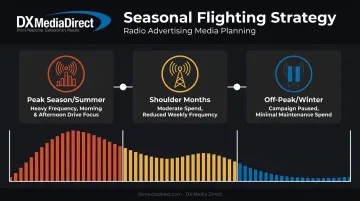
Actual rates and performance figures vary widely by market and station — always request current quotes rather than relying on published averages.
Quick checklist to build your own plan:
- Define the goal (calls, visits, sales)
- Profile the target audience
- Split budget across 2-3 dayparts
- Choose a scheduling pattern (continuity, flighting, or pulsing)
- Write one clear message with a single CTA
- Set measurement tools before launch (call tracking, promo codes, vanity URLs)
Agencies like DX Media Direct, with decades of daypart and station-level data, can turn this checklist into a fully calibrated media plan rather than a guessing game.
Frequently Asked Questions
What are the four steps in radio media planning?
The four steps are market analysis, objective-setting, strategy development/execution, and evaluation. Each stage builds on the last, moving from research to a measurable outcome.
What are the 5 M's of radio media strategy?
Mission (objective), Money (budget), Message (what the ad says), Media (station/daypart selection), and Measurement (how results are judged). It's a checklist layered on top of the four-step process.
What is an example of a radio media plan?
A local service business might target homeowners with calls as the goal, split budget across morning and afternoon drive, and flight spend heavier during peak season. See the walkthrough above for the full structure.
How much does radio advertising typically cost?
Costs vary widely by market, daypart, and station size, a single spot can range from a few dollars to several hundred. Cost-per-point (CPP) is the standard way to compare pricing fairly across stations.
What is the difference between reach and frequency in radio advertising?
Reach is the number of unique listeners exposed to your ad. Frequency is how many times each listener hears it. Both need to work together: low frequency rarely drives a response, no matter how strong the reach.
Is radio advertising still effective today?
Yes. According to Nielsen, AM/FM still reaches 93% of U.S. adults monthly and holds the largest share of ad-supported audio listening, extending reach well beyond digital-only audiences. Effectiveness still depends on audience fit, message, and adequate frequency.