That headline number, though, doesn't tell the whole story. Cost swings widely depending on the broadcasting network, where your ad lands in the game, and how early you commit to buying in.
This article breaks down what a 2026 Super Bowl ad actually costs, what's driving prices to these levels, the hidden expenses beyond airtime, and whether the investment makes sense for your business. Spoiler: for most advertisers, it doesn't, and there's a smarter way to reach a mass audience.
Key Takeaways
- $8 million buys 30 seconds in the 2026 Super Bowl, with select NBC slots topping $10 million
- Total campaign costs (production, talent, promotion) often reach $15 million to $30 million, 2-3x the airtime price alone
- Network exclusivity and bundled Olympics packages, combined with record viewership, are pushing prices to new highs
- Local affiliate buys give regional advertisers Super Bowl reach at a fraction of the national rate
- Direct-response TV strategies deliver more measurable ROI than a single mega-spend for most businesses
How Much Do Super Bowl Ads Cost in 2026? (Pricing Overview)
There's no single price tag for a Super Bowl commercial. Cost depends on which network is airing the game, how far in advance you buy, and which slot you're purchasing within the broadcast.
For Super Bowl LX, NBCUniversal reported record pricing and demand:
- $8 million average rate per 30-second spot, according to a CNBC report on the 2026 ad market
- $10 million+ for a "handful" of premium units, according to network ad chief Mark Marshall, a first for the network
- September 3, 2025 sellout for national ad inventory, nearly five months before kickoff and before the regular season had even wrapped, according to Adweek's coverage of the sellout
Here's how pricing breaks down by tier:
| Ad Tier | Cost Range | What's Included | Best For |
|---|---|---|---|
| Standard national slot | ~$8 million | Broadcast airtime only, mid-game placement | Large brands with dedicated national budgets |
| Premium/high-visibility slot | $10 million+ | Priority placement (first quarter, post-halftime) | Brands chasing maximum cultural impact |
| Local/regional affiliate time | $15,000-$2 million | Airtime in a specific city or DMA (designated market area) only | Regional businesses testing the audience affordably |
One critical clarification: every figure above covers airtime only. Production, talent fees, and promotional spend are separate costs, and they add up fast. More on that below.
Key Factors That Affect Super Bowl Ad Costs
Super Bowl pricing isn't arbitrary. It's shaped by network economics, scheduling decisions, and how badly advertisers want in.
Network and Year of Broadcast
The broadcasting rights rotate annually between NBC, CBS, and Fox, and each network sets its own rate based on its audience deals and ad sales strategy. Here's how the price has climbed over the decades:
- 1967: $37,500
- 1987: $600,000
- 2007: $2.385 million
- 2017: $5 million
- 2026: $8-10 million
That's more than a 200x increase since the first Super Bowl.
Ad Slot Placement and Timing
Not all slots are priced equally. First-quarter spots and the units airing immediately after halftime typically command a premium because viewership peaks during those windows.
Overtime adds another wrinkle. Networks have historically kept a small reserve of contingency inventory (around $4 million per 30-second unit in recent years) in case the game runs long, as it did during the 2017 overtime finish.
Bundled Media Packages
NBC didn't sell Super Bowl LX in isolation. The network packaged it inside "Legendary February," a 17-day stretch that also included the Milan Cortina Winter Olympics and NBA All-Star Weekend. Roughly 70-75% of LX advertisers also purchased Olympics inventory, letting them spread costs across multiple high-profile broadcasts rather than absorbing one massive expense.
Viewership and Cultural Relevance
Super Bowl LX drew an average of 125.6 million viewers, with a peak of 137.8 million, making it the second most-watched broadcast in television history according to Nielsen's official viewership report. It's one of the last events that reliably delivers a true mass audience as streaming fragments the rest of television, and networks price accordingly.
Advertiser Demand and Early Sellouts
Because inventory sells out months in advance, any brand that waits until January faces a shrinking pool of leftover slots, usually at whatever price the network wants to charge. Early demand creates its own inflation.
The Real Cost of a Super Bowl Ad: Beyond the Airtime
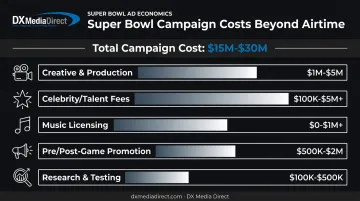
The $8-10 million headline number is just the entry fee. Once you add production, talent, and promotion, total campaign costs typically land between $15 million and $30 million, sometimes higher, according to The Hollywood Reporter's breakdown of 2026 Super Bowl ad spending.
Here's where the rest of the budget goes:
| Cost Category | Range | Notes |
|---|---|---|
| Creative & production | $1M-$5M | Agency fees, scriptwriting, set design, high-end filming crews |
| Celebrity/talent fees | $100K-$5M+ | A-list stars command $2M-$5M; cameo appearances run $100K-$1M |
| Music licensing | $0-$1M+ | A hit song from a major artist costs far more than a custom score |
| Pre/post-game promotion | $500K-$2M | Teaser trailers, social boosting, streaming extension |
| Research & testing | $100K-$500K | Focus groups, brand lift studies, sentiment tracking |
Two patterns emerge from this breakdown. Talent costs can rival the airtime price tag for brands chasing star power, and promotion is no longer optional. Most brands release their ads online days before the game to build buzz, then keep boosting them afterward to extend the shelf life of a $10 million investment.
Is a Super Bowl Ad Worth the Investment?
The appeal is obvious: over 125 million viewers, instant cultural conversation, and the kind of viral replay value no other ad slot offers. About half of surveyed viewers in past studies say they've made a purchase influenced by a Super Bowl commercial. That sounds compelling, until you realize it doesn't guarantee anything for your specific brand or budget.
Several major advertisers have walked away for exactly this reason:
- GoDaddy dropped out after 11 straight years, shifting toward "more targeted" marketing instead of what its own executives called a "generic megaphone"
- Avocados From Mexico exited after eight years of Super Bowl spots, moving budget toward college football, where nearly 1,600 games offer more targeted, affordable placement
- CarMax once bought local spots across 48 markets for about $5 million instead of a $10 million national buy, because its store footprint only covered half the country anyway
The pattern here matters: reach without relevance doesn't equal return. A 30-second national spot reaches people who will never set foot in your store, use your service, or fit your target customer profile. You're paying premium rates for scale, not precision.
This is where the math changes for most businesses. Instead of gambling $15-30 million on one game, a smarter approach uses TV strategically:
- Test smaller, structured campaigns before committing major budget
- Target dayparts and networks that match your actual customer base
- Track results through phone numbers, promo codes, and landing pages, not just impressions
This is exactly the gap a specialized media buying partner fills. DX Media Direct has spent 35 years building direct relationships with network sales reps across FOX, NBC, ESPN, CBS, Hulu, and dozens of other networks, giving them access to remnant inventory that automated platforms simply can't touch.
That access can mean securing rates 75-90% below published rate-card pricing, turning a $500,000 test budget into the equivalent of $2 million to $5 million in airtime value. For a business without an eight-figure marketing budget, that's a far more defensible starting point than a single Super Bowl gamble.

What Advertisers Often Miss About Super Bowl Ad Costs
Even brands with the budget to play at this level make avoidable mistakes. The most common ones:
- Underestimating total spend. Fixating on the $8-10 million media buy while ignoring that production, talent, and promotion routinely double or triple the real cost.
- Treating media buying as a commodity. Securing favorable rates and the right dayparts takes relationship-driven negotiation, not a self-serve programmatic dashboard.
- Assuming budget size guarantees results. A massive spend won't fix weak creative or a poor media mix. Structured tests before a major commitment show what's actually working first.
Winning with TV advertising, Super Bowl-scale or not, comes down to testing, measuring, and scaling based on data, not writing the biggest check and hoping for the best. That discipline, not budget size, determines which campaigns turn into profit.
Frequently Asked Questions
How much does it cost to put a commercial on TV during the Super Bowl?
The 2026 average is roughly $8 million per 30 seconds, with some premium slots exceeding $10 million. Pricing varies based on the broadcasting network, slot timing, and how early you buy in.
Who paid the most for Super Bowl ads?
Anheuser-Busch remains the biggest historical spender, investing over $239 million in Super Bowl airtime between 2003 and 2012 alone. On the network side, NBC's 2026 broadcast set a new record, selling several slots for over $10 million each.
Do Super Bowl ads make money?
Results vary widely by brand. Some ads drive documented purchase intent and brand lift, while others fail to recoup costs, which is why companies like GoDaddy and Avocados From Mexico have both paused their participation in past years.
How much does a 60-second Super Bowl ad cost?
Longer spots typically cost roughly double the 30-second rate, with 60-second units reportedly reaching up to $20 million in 2026. Some networks offer modest discounts for advertisers buying multiple spots.
Why are Super Bowl ads so expensive?
Record-breaking viewership (125.6 million average viewers in 2026), cultural relevance, and limited inventory give networks leverage to charge a premium. Few other broadcasts still deliver this level of mass audience.
Can small businesses afford Super Bowl advertising?
Local affiliate ad time offers a lower-cost entry point, often starting around $15,000 per market. That said, most small businesses see stronger, more measurable ROI through targeted direct-response TV strategies instead of a national Super Bowl slot.