Here's the pain point: most businesses can't tell the difference between spending more and spending strategically. They pour money into TV, digital, and social without a clear plan for where that money actually works hardest. The result is wasted budget, inflated cost-per-acquisition, and campaigns that never quite prove their worth.
This guide breaks down what media buying actually is, the three buying models advertisers use (including one that most programmatic-first content skips entirely), and how to build a testable, negotiation-driven media buying strategy that doesn't just spend money — it spends it well.
Key Takeaways
- Media buying purchases ad placements; media planning sets the strategy first
- Direct, programmatic, and relationship-based buying each offers different costs and control levels
- Smart buying relies on testing and negotiation, not automation, to cut acquisition costs
- Relationship-based buying built over decades unlocks rates and inventory that algorithms can't reach
What Is Media Buying?
Media buying is the process of purchasing ad space or airtime across both traditional channels (TV, radio, print, out-of-home) and digital channels (search, social, display, streaming) to put a brand's message in front of a specific audience. It's the execution layer of advertising: the point where a strategy turns into an actual, paid placement.
That last word matters: paid. Media buying differs from PR and content marketing, which build awareness organically without a direct exchange of money for placement.
With media buying, you're paying a publisher, network, or platform for guaranteed space. The American Marketing Association draws this exact line between paid placements and earned or owned media.
Example of Media Buying in Action
Picture a national furniture retailer buying a 30-second spot during the 6 p.m. news on a regional network. There's a published rate-card price for that slot. There's also a negotiated price — the one a skilled buyer with an existing relationship at that network can secure instead.
That gap between rate card and negotiated rate is where media buying either earns its keep or doesn't.
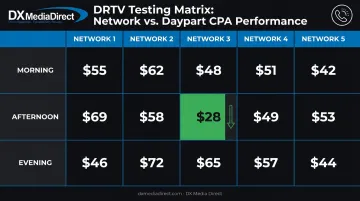
Direct-response TV takes this further. A business testing a new offer might run it across five networks and three dayparts simultaneously, tracking calls and conversions in real time. The goal is identifying which network-daypart combination produces the lowest cost per acquisition, so future spend goes exactly where it performs.
Why Media Buying Matters More Than Ever
Media costs are climbing at a market level, not just anecdotally. Global media-cost inflation hit 4.3% in 2025, with US inflation at 3.8%, according to WFA Outlook data reported by MediaPost.
Meanwhile, audiences keep scattering. Nielsen reported that streaming reached 44.8% of total US TV usage in May 2025, overtaking the combined share of broadcast and cable for the first time, with streaming usage up 71% since 2021.
Higher costs plus more fragmented attention means inefficient buying drains budgets faster than ever. Every placement decision now carries more weight than it did five years ago.
Media Buying vs. Media Planning
These two terms get used interchangeably, and that's a mistake worth fixing. Media planning is the strategy phase. It's where a team researches the target audience, selects channels, and allocates budget across them. Media buying is the execution phase, negotiating and purchasing the actual placements the plan calls for.
Planning decides where you want to advertise and how much you're willing to spend. Buying determines what you actually pay, what inventory you get, and whether the plan's assumptions hold up once real money hits real placements.
A few practical distinctions:
- Planning asks: Who's our audience? Which channels reach them? How should budget split across TV, digital, and radio?
- Buying asks: What's the best rate for this placement? Which network rep can get us premium inventory? How do we negotiate below rate card?
- Planning happens once (with periodic revisits); buying happens continuously, deal by deal, placement by placement
Here's the part that gets overlooked: even a brilliant plan collapses without skilled buying execution.
A perfect audience strategy built around prime-time inventory means nothing if the buyer pays full rate card for it and blows the budget in week two.
Planning sets the direction. Buying determines whether the campaign can actually afford to get there.
The two functions work as a continuous feedback loop: buying performance informs the next planning cycle, and planning assumptions get tested against real rates each time a placement is negotiated.
Media Buying Models: Direct, Programmatic & Relationship-Based Buying
Not all media buying happens the same way. Three models dominate the landscape, and picking the wrong one for your campaign type is one of the fastest ways to overpay.
Programmatic and real-time bidding (RTB) use automated, data-driven auctions to purchase digital inventory at scale, often in fractions of a second. It's efficient for reach.
eMarketer forecast that programmatic transactions would account for more than 90% of US digital display ad dollars in 2024. That's a display-specific figure, not a claim about all advertising, but it shows how dominant automation has become for digital placements.
Direct and relationship-based buying works differently. Instead of an algorithm bidding into an open auction, a human buyer negotiates directly with a network representative or publisher. No self-serve portal. No standardized rate card acceptance. Just a conversation about what's available, what the campaign needs, and what price makes it work.
Why Relationships Still Beat Algorithms
This is the model most programmatic-first content ignores, and it's where decades of network relationships pay off. DX Media Direct has spent 35+ years building direct partnerships with networks (ESPN, Fox News, CNN, HGTV, and 100+ others) that give clients priority placement and pricing an algorithm simply can't access.
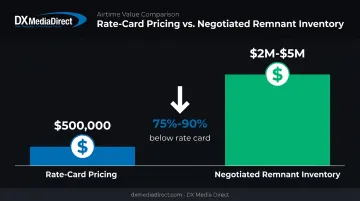
The mechanism is remnant inventory: unsold ad slots networks need to move before airtime expires. A buyer with the right relationships can negotiate these slots at 75% to 90% below rate card.
In practical terms, a $500,000 budget at rate-card pricing buys $500,000 in airtime. The same budget, negotiated through remnant inventory, can buy the equivalent of $2 million to $5 million in airtime.
An algorithm can't replicate this. It has no relationship with a network sales rep and no way to know a station has unsold Tuesday-morning inventory it needs off the books by Thursday. That call happens between people, not platforms.
Programmatic fits best for scalable digital reach, retargeting, and campaigns where volume matters more than individual placement quality. Direct/relationship-based buying fits best for high-stakes brand campaigns and direct-response TV, where rate and placement quality directly determine ROI.
The smartest advertisers rarely pick one model exclusively. They blend both, using programmatic for breadth and relationship-based buying for the placements where negotiation skill actually moves the P&L.
The Smart Media Buying Process: From Strategy to Optimization
Smart media buying isn't a single decision. It's a sequence. Here's the process that separates campaigns with a repeatable playbook from ones that just burn budget.
Define goals and audience first. Get specific about the business outcome (leads, sales, or calls) and who you're targeting before selecting a channel. Skip vanity metrics like raw impressions since they don't pay bills.
Negotiate placements and rates. This is where buying skill separates outcomes. Self-serve bidding accepts whatever the auction produces. A negotiated deal, built on relationship and leverage, consistently beats it.
Run a controlled test before scaling. A structured test, such as a 90-day direct-response TV test, builds a repeatable playbook. Without structure, the same budget produces inconclusive data instead, a real risk when too many variables get tested at once.
Launch, monitor, and diagnose correctly. When performance dips, ask why: is the media mix wrong (network, daypart, channel), or is the creative failing to convert a well-placed audience? Pulling the wrong lever wastes another testing cycle.
Scale only what's proven. Accumulated pattern recognition (which dayparts convert for which product categories, which networks deliver viewers versus buyers) reduces guesswork in every subsequent campaign.
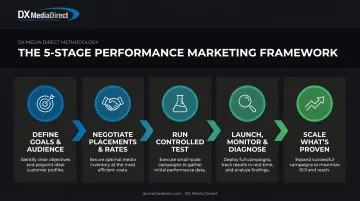
That fifth step compounds over time. Decades of cross-category buying data mean a test doesn't start from zero; it starts from an informed hypothesis about where response is most likely.
Common Media Buying Mistakes That Waste Ad Spend
Even well-funded campaigns bleed money through a handful of repeatable mistakes.
- Going all-in on automated platforms. Skipping negotiated buying means paying rate-card pricing by default. ANA's 2025 benchmark found $26.8 billion in wasted programmatic spend industry-wide.
- Targeting too broadly or skipping conversion tracking. IAB's 2024 survey found 66% of digital-video buyers report measurement problems, with CTV issues cited by 67%. Without clean tracking, you can't tell which placements earn their spend.
- Treating the media plan as "set and forget." Markets shift and networks renegotiate constantly, so an unrevisited plan quickly falls out of sync with performance data. Continuous testing keeps cost per acquisition in check.
The common thread across all three is clear: each mistake removes a human check, such as negotiation, tracking, or ongoing optimization, that automated systems don't apply on their own.
Frequently Asked Questions
What exactly is media buying?
Media buying is the process of purchasing ad placements across TV, radio, streaming, and digital channels to reach a target audience at the right time and cost. It's the execution stage that follows media planning.
What is an example of media buying?
A brand negotiating a 30-second TV spot in a specific daypart, below the published rate card, is a classic example. Direct-response advertisers go further, testing the same offer across multiple networks and dayparts simultaneously.
What's the difference between media buying and media planning?
Media planning sets the strategy: audience research, channel selection, budget allocation. Media buying executes that strategy by negotiating and purchasing the actual placements. Neither works well without the other.
What is programmatic media buying and how does it differ from direct buying?
Programmatic buying uses automated, real-time auctions to purchase digital inventory at scale. Direct buying involves a human negotiating placements directly with a network or publisher rep, often accessing rates and inventory that never enter an automated marketplace.
Is direct-response TV advertising still effective in a digital-first world?
Yes, when paired with proper testing and negotiated media buying. DRTV remains one of the few channels that ties ad spend directly to trackable conversions, keeping it measurable even as consumer attention fragments across platforms.
How much should a business budget for media buying?
Budgets vary widely by industry and goals, so there's no universal number. A structured test phase, rather than a full-scale budget commitment upfront, helps determine what an efficient, scalable spend level looks like for your specific offer.