Introduction
Digital ad costs keep climbing. Google itself admitted to raising search-auction prices by up to 5%, and as much as 10% for some queries just to hit revenue targets. Add in feed fatigue and shrinking organic reach. Marketers are staring at diminishing returns from the channels they've leaned on for a decade.
That's pushed a lot of businesses back toward television, but usually with the wrong questions. They ask about reach and prestige instead of leads, cost per acquisition, and return on ad spend.
This article skips the theory. Here are 10 advantages of TV advertising, framed around outcomes you can actually track.
Key Takeaways
- TV advertising delivers reach and trust that social media ads can't match
- Daypart, addressable, and CTV targeting eliminate most "spray and pray" waste
- Direct-response tactics turn TV into a measurable revenue channel, not just brand spend
- Cost-effectiveness depends more on media buying relationships than raw budget size
What Is TV Advertising?
TV advertising is the purchase and placement of video commercials across linear broadcast, cable, and connected/streaming TV to reach viewers during or alongside programming.
Businesses typically use it for:
- National and local brand campaigns
- Direct-response offers (calls, promo codes, web visits)
- Product launches
- Regional business promotion
TV advertising works toward a specific outcome, whether that's awareness, leads, or sales.
10 Advantages of TV Advertising
These advantages are grouped around measurable, operational impact, meaning reach, trust, engagement, targeting, and revenue, rather than purely creative appeal. Each one ties back to a metric advertisers already track: cost per acquisition, brand recall, or media efficiency.
1. Massive, Broad-Based Reach
A single TV campaign can put your message in front of millions of viewers at once, spanning broadcast, cable, and streaming platforms simultaneously. No other channel compresses that much reach into one buy.
Streaming has only expanded this. Comscore counted 96.4 million U.S. CTV-streaming households as of August 2025, an increase of 849,000 households year over year. Layer that on top of traditional broadcast and cable audiences, and you get a media footprint few other channels can touch.
2. Multi-Sensory Storytelling Drives Recall
Sight, sound, and motion working together create a stickier impression than a static image or a five-second scroll. TV commercials engage viewers on multiple sensory levels at once, which is exactly why they tend to stick.
A MediaScience study for Comcast Advertising found unaided ad recall was more than double on a TV screen compared to the same ad viewed on mobile. That's a controlled lab result, not a universal guarantee, but the direction is consistent: bigger screens and longer-form storytelling leave a deeper mark.
3. Builds Instant Brand Credibility and Trust
Getting on TV costs money and clears production hurdles. Viewers know this, even subconsciously, and it signals legitimacy in a way a boosted Instagram post never will.
The trust gap is significant. TVB's 2025 Media Comparisons study found 74% of U.S. adults trust local broadcast TV news, compared to just 39% for social media. That's nearly double the confidence, and it carries over to the brands that advertise within that trusted environment.
4. High Viewer Engagement During Focused Viewing
TV viewing is passive but focused. Viewers sit with the screen; they're not simultaneously texting, scrolling a second app, and half-watching like they are on mobile.
That attention peaks during high-interest programming:
- Live sports broadcasts
- Award shows
- Season premieres of popular series
Advertisers who buy into these moments get more than reach. They get audiences that are actually watching.
5. Targeted Reach Through Dayparts, Local Markets, and Addressable TV
The old "TV means untargeted, national reach" assumption no longer holds. Modern buying tools let advertisers narrow the audience without giving up scale:
- Dayparts: schedule ads during the hours your specific audience actually watches
- Local/regional buys: target specific DMAs instead of paying for national coverage
- Addressable TV — deliver different ads to different households watching the same program, based on data-driven targeting rather than broad demographics
This precision reduces wasted impressions compared to a blanket national buy, meaning more of your budget lands in front of people likely to actually respond.
6. Wide Demographic Appeal Across Age Groups
Few channels reach teenagers and seniors with the same medium. TV does, thanks to the sheer variety of networks and programming formats available across broadcast, cable, and streaming.
That breadth matters for:
- Mass-market products with broad appeal
- Multi-generational household purchases and family-wide brand building, spanning insurance, home services, and healthcare
7. Drives Direct, Trackable Response When Structured Correctly
This is where TV stops being "brand awareness" and starts showing up as a line item with actual numbers behind it. Direct-response formats give every airing a way to be measured:
- Vanity URLs unique to the campaign
- Dedicated call-tracking phone numbers
- Unique promo codes tied to specific spots
- QR codes linking viewers directly to a landing page or offer
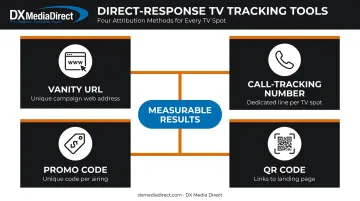
Why this matters: tying exposure to response removes guesswork from media planning. Instead of debating whether TV "worked," you can point to call volume, code redemptions, and site visits tied to specific airings.
TV ads also drive real search behavior. TVB's 2025 Purchase Funnel study found most of adults who searched online said TV ads influenced which brands they searched for, a signal that the funnel doesn't stop when the commercial ends.
KPIs impacted: cost per acquisition, lead volume, sales lift, return on ad spend.
When it matters most: campaigns built to generate revenue, not just awareness. Structured 90-day market tests, the kind experienced direct-response agencies like DX Media Direct run for clients, turn early results into a repeatable playbook instead of one-off, inconclusive data.
8. Cost-Effective When Media Is Bought Strategically
"TV is expensive" is a half-truth. Rates swing wildly by daypart, network, and, most importantly, who's negotiating.
Relationship-based media buying, meaning direct negotiation with network representatives instead of routing everything through an automated insertion-order portal, secures rates and inventory that programmatic platforms simply can't access. Programmatic tools optimize within available inventory; they don't build the decades-long relationships that unlock preferential rates in the first place.
Why this matters: lower effective media costs improve ROI without cutting reach. DX Media Direct's 35+ years of network relationships, for example, translate into rates that newer or self-serve buyers rarely see.
KPIs impacted: cost per point, effective CPM, overall media efficiency.
When it matters most: multi-market or multi-daypart campaigns, where small per-spot savings compound fast at scale.
9. Synergizes With Digital and Social Channels
TV rarely operates in isolation. A commercial airs, and search volume for the brand ticks up. Social mentions spike. Website traffic sees a bump right after high-visibility spots.
This "halo effect" primes audiences for digital retargeting. Someone who sees your TV spot during the evening news is more likely to click a retargeting ad an hour later, because the brand is already top of mind. Smart advertisers plan digital campaigns to catch that wave rather than running TV and digital in separate silos.
10. Provides Testable, Scalable Playbooks for Growth
Structured testing across markets, creative variations, and offers turns TV into a data-backed playbook instead of a one-time bet. Run the same offer across three test markets with different creative, and you learn what actually moves the needle before committing a national budget to it.
That structure matters because:
- It reduces financial risk before scaling
- It isolates which variable (market, creative, or offer) is driving results
- It gives you a repeatable formula instead of a single campaign's worth of anecdotes
What Happens When TV Advertising Is Missing or Ignored
Skipping TV, or treating it as an afterthought, has real costs:
- Rising acquisition costs: you're left leaning on digital channels alone, right as costs per click keep climbing
- No mass-reach channel feeding the funnel: your pipeline depends entirely on demand you're actively paying to generate, spot by spot
- Missed emotional differentiation: performance channels are built for clicks, not the kind of brand connection that gets created through sight, sound, and motion
- Inconsistent, hard-to-scale results: testing digital in isolation rarely produces the same compounding effect that a structured, multi-channel test does
None of this means digital doesn't work. It means digital alone eventually hits a ceiling that TV, used correctly, can break through.
How to Get the Most Value From TV Advertising
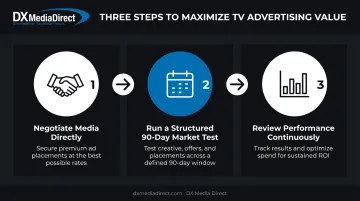
TV advertising compounds in value when it's bought strategically, tested methodically, and measured continuously, not treated as a one-time media buy.
A few things separate advertisers who see real returns from those who don't:
- Negotiate media directly through long-standing network relationships instead of relying on blind, automated insertion orders
- Run a structured test — a 90-day market test, for example, before committing to a full national rollout
- Review performance continuously to distinguish underperforming media placement from underperforming creative and fix what's actually broken
Businesses without in-house media buying expertise often benefit from outside guidance. A free consultation with an experienced direct-response TV agency like DX Media Direct can help evaluate whether TV fits the growth plan and where the budget should actually go.
Conclusion
TV advertising's real advantage lies in pairing mass reach and credibility with a measurable, direct-response structure that turns brand spend into revenue you can track, not a cost you hope pays off eventually.
The benefits compound through consistent testing, negotiation, and optimization, not a single campaign. Businesses evaluating TV should prioritize partners who can prove results in hard numbers, not just impressions. DX Media Direct's 90-day tests follow that standard: tracked revenue, not guesswork.
Frequently Asked Questions
What are the advantages of TV commercials?
TV commercials offer broad reach, high consumer trust, emotionally resonant storytelling, and modern targeting options like dayparts and addressable TV. When structured with call tracking or promo codes, they also deliver measurable, trackable results.
How effective are TV commercials?
TV consistently outperforms mobile and social in recall and trust. Effectiveness rises sharply when campaigns are built for direct response and paired with strategic, relationship-based media buying.
What is the purpose of a TV commercial?
TV commercials build awareness and credibility while creating an emotional connection with viewers. In direct-response formats, they also drive trackable leads through call tracking or promo codes.
Is TV advertising affordable for small businesses?
Yes. Local and regional buys paired with off-peak dayparts can bring TV costs well below national primetime rates. Experienced negotiation pushes costs down further, making TV accessible for smaller budgets.
How is TV advertising different from digital or CTV advertising?
Linear TV is typically bought through direct network negotiation, while CTV often runs through programmatic platforms with household-level targeting and real-time optimization. Both can reach similar audiences through different buying mechanics.
How do you measure ROI from a TV advertising campaign?
Vanity URLs and unique promo codes tie specific ad airings to specific conversions, with dedicated call-tracking numbers adding another attribution layer. Structured 90-day market tests then reveal which markets and creative approaches actually drive revenue.