Here's the catch: "prime time" isn't one price. Cost swings wildly based on national versus local reach, market size, show ratings, and time of year. A late-October buy during election season looks nothing like a June rate.
This article breaks down real prime time pricing ranges, the factors pushing cost up or down, how prime time stacks up against off-peak dayparts, and how to secure prime time-caliber reach without paying full rate-card price.
Key Takeaways
- Local prime spots start in the hundreds; national spots on top shows can hit $50,000-$130,000 per 30 seconds
- Market size, ratings, spot length, and season affect cost more than any flat industry rate
- Prime time draws the biggest audience, but off-peak slots often win on direct-response ROI
- Skilled buyers tap remnant inventory at 75-90% below rate card, stretching every ad dollar further
How Much Does Prime Time TV Advertising Cost? (Pricing Overview)
There's no fixed number for prime time. A 30-second spot might cost a few hundred dollars on a small local affiliate or climb past six figures on a national network airing a hit show. Everything depends on whose slot you're buying and when.
Three misunderstandings trip up first-time TV buyers:
- Assuming national network rates apply to local station buys (they don't — local rates are usually a fraction of national)
- Treating "prime time" as one uniform price tier across every network and market
- Forgetting that airtime and commercial production are two separate budget lines
Local Prime Time (Local Broadcast Stations)
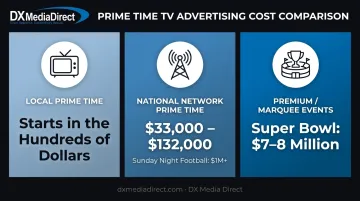
A local prime time buy typically means a 30-second spot on an ABC, NBC, CBS, or FOX affiliate during the 8-11 PM block. Small and midsize markets generally price these spots far below the national averages reported by trade press.
Top-10 DMAs like New York, Los Angeles, or Chicago push rates substantially higher, thanks to sheer audience size.
Best for: Local and regional advertisers who want strong community-level reach without committing to national-scale spend.
National Network Prime Time
This means a 30-second spot on a major broadcast network during a top-rated primetime series. Pricing varies dramatically by show. According to Ad Age's 2024-25 agency survey, average 30-second rates ran $33,756 for "Krapopolis," $57,755 for "20/20," $95,139 for "Survivor," and $131,943 for "American Idol."
Live sports command their own tier entirely. That same survey found NBC's "Sunday Night Football" averaged $1,008,746 per 30 seconds, up 14% year over year.
Best for: National brands with sizable budgets seeking mass simultaneous reach and brand credibility.
Premium/Marquee Event Prime Time
Live events, finales, championship games, and awards shows push pricing well above standard prime time. Super Bowl LIX inventory started near $7 million per 30 seconds, with some units reaching $8 million.
Best for: Brands with budgets for maximum visibility and cultural relevance, not testing or direct-response goals.
One more thing: these figures cover only the media buy, not production. A basic commercial can cost a few thousand dollars, while a professionally produced spot can run into the tens of thousands. Budget for both separately.
Key Factors That Affect the Cost of Prime Time Advertising
Prime time pricing isn't a flat industry rate. It's shaped by audience size, how much demand exists for a given slot, and market-specific dynamics.
Market Size (DMA) and Station Reach
Advertising in a top-10 DMA costs dramatically more than a small or midsize market simply because more households are watching. National network reach and local station reach also change the pricing math entirely: a network buy spreads across hundreds of affiliates simultaneously, while a local buy only covers one market's viewers.
Show Ratings and Popularity
Networks price slots using Nielsen ratings data, so a hit show costs far more than a lower-rated show in the same time block. NBC's "Sunday Night Football" has been prime time's No. 1 show for a record 14th consecutive year, which explains why it commands over $1 million per 30-second spot while other primetime programs sit closer to $30,000-$130,000.
Ad Length and Frequency
- A 15-second spot typically costs meaningfully less than a 30-second spot, with historical industry research pegging it around 60-80% of the 30-second price
- A 60-second spot can run close to double the 30-second rate
- Buying in bulk or committing to longer flights can shift per-spot pricing lower
Seasonal and Event-Driven Demand
Q4 holiday season, election cycles, and major sporting events all drive prime time rates upward. Live sports inventory illustrates this well: Sunday Night Football climbed 14% year over year, while Monday Night Football rose 13% to $637,718 per 30-second spot in the same period. Expect similar upward pressure across the broader market during these high-demand windows.
Network Relationships and Media Buying Approach
Published rate cards set a baseline that shifts significantly through negotiation. Agencies with long-standing network relationships can negotiate preferential rates and inventory access that programmatic or self-serve platforms structurally cannot match, since those platforms price strictly off fixed exchange rates rather than direct negotiation.
Prime Time vs Off-Peak: Is the Premium Worth It?
Prime time isn't automatically the smartest buy for every advertiser. The right choice depends on how much audience size you need versus how efficiently you need to spend the budget.
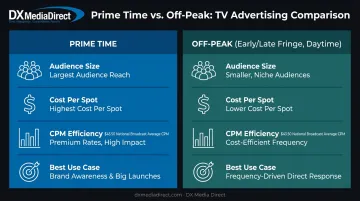
| Factor | Prime Time | Off-Peak (Early/Late Fringe, Daytime) |
|---|---|---|
| Audience Size | Largest, most concentrated audience of the day | Smaller but often highly specific (stay-at-home parents, night owls) |
| Cost Per Spot | Highest per-spot cost on any given station | Costs far less on a comparable local station |
| CPM Efficiency | Premium CPM justified by scale and engagement — national broadcast CPM for 2025-26 sits near $43.50 for adult viewers | Often lower CPM, useful for building frequency affordably |
| Best Use Case | Brand launches, major announcements, broad simultaneous reach | Direct-response campaigns, frequency building, budget-conscious testing |
For direct-response advertisers specifically, off-peak dayparts often deliver comparable ROI at a fraction of the cost. Prime time earns its premium through scale and cultural visibility, not necessarily through better conversion economics. DX Media Direct's network relationships extend to remnant inventory and off-peak slots, often securing rates programmatic platforms can't match.
How to Get Prime Time Reach Without Overpaying for It
The rate card is a ceiling, not a fixed price. Several proven tactics can lower your effective cost while still reaching prime time-caliber audiences.
- Consider adjacent dayparts. Early and late fringe often deliver much of prime time's audience quality at a noticeably lower price point.
- Explore remnant inventory. Networks discount unsold prime time slots as air dates approach. Skilled buyers can secure this inventory at 75-90% below rate card pricing, turning a $500,000 budget into $2 million to $5 million in rate-card value.
- Don't assume uniform pricing. Prime time rates vary widely by network, market, and season — treat every quote as negotiable.
- Budget beyond airtime. Set aside separate funds for production, agency fees, and creative testing alongside your media spend.
Working with an experienced media buying partner changes the equation. DX Media Direct's 35+ years of direct-response TV buying and long-standing network relationships give clients access to rates and inventory that automated or programmatic platforms cannot structurally offer. That turns a prime time decision into a performance-driven investment backed by real data.
Conclusion
Prime time TV advertising cost varies enormously based on market, show ratings, spot length, and season. There's no single "right" number here — a small-market local spot and a Sunday Night Football buy exist in entirely different pricing universes.
Understanding these cost components turns guesswork into a real budget strategy, whether your goal is national brand reach or targeted local direct response. The best prime time strategy balances audience scale with measurable return, and that's where relationships matter: DX Media Direct's 35 years of network buying experience consistently outperform self-serve or programmatic rate cards.
Frequently Asked Questions
How much does it cost to advertise on prime time TV?
Cost ranges from a few hundred dollars for local prime time spots to well over six figures for national network prime time during top-rated shows. Market size and ratings drive most of that variation.
Is it worth advertising on TV?
TV advertising, including prime time, delivers strong brand credibility and broad reach. It's worth it when the daypart and market match your campaign goals and results are tracked for measurable return.
What time is considered "prime time" on TV?
Prime time is generally 8-11 PM Eastern/Pacific (7-10 PM Central) on major broadcast networks. Exact hours can vary slightly by network and region.
Why is prime time advertising so much more expensive than other dayparts?
Prime time commands the largest and most engaged audience of the day. Networks price it at a premium based on Nielsen ratings and advertiser demand for that concentrated reach.
Can small businesses afford prime time TV advertising?
Yes. Local prime time on smaller-market stations is far more accessible than national rates. Pairing it with remnant inventory or an experienced media buyer can secure rates below standard rate card.
How much does a 30-second prime time commercial cost on average?
Local market averages differ substantially from national network averages. Based on industry benchmarks, national entertainment programs have averaged roughly $33,000 to $132,000 per 30 seconds, while live sports and marquee events run far higher.