Channel fragmentation, longer buying cycles, and cookie deprecation have made it genuinely difficult to prove what's actually driving revenue. Many marketing teams struggle to connect a campaign to a dollar amount CFOs will accept without pushback.
The stakes are real. Without proof of effectiveness, marketing gets treated as a cost center — first on the chopping block when budgets tighten, rather than a driver of growth.
This guide covers what you need before launch, the three core measurement methods, how to interpret results correctly, and the mistakes that quietly wreck your data.
Key Takeaways
- Effectiveness measurement needs KPI tracking, attribution modeling, and incrementality testing combined
- Clean tracking and a pre-launch baseline make later results meaningful
- Vanity metrics and last-touch attribution cause the most misleading conclusions
- Structured holdout testing brings digital-level rigor to TV and offline channels
What You Need to Measure Marketing Effectiveness
Choosing the right tools and locking in preconditions before a campaign launches is what separates reliable measurement from a guessing game after the fact.
Tools and Platforms Required
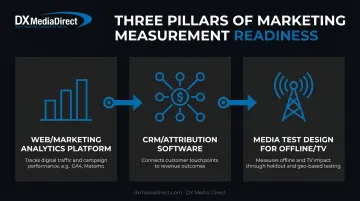
You need three categories of infrastructure, and skipping any one of them creates a blind spot:
- Web/marketing analytics platform (GA4, Matomo, or similar) for conversion and goal tracking
- CRM or attribution software to connect touchpoints and revenue across the full customer journey
- A media test design for offline/TV channels, since pixel-level tracking simply doesn't exist there, meaning a holdout or geo-based structure instead
For channels like TV and radio, DX Media Direct uses call tracking and dedicated attribution tools to connect calls, web visits, and conversions back to specific stations, programs, and dayparts. This bridges the gap between an offline ad and a measurable action downstream.
Preconditions and Setup
Three things need to happen before a single dollar gets spent:
- Define measurable goals tied to a specific business outcome, such as revenue targets, lead volume, or a ROAS number, not vague notions of "brand awareness"
- Establish a historical baseline so campaign results have something real to compare against
- Standardize data collection across every channel with consistent UTM tagging and a unified taxonomy, so reporting doesn't fragment into six disconnected spreadsheets
Skip this step and you'll spend the campaign arguing about whose numbers are right instead of what to do next.
Methods to Measure Marketing Effectiveness
The right method depends on the channel, the data you have access to, and whether you're making a tactical call (creative, targeting) or a strategic one (budget allocation). Most experienced marketers use all three below in combination.
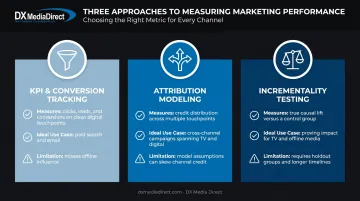
Method 1: KPI and Conversion Tracking
This tracks funnel-stage metrics tied directly to revenue outcomes, rather than surface-level engagement numbers that look nice in a slide deck.
What you need: an analytics platform, conversion/goal setup, and a KPI dashboard.
Step-by-step:
- Define funnel-stage KPIs matched to the campaign objective, such as CAC, CTR, conversion rate, ROAS, and CLV
- Configure conversion tracking and goals inside your analytics platform
- Monitor the dashboard on a set cadence and compare results against pre-set targets
Where it works, and where it doesn't: This method is strong for channels with a clean digital conversion path, such as paid search, email, and e-commerce. It's weak at capturing brand or upper-funnel impact, because a CTR tells you who clicked, not who eventually bought something three weeks later.
Method 2: Marketing Attribution Modeling
Attribution assigns credit across multiple touchpoints to figure out which channels are actually driving conversions, rather than which one happened to be last in line.
What you need: CRM/analytics data and attribution modeling software.
Step-by-step:
- Map every touchpoint a customer interacts with before converting
- Select a model suited to your sales cycle length: first-touch, last-touch, linear, position-based, or time-decay
- Apply the model and reallocate budget toward the channels showing the highest contribution
The IAB's Digital Attribution Primer notes that accuracy degrades fast once walled-garden platforms, long buying journeys, or offline touchpoints enter the picture, because those don't hand over clean, linkable data. Attribution reveals cross-channel contribution well. It's just not built to prove causation.
Method 3: Incrementality Testing and Controlled Media Experiments
This is the only method that measures true causal lift: comparing an exposed test group against a matched holdout or control group. It's the sole reliable option for channels like TV, where user-level tracking doesn't exist at all.
What you need: a test/control market or audience design, sales or response data, and a statistical significance calculation.
Step-by-step:
- Select test and control groups or markets with comparable baseline characteristics
- Run the campaign in the test group only (or vary spend levels) over a defined window
- Compare incremental response or revenue between groups to isolate the lift the campaign actually caused
The Media Rating Council calls randomized controlled trials the "truth standard" for validating incrementality, precisely because exposure is explicitly controlled, not merely inferred. This is exactly the model behind structured direct-response TV testing.
DX Media Direct runs 90-day TV media tests built to generate a clear, scalable playbook backed by hard revenue numbers. That's a different standard than the inconclusive, sampled data programmatic platforms often produce when trying to approximate incrementality through observational data.
How to Interpret the Results
Misreading results is expensive. It can mean scaling a channel that isn't really working, or killing one that actually was.
Strong/Effective performance looks like this:
- KPIs meeting or exceeding targets
- ROAS/ROI trending upward
- Statistically significant incremental lift confirmed in testing
Next step: scale budget and expand to similar audiences or media dayparts.
Moderate/Mixed performance shows up as:
- KPIs within an acceptable range but below target
- Attribution models disagreeing on which channel deserves credit
- Early lift signals present, but the test hasn't run long enough to confirm significance
Next step: test creative or offer variations and extend the measurement window before making a final call. Killing a campaign after two weeks of "meh" data is often premature.
Underperforming/Out-of-spec performance means:
- CAC exceeding CLV
- ROAS below breakeven
- No statistically significant lift found in a controlled test
Next step: pause spend and diagnose the root cause — but diagnose before you cut.
Media-Mix Problem or Creative Problem?
This distinction is where experienced media buyers earn their fee. A campaign can underperform for two very different reasons, and the fix (and the money saved) differs depending on which one is actually broken:
- Media-mix problem: the network, daypart, or audience targeting is off. The creative may be fine — it's just reaching the wrong people at the wrong time
- Creative problem: the placement is sound, but the message, offer, or call-to-action isn't converting
Swap the creative on a media-mix problem and you'll waste another test cycle. Swap the network on a creative problem and you'll do the same. Isolate the variable before you touch the budget.
Common Mistakes That Skew Your Marketing Effectiveness Data
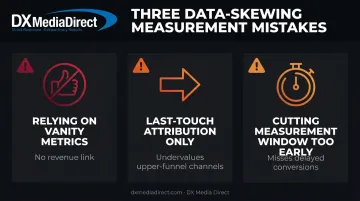
Three mistakes account for most of the misleading conclusions marketers walk away with:
- Relying on vanity metrics. Impressions, likes, and follower counts look impressive in a report but have no proven link to revenue. Nielsen found little correlation between click-through rates and offline sales lift.
- Depending solely on last-touch attribution. This model undervalues upper-funnel channels like content, SEO, and TV, which set the conversion in motion before the final click gets credit.
- Cutting the measurement window too early. High-consideration sales cycles have delayed conversions baked in — end the test at day 14 for a six-week sales cycle, and you'll miss most of the actual results.
Best Practices for Accurate, Actionable Measurement
Three habits separate teams that measure well from teams that just measure often:
- Triangulate methods. Combine KPI tracking, attribution, and incrementality testing (such as a 90-day test that isolates a channel's actual lift) instead of trusting one model or one platform's self-reported numbers. Each method fills a gap the others leave open.
- Keep tagging clean before launch. Consistent UTM structure and taxonomy across every channel prevents fragmented reporting you can't reconcile later.
- Translate results into business language. Report revenue impact and cost per acquisition instead of click totals. These are the numbers leadership uses to approve next quarter's budget.
Measuring marketing effectiveness works as an ongoing cycle: test, interpret, then reallocate spend toward channels that prove out and cut the ones that don't.
Frequently Asked Questions
How do you measure marketing effectiveness?
Set clear goals, track funnel-stage KPIs, and apply an attribution model to see cross-channel contribution. Validate results with incrementality testing, since no single method covers everything alone.
What are the 3 C's of marketing success?
The 3 C's (Company, Customers, Competitors) come from Kenichi Ohmae's strategic triangle framework. They ground your strategy in market reality before you ever start measuring campaign performance.
What is the difference between marketing effectiveness and marketing efficiency?
Effectiveness measures whether marketing achieved its intended outcome, like revenue growth. Efficiency measures the cost per outcome. A campaign can be efficient at small scale without being effective enough to move the business.
Which metrics matter most for measuring marketing ROI?
ROAS, ROI, CAC, and CLV are the core revenue-linked metrics that matter. Vanity metrics like impressions or likes don't reliably connect to actual business outcomes, so they shouldn't drive budget decisions.
How long should a marketing effectiveness test run before drawing conclusions?
Test length depends on your sales cycle and channel, since longer consideration cycles need longer windows. Structured TV tests, like the 90-day model DX Media Direct runs, are built to generate enough volume for statistically confident, scalable results.
Can marketing effectiveness be measured for offline or TV advertising?
Yes, through geo/holdout testing and media mix modeling, both of which create a valid control group without needing pixel-level tracking. DX Media Direct specializes in exactly this kind of testing, backed by decades of direct-response TV experience.