This guide breaks down what marketing planning services actually include, the four types of plans you'll encounter, what they cost, and how to choose between building one in-house, hiring a generalist agency, or working with a direct-response specialist. For businesses that want plans built around provable revenue results rather than vanity metrics, we'll also look at the results-driven approach DX Media Direct has refined over 35 years.
Key Takeaways
- Marketing planning turns strategy into a documented, measurable plan with budgets and KPIs attached
- Costs range from a few thousand dollars for tactical plans to $40,000+ for full strategic work
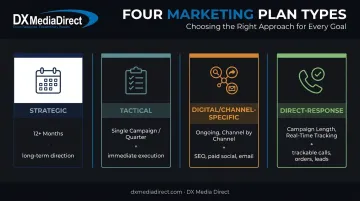
- Four plan types exist: strategic, tactical, digital/channel-specific, and direct-response
- Generalist and programmatic-only providers often lack the negotiated media rates specialists secure
- A 90-day test isolates bad creative from bad media placement before you scale spend
What Are Marketing Planning Services?
Marketing planning is the systematic process of turning a marketing strategy into a documented, tactical action plan. It defines goals, budgets, channels, and KPIs.
Coursera and Investopedia draw a clear line here: a business plan sets overall structure and growth goals, while a marketing strategy defines the long-term value proposition. A marketing plan then spells out the concrete tactics and timelines used to execute that strategy.
Marketing planning services are simply the outsourced version of this work. Instead of an in-house team building the plan, a firm handles the research, planning, media buying, and measurement on your behalf.
Service Marketing vs. Product Marketing Planning
"Service marketing planning" refers specifically to planning for services-based or intangible offerings, as opposed to physical products. Because customers can't touch or preview a service, this type of planning typically requires:
- Trust-building content (testimonials, case studies, credentials)
- Longer sales cycles with more touchpoints before conversion
- Messaging focused on outcomes rather than product features
Who Actually Needs This Service
Beyond this services-vs-products distinction, marketing planning services solve a handful of recurring problems: scattered marketing activity with no coordination, inefficient budget allocation, vague or missing KPIs, and no accountability for results. Businesses that typically need this help include:
- Growing companies without an internal marketing department
- Brands launching a new product, service, or channel
- Companies wanting an outside, unbiased audit of current marketing spend
The Four Types of Marketing Planning
Marketing plans can be sliced many ways, but most fall into four categories. Understanding which one you actually need before hiring a provider saves time and money.
Strategic Marketing Planning
This is the long-term, big-picture plan, usually covering 12 months or more. It defines market position, target audience, and overall direction. Think of it as the 'why' behind every marketing decision that follows. A company entering a new market, for example, spends months here before any ad runs.
Tactical Marketing Planning
Tactical plans are short-term and execution-focused, typically built around a single campaign or quarter. They translate strategy into specific channels, content pieces, and timelines your team can act on immediately.
Digital/Channel-Specific Marketing Planning
This type builds a plan around specific platforms: SEO, paid social, email, or programmatic display.
The catch is that digital ad platforms are increasingly saturated. Google Ads CPC rose 10% year-over-year to $4.66 in early 2024, a clear sign that self-serve digital channels are getting more expensive without any guarantee of proportional results.
Direct-Response Marketing Planning
This fourth type is often overlooked, yet it's tied most directly to hard ROI. Direct-response plans focus entirely on driving a measurable, trackable action, such as a call, an order, or a lead, rather than chasing brand awareness.
A TV spot driving viewers to call a number or visit a website is one example. Every media dollar is judged against that specific response, not an impression count.
What's Included in a Full-Service Marketing Planning Engagement
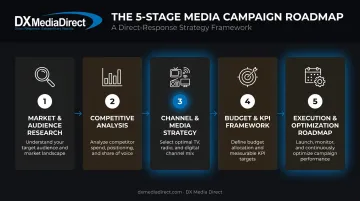
A proper engagement covers five interconnected pieces. Skip one, and the whole plan gets weaker.
Market and audience research. Buyer personas, media consumption habits, and purchase triggers get defined before any tactic gets chosen. Skipping this step is why so many campaigns launch with a guess instead of a target.
Competitive analysis. Benchmarking competitor messaging, offers, and media presence reveals the gaps your plan can exploit.
Channel and media strategy. This is where the mix gets chosen, TV, streaming, radio, outdoor, digital, based on where your audience actually responds, not where it's easiest to buy ads. For many product categories, direct-response TV testing remains one of the most cost-efficient ways to find scalable growth.
Relationship-based media buying matters here. DX Media Direct's 35 years of network relationships and rate negotiation give clients access to remnant inventory and media costs unavailable through self-serve programmatic platforms.
Budget and KPI framework. Specific, measurable targets: cost-per-acquisition, conversion rate, revenue per campaign. Not vague goals like "increase awareness."
Execution and optimization roadmap. A documented calendar for testing, measuring, and scaling what works. A professional planning service typically builds in a defined test window, often a 90-day pilot, before committing to a larger budget. That test period exists for a specific reason: it separates underperforming media placement from underperforming creative before you scale either one.
How Much Do Marketing Planning Services Cost?
Costs vary widely by scope and complexity. Investopedia's benchmarks put professional marketing plans anywhere from $10,000 to $40,000 or more, depending on how deep the research goes and whether execution is bundled in.
Four main factors drive that range:
- Depth of research required: a single-persona tactical plan costs far less than multi-persona strategic research
- Number of channels covered: a plan spanning TV, digital, and radio takes more work than one channel alone
- Media buying inclusion: planning-only engagements cost less than planning plus execution
- Agency experience level: decades of pattern recognition command a different rate than a junior team learning as they go
Here's the part most businesses miss: cost should be measured against expected ROI, not sticker price alone. A cheap DIY plan built on guesswork can cost far more in wasted ad spend than a properly researched, professionally executed one.
The Nielsen data cited earlier makes this concrete: half of all media plans are already underfunded by 50%, and that gap gets worse when the underlying plan is also poorly researched. A free consultation with an experienced agency like DX Media Direct can clarify true scope and expected ROI before you commit budget.
Choosing the Right Marketing Planning Partner: DIY vs. Agency vs. Specialist
Three paths exist, and each fits a different business stage.
| Path | Best For | Key Limitation |
|---|---|---|
| DIY / in-house | Very early-stage businesses with tight budgets | Lacks research depth and negotiated media rates |
| Generalist agency | Businesses needing broad digital coverage | Limited pattern recognition in any single channel |
| Direct-response specialist | Businesses wanting measurable, trackable ROI | Narrower channel focus, but deeper results |
Why Generalist and Programmatic-Only Providers Fall Short
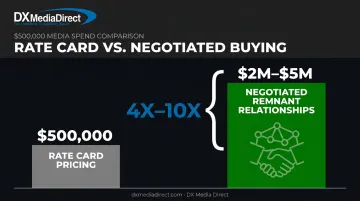
Automated platforms buy available inventory at market rate, optimized by algorithm. What they can't do is access remnant inventory, unsold ad time that networks discount steeply to fill before airtime. That access only comes from relationships built over years with network sales representatives, not insertion orders submitted through a portal.
The financial gap this creates is significant. A $500,000 budget spent at rate card pricing buys roughly $500,000 in airtime. The same budget negotiated through established remnant relationships can produce $2 million to $5 million in equivalent airtime value. That gap can turn a modest test budget into a fully-funded regional campaign.
What to Look for in Any Marketing Planning Partner
- Proven track record of executed campaigns, not just case studies on a website
- Transparent reporting tied to hard revenue numbers, not impressions or clicks alone
- Willingness to test before scaling, rather than pushing straight to a full budget commitment
DX Media Direct has refined this model over 35 years and thousands of executed campaigns, offering a free, no-obligation consultation to map out a scalable media test before any money changes hands.
Vetting Checklist
Before signing with any provider, ask:
- What's your measurement methodology, and how do you attribute a call or sale back to a specific ad?
- What's the minimum budget for a meaningful test?
- What's the realistic timeline to first measurable results?
- Is media buying relationship-based, or are you submitting orders through a self-serve portal?
Frequently Asked Questions
How much do marketing plans cost?
Costs range from a few thousand dollars for a simple tactical plan to $40,000+ for comprehensive strategic plans, depending on research depth and whether execution is included.
What is service marketing planning?
It's planning tailored to intangible, services-based offerings. It requires different trust-building messaging and often longer buyer decision cycles than planning for physical products.
What are the four types of marketing planning?
Strategic (long-term direction), tactical (short-term execution), digital/channel-specific (platform-focused), and direct-response (built around trackable actions like calls or orders).
How long does it take to create a marketing plan?
Tactical plans can take a couple of weeks. Comprehensive, research-heavy strategic plans typically take four to six weeks, sometimes longer depending on scope.
Do I need a marketing plan if I already have a marketing strategy?
Yes. Strategy sets your long-term direction; a plan translates that into specific, measurable actions with budgets and timelines. Most businesses need both.
Can a marketing agency create and execute my marketing plan for me?
Full-service agencies like DX Media Direct handle both planning and execution under one roof, from media strategy through TV, CTV, radio, and digital buying. This end-to-end approach closes the gap that often opens between strategy and actual results.