That's the real problem. Disconnected media can't move a stranger through the actual decision a buyer makes, from "never heard of you" to "here's my card." Teams run these efforts as separate line items with separate KPIs, then wonder why growth stalls despite steady spend.
A full-funnel media strategy is a coordinated media plan that intentionally builds awareness, nurtures consideration, and drives conversion across channels, using shared data and messaging so each stage strengthens the next.
This guide breaks down the frameworks, channel applications, and measurement approach behind a real full-funnel strategy, including why an old-school channel like direct-response TV still plays a role most marketers overlook.
Key Takeaways
- Full-funnel media treats awareness, consideration, and conversion as simultaneous jobs, not sequential steps
- Fragmented daily touchpoints mean single-stage campaigns miss most buyers before they ever convert
- YouTube, podcast, and TV channels apply the same three-layer logic in very different ways
- Last-click attribution undervalues upper-funnel spend; lift testing and MMM reveal its true contribution
- Direct-response TV can build awareness and drive a trackable conversion in the same spot
What Is a Full-Funnel Media Strategy?
"Media strategy" and "marketing strategy" get used interchangeably, but they're not the same thing.
Marketing strategy covers everything: product positioning, brand identity, organic content, PR, pricing. Media strategy is narrower: it's specifically how and where you allocate paid budget across channels like TV, video, social, search, and display to serve each funnel stage.
A full-funnel media strategy applies that paid-budget allocation across all three funnel stages at once:
- Awareness spend introduces the brand to people who don't yet realize they need it
- Consideration spend builds trust with people actively comparing options
- Conversion spend prompts an immediate decision from people ready to buy
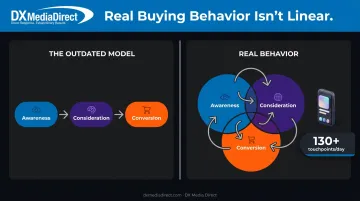
Here's what most media plans get wrong: they treat these as sequential steps, assuming a customer sees an awareness ad, then a consideration ad, then converts in a neat line. Real buying behavior doesn't work that way.
Google and BCG research found that consumers interact with more than 130 mobile touchpoints per day, describing decision behavior as constant streaming, scrolling, searching, and shopping rather than a linear path.
A prospect might see a TV spot and ignore it, then search your brand name three weeks later. They click a retargeting ad and buy after seeing a testimonial post, in whatever order fits their life, not your funnel diagram.
That's why full-funnel media treats awareness, consideration, and conversion as simultaneous jobs media has to do, not sequential stages a customer walks through in order.
The Three Layers of a Full-Funnel Media Plan
A full-funnel plan breaks into three working layers. Each layer uses its own creative approach and channels, judged by a different success metric.
Awareness: Introducing the Brand
Awareness media is built for people who don't yet know they have the need your brand solves. This layer typically runs through:
- Linear and cable TV for broad-reach exposure across dayparts and audiences
- Streaming and CTV to reach cord-cutters without losing television's storytelling format
- Audio and streaming radio for frequency at a lower cost per impression
- Broad-reach video on platforms like YouTube, built for reach rather than an immediate click
Reach, frequency, and eventually brand lift define success here, not clicks.
Consideration: Building Trust
Once someone knows the brand exists, consideration media closes the gap between aware and convinced:
- Retargeting keeps the brand visible to people who've already shown interest
- Testimonial-driven content builds credibility through real customer results, not brand claims
- Comparison and demo assets answer the specific question a shopper is asking before they buy
This layer is where trust gets built, or lost, if the creative feels generic.
Conversion: Prompting the Decision
Conversion media has one job: convincing someone who's ready to buy to act right now. Direct-response offers, urgency-driven creative ("limited time," "while supplies last"), and retargeting with an unmistakable call-to-action all live here.
This is also where a channel like direct-response TV earns its place outside the awareness-only box. A strong DRTV spot with a clear offer can function as conversion media on its own, not just a brand-building placeholder waiting for digital to close the sale.
Funnel Frameworks That Shape a Full-Funnel Media Strategy
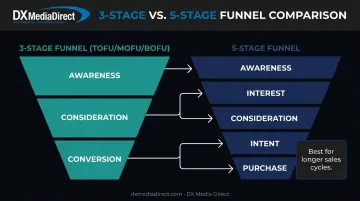
The three-stage TOFU/MOFU/BOFU model (top, middle, and bottom of funnel) is still the foundation most media plans are built on. It's simple, it maps cleanly to awareness, consideration, and conversion, and it works as fast planning shorthand for teams that need a shared vocabulary.
Some businesses need more granularity. A five-stage funnel breaks the middle stage into two, giving room to build separate creative and offers as consideration deepens into intent:
- Awareness
- Interest
- Consideration
- Intent
- Purchase
This extra stage matters most for longer sales cycles or higher-consideration purchases, such as a $30,000 home renovation, a B2B software contract, or a legal service.
The 3-3-3 Rule: A Heuristic, Not an Industry Standard
You'll see the "3-3-3 rule" referenced in media planning conversations, usually around creative testing. One version runs three messages across three audiences through three placements before drawing conclusions. Another tests variations for at least three days across three ad sets before judging performance. Different teams define it differently, and no advertising platform or standards body has published one official version. Treat it as a practical testing discipline, not a fixed law.
No single framework here is universally correct. The right one depends on purchase consideration time, price point, and how quickly a brand needs data back. A $40 impulse purchase might only need TOFU/MOFU/BOFU, while a multi-year enterprise contract might need the full five stages.
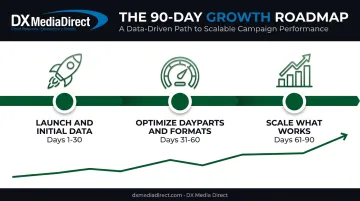
This is exactly why direct-response media buyers often compress these frameworks into short, structured test windows. A 90-day TV test, for example, replaces ambiguous, drawn-out attribution data with a clear answer: did this media mix produce buyers within a timeframe short enough to act on?
What a Full-Funnel Media Strategy Looks Like Across Channels
The same three-layer logic applies differently depending on the channel. Here's what full-funnel actually looks like in practice across three of the most commonly asked-about channels.
Full-Funnel on YouTube
YouTube full-funnel campaigns typically combine three ad format types:
- Non-skippable and bumper ads cover the awareness layer, built for broad reach and fast exposure
- In-feed and discovery-style ads cover consideration, longer, more informative content people actively choose to click into
- Action-focused formats with strong calls-to-action cover conversion, built for someone ready to click through and buy
Running lower-funnel formats alone caps how much they can do. Among 600 advertisers studied by Google, those who added at least two upper-funnel, CPM-priced brand formats on top of existing Video action campaigns saw stronger results. Conversions rose by a 9% average over the following 20 weeks, compared with running action campaigns alone.
The awareness layer isn't just brand-building fluff. It feeds the conversion layer more qualified viewers.
Full-Funnel Influencer Strategy
A full-funnel influencer strategy pairs macro or celebrity influencers for broad reach (awareness) with micro and niche creators for trust-building content (consideration), then layers in affiliate-style, code-tracked partnerships for direct, measurable sales (conversion).
In practice, most brands run these creator tiers simultaneously rather than assigning strict roles. A macro creator's post might drive both reach and direct sales through a tracked code, while a micro creator's honest review builds the trust a later retargeting ad closes.
Increasingly, that influencer content gets repurposed as paid social ads, sometimes called whitelisting or spark-style ads, so the same piece of creative gets pushed to cold, warm, and hot audiences with different targeting behind each version. One video, three funnel jobs.
Full-Funnel on TV and Direct-Response Media
Most marketers file TV under "awareness only" and move on. That's a mistake.
Long-form direct-response TV spots, the two-minute-plus format built around a clear offer and a phone number or URL, can build brand awareness and drive an immediate, trackable response in a single airing. Someone who's never heard of the brand can act before the ad even ends.
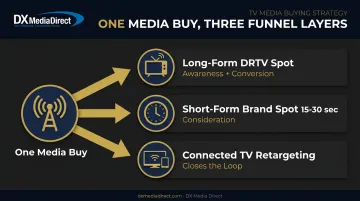
That same TV investment can extend across all three layers, not just one:
- Long-form DRTV spots introduce the brand and prompt immediate action: awareness and conversion, at once
- Short-form brand spots (15 to 30 seconds) reinforce the offer for people who saw the long-form spot but didn't act yet: the consideration layer
- Connected TV retargeting puts a conversion-focused ad back in front of households that streamed the original spot but haven't converted, closing the loop
Treated this way, TV stops being just a reach-only line item competing for the same budget as digital conversion channels. It handles all three jobs a full-funnel plan needs, off one media buy.
Measuring a Full-Funnel Strategy (and the Mistakes That Undermine It)
Last-click attribution is the default reporting view in most ad platforms, and it systematically undervalues upper-funnel media. A TV spot or a bumper ad rarely gets the "last click." Its impact shows up two weeks later when someone searches the brand name and converts through a completely different channel. Judge that spend by last-click alone, and it looks like it did nothing.
Incrementality and lift testing (brand lift studies and conversion lift tests) solve this by measuring what happens with upper-funnel media running versus a matched control group without it, rather than crediting whichever channel touched the sale last.
Nielsen's analysis of more than 1,300 campaigns across 20 CPG brands found that full-funnel campaigns delivered up to 45% higher ROI and 7% higher offline sales compared with campaigns focused on a single purchase stage.
For channels attribution can't see at all, TV chief among them, marketing mix modeling (MMM) is the better tool. MMM analyzes aggregate sales, marketing, and business data over time to quantify each channel's contribution, rather than trying to tie individual pixels to individual purchases. It's slower to report than click-based dashboards, but it's the only method that fairly credits offline media alongside digital.
Where Full-Funnel Plans Go Wrong
Even with the right measurement approach in place, three mistakes show up over and over:
- Confusing "more platforms" with "full-funnel" means running ads on five platforms with five disconnected messages, creating fragmented spend and an inconsistent brand experience.
- Underinvesting in top-of-funnel spend because it's harder to measure quietly shrinks the pool of future buyers, leaving conversion campaigns with fewer warm prospects.
- Ignoring offline media like TV cuts off households that CTV and linear reach but digital plans alone can't recover.
Why Direct-Response TV Deserves a Bigger Role in Your Full-Funnel Mix
Most full-funnel plans treat TV as reach-only and put all the "real" performance pressure on digital. That's backwards from what direct-response TV can actually do.
DRTV is one of the only media types that builds brand awareness and drives an immediate, trackable conversion in the same spot. A single airing can introduce a brand to a cold audience and generate a call, a website visit, or a sale within minutes.
That's a dual role most digital channels can't replicate without stitching together two separate campaigns.
Relationship-Based Buying Changes the Economics
That dual role only matters if the media buy behind it is efficient, and that's where the economics diverge.
Programmatic and self-serve TV platforms buy inventory through automated portals, at whatever rate the system quotes. Relationship-based media buying, negotiating directly with network reps instead of through a portal, works differently.
Decades of relationships with network representatives secure specific dayparts and rates automated platforms can't access. Those deals simply aren't listed in any portal to begin with.
That difference compounds across a full-funnel mix. Every dollar saved on rate is a dollar that can fund:
- An additional flight
- A longer test window
- A wider daypart spread
The 90-Day TV Test
DX Media Direct built its approach around structured 90-day TV tests. The window is long enough to see how a media mix performs across dayparts and formats, yet short enough to act on results instead of waiting months on ambiguous attribution data.
The goal is a scalable playbook backed by hard revenue figures, the kind that show up in the profit column, not a vague "brand lift" number on a dashboard nobody trusts.
For a channel that's existed since before programmatic advertising did, direct-response TV still solves a problem most full-funnel digital plans struggle with: proving upper-funnel media actually produced buyers, not just impressions.
If TV hasn't had a real seat in your full-funnel mix, a free, no-obligation consultation is a low-risk way to find out where it fits. A structured test can tell you more about your funnel than digital attribution alone.
Frequently Asked Questions
What does a full-funnel media strategy on YouTube look like?
It layers three ad format types together: reach-focused bumper and non-skippable ads for awareness, in-feed discovery ads for consideration, and action-focused formats with strong CTAs for conversion. Running all three outperforms relying on conversion formats alone.
What funnel frameworks are used in a full-funnel media strategy?
TOFU/MOFU/BOFU, the five-stage funnel, and the 3-3-3 rule are all planning frameworks, not universal laws. The right one depends on your sales cycle length and how quickly you need performance data back.
What does a full-funnel strategy look like across TV and CTV/streaming?
It combines broad-reach linear TV or CTV spots for awareness, retargeted streaming placements for consideration, and direct-response spots with trackable phone numbers or landing pages for conversion. The same reach-to-response logic that works on YouTube applies across screens.
How is a full-funnel media strategy different from a full-funnel marketing strategy?
Media strategy refers specifically to paid channel allocation across the funnel: TV, video, search, social, display. Marketing strategy is broader and includes organic content, product, pricing, and brand positioning.
How long does it take to see results from a full-funnel media strategy?
Lower-funnel results, like clicks and immediate conversions, can show up within weeks. Upper-funnel impact typically needs a structured test window, such as 90 days, to reveal reliable, scalable patterns.
Can small businesses run a full-funnel media strategy?
Yes. Scale it down by running one channel across all three funnel layers first, rather than spreading a small budget thin across many platforms at once.