Here's the catch: pricing is all over the map. A 30-second spot might run you under $200 on a small-town station, or north of $8,000 on a major-metro drive-time slot. There's no single number to anchor your budget around.
Rates swing based on market size, daypart, ad length, station popularity, and how the spot gets sold — CPM, CPP, or flat-rate. This guide breaks down realistic 2026 pricing ranges, what actually drives those numbers up or down, and how to negotiate a deal that doesn't leave money on the table.
Key Takeaways
- Local 30-second spots typically run $200–$3,000+, depending on market size and daypart
- Morning and afternoon drive time on major-metro stations command the highest premiums
- A realistic starting budget is $1,500–$2,500/month in smaller markets, $5,000+ in major metros
- Experienced media buyers with direct station relationships routinely beat self-service rates
How Much Does Radio Advertising Cost in 2026? (Pricing Overview)
Radio advertising doesn't have one fixed price. Costs shift depending on the market you're targeting, the specific station's ratings, and how you structure the buy. Two businesses in the same city can pay wildly different rates for what looks like the same package.
Three budgeting mistakes trip up first-time radio advertisers:
- Underbudgeting for frequency — one or two spots a week won't move the needle
- Quoting only the "spot price" while ignoring production and agency fees
- Buying the wrong daypart for the target audience, then blaming radio for weak results
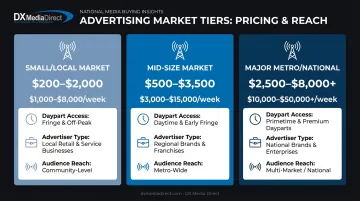
Here's how airtime-only pricing usually breaks down across market tiers:
| Market Tier | Per-Spot Range (30-sec) | Weekly Package |
|---|---|---|
| Small/Local | $200–$2,000 | $900–$2,000 |
| Mid-Size | $500–$3,500 | $2,500–$5,000 |
| Major Metro | $2,500–$8,000+ | Varies by CPM ($9–$35) |
These figures cover airtime only. Production, talent, and agency fees are typically separate line items. This distinction trips up plenty of first-time buyers.
Price Range 1: Small/Local Market
This tier typically includes a standard 30-second produced spot with off-peak to mid-tier daypart access. It's the entry point for local shops, startups, and businesses testing radio for the first time without committing to a big spend.
Price Range 2: Mid-Size Market
Expect broader daypart access, moderate frequency packages, and occasional remnant discounts. This tier suits regional brands and businesses scaling beyond a single city that need more reach without major-metro pricing.
Price Range 3: Major Metro / National
Think premium drive-time inventory on high-rated stations, plus possible sponsorship or host-read add-ons. This is where established brands, national retailers, and direct-response advertisers needing real scale tend to land.
Key Factors That Affect the Cost of Radio Advertising
Radio pricing depends on a mix of audience size, timing, format, and sales structure working together. Understanding each lever helps you spend smarter, not just more.
Market Size & Station Popularity
A station's Designated Market Area (DMA) rank and local population set the baseline. A top-10 metro station will cost dramatically more than a small-town equivalent, purely because more people are listening.
But size alone doesn't tell the whole story. A station's own ratings and listenership, not just its home city, further push rates up or down. A mid-size market's top-rated morning show can out-price a bigger market's underperforming station.
Daypart & Time Slot
Pricing generally follows this hierarchy, most expensive to least:
- Morning Drive
- Afternoon Drive
- Midday
- Evening
- Overnight
Drive-time commands the highest premium because it captures a captive commuter audience: people stuck in traffic with nowhere else to look. Overnight and remnant slots sit at the bottom because listenership drops off sharply once the workday ends.
Ad Length & Format
Spot length changes the pricing math:
- 15-second spots: roughly 60% of a 30-second rate
- 30-second spots: the industry standard, used as the pricing baseline
- 60-second spots: typically 1.5–2x the cost of a 30-second spot
Live host-reads and sponsorships (the "brought to you by" style mentions) cost more than a standard produced spot. They also carry more credibility since listeners hear the endorsement from a voice they already trust, a factor worth weighing against the extra cost.
Audience Demographics & Targeting
Stations that reach a specific, high-value audience (affluent listeners, young professionals, niche hobbyists) can charge a premium over general-audience competitors. You're paying for the right ears, the audience most likely to become customers.
Pricing Model (CPM vs. CPP vs. Flat-Rate)
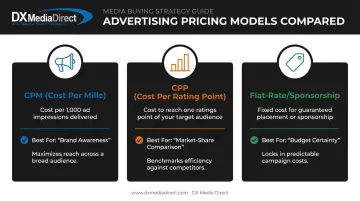
Three models dominate radio buying:
- CPM (cost per mille): what you pay per 1,000 listener impressions. Best for brand-awareness campaigns measuring reach.
- CPP (cost per rating point): what you pay to reach an audience equal to 1% of a market's population. Common in larger-market negotiations.
- Flat-rate/sponsorship: a fixed price for a defined package or sponsorship slot, common with smaller and mid-size stations.
Each model suits different goals — CPM for reach, CPP for market-share comparisons, flat-rate for simplicity and budget certainty.
Cost Breakdown: What Goes Into Your Radio Ad Budget
The quoted airtime rate is only one piece of the puzzle. Four cost categories typically make up a full radio campaign budget.
Airtime / Media Buy (Recurring) The base cost of your actual on-air spots, priced via CPM, CPP, or flat rate. This is the number most stations quote first, and the one most advertisers mistake for the total cost.
Production (One-time, per creative) Covers script, voice talent, and sound engineering. A simple local spot might run a few hundred dollars; a national-quality ad with custom music and professional voice talent can run into the thousands.
SAG-AFTRA's 2025–2026 rate sheet sets a solo/duo session fee of $404.30, with national terrestrial-use rates running $808.49 for four weeks or $4,273.43 for a full year. Those figures are union talent minimums, not a full production budget with studio time and editing included.
Agency or Media-Buying Fees (Recurring) Usually a percentage of ad spend, paid in exchange for negotiated rates, placement strategy, and campaign management. A good agency fee pays for itself many times over in rate savings alone.
Tracking & Attribution Tools (Recurring) Vanity URLs, promo codes, and dedicated phone lines that let you tie leads and sales back to the campaign. Skip this, and you're flying blind on ROI.
The most common oversights: ignoring production costs when budgeting, underbudgeting frequency, and skipping ROI tracking entirely. These three mistakes undermine otherwise solid radio campaigns.
How to Get the Best Radio Advertising Rates in 2026
Treat the first quote a station gives you as a starting point, not the final answer. Every rate card has flexibility built in ; you just have to know how to ask.
Before you call a station, have ready:
- A defined goal or KPI (calls, leads, foot traffic, sales)
- Your target audience profile
- A firm budget range
- A campaign timeline
With that groundwork in place, you're ready to negotiate.
Negotiation tactics that actually move the needle:
- Ask directly about frequency and bulk discounts
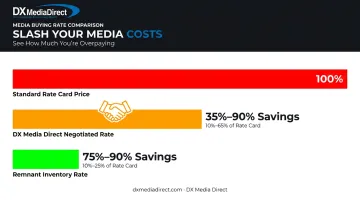
- Request pre-emptible "remnant" inventory, often 50% or more off standard rate
- Build a relationship with the sales rep over time; renewals often come with better rates and added-value spots the rate card never mentions
None of this works without a human on the other end of the line. Self-service and programmatic platforms buy at whatever the algorithm sees on the open market. They don't get a phone call when a station has unsold Tuesday-morning inventory it needs to move by Thursday. Relationship-based buyers do.
This is where a full-service media partner earns its fee.
DX Media Direct's long-standing relationships with major radio networks and stations, including iHeart and other national audio networks, have secured client rates 35% to 90% below prime rate card pricing. Remnant inventory specifically comes in at 75% to 90% below standard rates when a trusted buyer negotiates on the client's behalf.
With 35+ years of direct-response media buying, DX Media Direct has seen enough campaigns across dayparts, networks, and product categories to diagnose weak spots fast. Whether the issue is a media-mix problem, a creative problem, or both, that experience fixes it. That conversation starts with a free, no-obligation consultation.
Conclusion
Radio advertising costs vary enormously by market, daypart, ad length, and pricing model. There's no single "right" number to plug into a spreadsheet.
What matters is understanding the full cost picture: airtime, production, agency fees, and tracking, so you're not blindsided by hidden costs. The best radio budget balances reach, frequency, and measurable ROI against your specific goals, not just the lowest price.
DX Media Direct's 35 years of network relationships can secure rates programmatic platforms can't match. Request a free consultation to get started.
Frequently Asked Questions
How much does it cost to advertise on local radio?
Local 30-second spots typically run $100–$3,000+, with small-market and off-peak placements sitting at the low end. Major-metro drive-time slots push well past that range.
Is it worth advertising on the radio?
Radio remains highly effective, reaching 87% of Americans 18+ weekly. It builds trust fast and often lifts performance of your other marketing channels, making it a strong complement to digital spend rather than a replacement.
How much does a 30-second radio ad cost?
Rates range from under $100 on small local stations to $2,500–$8,000+ in major metros during drive time. Market size and station ratings are the biggest swing factors.
How much does a 60-second radio ad cost?
A 60-second spot typically costs 1.5–2x the price of a 30-second spot in the same daypart and market. The exact multiplier depends on the station's own pricing structure.
What's a realistic minimum budget to start with radio advertising?
Plan for roughly $1,500–$2,500 for a one-month, single-station campaign in a smaller market. Major-metro campaigns typically start at $5,000 or more per month.
What's the difference between CPM and CPP pricing?
CPM charges you per 1,000 listener impressions, ideal for broad reach goals. CPP charges per rating point (1% of a market's population) and is more common in larger-market negotiations.