Despite the shift to streaming, 87% of U.S. adults 18+ still listen to broadcast radio every week, according to Nielsen data cited by the Radio Advertising Bureau. That reach comes at a price that varies enormously: a 30-second spot can run under $50 in a small market or top $1,000 in a major metro like New York or Los Angeles.
That gap trips up a lot of first-time radio advertisers. This guide breaks down 2026 pricing by market, length, and daypart, the factors pushing costs up or down, a full breakdown of what you're actually paying for, and how to set a budget that fits your goals.
Quick Summary (TL;DR)
- 30-second spots cost $17-$50 in small markets, but top $1,000+ in major metros at peak times.
- Market size, daypart, spot length, and pricing model (CPM vs. CPP) drive most cost differences.
- Off-peak and remnant buys are cheapest, while drive-time slots and host endorsements cost the most.
- Mass-reach brand campaigns justify heavier spending, while direct-response tests start lean and scale.
How Much Does Radio Advertising Cost in 2026? (Pricing Overview)
Radio has no fixed price sheet. Costs shift based on your market, your time slot, your spot length, and whether a station prices by CPM (cost per thousand listeners) or CPP (cost per rating point).
Three mistakes eat radio budgets before a campaign even gets a fair shot:
- Underestimating production costs and leaving nothing for creative refreshes
- Choosing premium drive-time slots before testing cheaper dayparts
- Buying too few spots per week to build listener recall
Typical Cost by Ad Length
Spot length is the first cost lever. Based on 2025 media-agency benchmarks spanning national and local radio, compiled by Ad Results Media:
| Spot Length | Typical Price Range |
|---|---|
| 15 seconds | $1.80 – $315 |
| 30 seconds | $3 – $525 |
| 60 seconds | $5 – $750 |
A 30-second spot generally costs 60%-70% of a 60-second spot, while a 15-second spot runs about 60% of a 30-second spot. In practice: doubling your airtime adds roughly 40%-60% to the price, not double.
Market size narrows those ranges quickly. A 30-second spot might cost under $100 on a small local station, a few hundred dollars in a mid-size market, and $1,000 to $5,000+ during peak drive time in a major metro.
Price Tiers by Campaign Scale
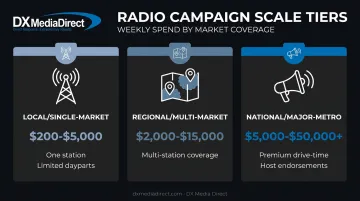
Your campaign's geographic scope matters as much as spot length. Here's how the three common tiers typically break down:
Local / Single-Market Campaign
- One station, limited dayparts, smaller footprint
- Best for local businesses or budget-conscious direct-response testing
- Weekly spend for meaningful frequency often falls between $200 and $5,000
Regional / Multi-Market Campaign
- Multiple stations across several markets, broader daypart coverage
- Best for brands expanding beyond a single city or state
- Weekly spend commonly runs $2,000 to $15,000, scaling with each additional market and station added to the buy
National / Major-Metro Campaign
- Premium drive-time inventory, top-15 market rates, sometimes host endorsements
- Best for national brands prioritizing reach and frequency over cost-per-spot
- Weekly spend for top-15 market, drive-time buys often starts at $5,000 and can exceed $50,000
Key Factors That Affect Radio Advertising Costs
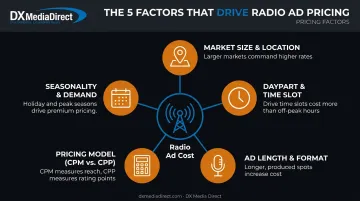
Radio pricing comes down to four variables: where you air, when you air, what format you use, and how the station prices its inventory.
Market Size & Location
Location alone can swing your rate 20-30x. A 2024 small-market rate card in Riverton, Wyoming priced a 30-second spot at just $7-$12, while a comparable spot in New York carries a CPM (cost per thousand impressions) of $9-$25, with 60-second averages running well past $795 in that market alone.
Population density and the number of competing stations shape available inventory. More stations chasing the same advertisers usually means more competitive pricing; fewer stations in a tight market can push rates up.
Daypart & Time Slot
Morning and afternoon drive, roughly 6-10 a.m. and 3-7 p.m., command the highest rates because that's peak listenership: commuters, mostly. Overnight and midday slots cost significantly less simply because fewer people are tuned in.
One real-world example: a 2024 rate card priced best-time-available 30-second spots at $7, preferred-daypart spots (including drive times) at $9, and fixed-position spots at $12. Even at the low end, guaranteed placement carries a real premium.
Ad Length & Format
Beyond standard produced spots, stations also sell live host-read and endorsement ads. These typically cost more than a pre-recorded spot because they borrow the host's credibility and personal connection with listeners, something a produced spot can't replicate.
Spot length matters too. Standard spots run 15, 30, or 60 seconds, and price scales with airtime: a 60-second spot often costs 50-100% more than a 30-second spot in the same slot, while 15-second spots run at a discount. Most rate cards, including the example above, are built around the 30-second spot as the default length.
Pricing Model: CPM vs. CPP
Stations price inventory two main ways:
- CPM (cost per thousand impressions): total campaign cost divided by impressions, multiplied by 1,000. Common when a station sells based on audience delivery.
- CPP (cost per rating point): gross media cost divided by gross rating points, where one point equals 1% of a market's population. Rates scale with market size, so the same point costs far more in New York than in a market a tenth its size.
Neither figure is a fixed rate. Both shift with the audience, schedule, and market you're buying into.
Seasonality & Demand
Q4 retail season pushes rates up. iHeartMedia's financial filings note that advertising revenue is typically highest in Q4, reflecting holiday consumer spending. Election years add another layer. Candidates get legally mandated "lowest unit rate" pricing during defined pre-election windows, but issue advertisers and PACs don't get that protection. They compete hard for the same limited inventory, pushing up rates for everyone buying around them.
Cost Breakdown: What You're Actually Paying For
Airtime is only part of a radio budget. Three categories make up the total spend.
Creative and production (one-time). Scriptwriting, voice talent, studio time, and sound design typically run $300 to $3,000 depending on complexity. A non-union local voice-over might cost around $100, while national campaigns using union talent carry session fees plus usage fees that scale by region and duration.
Media and airtime (recurring). This is usually the largest line item: the per-spot, per-week, or per-flight cost calculated through CPM or CPP, paid out over the life of the campaign.
Ongoing optimization (periodic). Radio creative wears out. Refreshing it every 4-6 weeks keeps listeners from tuning out a message they've heard fifty times. Pair that with tracking tools such as unique URLs, promo codes, and dedicated phone lines, so you know which stations and dayparts are actually driving results.
Radio Ad Costs by Market: Local vs. Regional vs. National vs. Streaming
Local markets stay genuinely affordable. Small-market rate cards have shown 30-second spots priced as low as $7-$12 per airing, a level that lets a small business run real frequency without a large budget.
Regional and national buys scale fast. Adding markets and stations multiplies the per-spot cost across the whole flight. A multi-market campaign can move from a few thousand dollars a month into the tens or hundreds of thousands. The exact cost depends on how many markets you add, how long the flight runs, and how much reach and frequency you're targeting.
Streaming and digital audio aren't the budget shortcut many advertisers expect. Managed buys carry real minimums:
- Spotify: roughly $25,000 per month for a managed, direct buy (self-serve entry starts much lower, around $250 lifetime minimum)
- Pandora: similar $25,000 monthly managed minimum, though self-serve options through AudioGo start near $250
- iHeartRadio: typically no minimum for managed buys, making it more accessible for smaller budgets
A $250 self-serve Spotify test and a $25,000 managed Pandora buy aren't comparable products. They reach different scales of audience with very different levels of targeting and support. For advertisers without six-figure digital audio budgets, traditional radio often remains the more predictable cost-per-reach option.
How to Budget for Radio Advertising the Right Way
Start with your goal, not a dollar figure.
Brand-awareness campaigns need heavier frequency and broader reach: think regional or national buys with consistent weekly spot counts over several months. Direct-response campaigns can start smaller, testing a single market or station, measuring calls and clicks, then scaling spend toward what's working.
Once you've settled on a goal, budget structure determines whether that goal is achievable. Three mistakes derail radio budgets before they get a fair test:
- Overspending on production. A polished 60-second spot with a full sound design budget doesn't guarantee more calls than a clean, well-written 30-second read.
- Underbuying frequency. Running 12 spots a week barely registers. Media-buying research links 44-75 spots a week to the frequency needed for meaningful reach and recall.
- Judging results too early. A two-week test rarely gives radio enough time to build the recall that drives response.
Why Media-Buying Experience Beats Self-Serve Platforms
Self-serve and programmatic radio tools are convenient, but they price inventory the same way for every buyer. An agency with decades of standing network relationships can often secure rates and inventory positions a self-serve dashboard simply doesn't offer.
DX Media Direct has spent 35 years building those relationships, developing pattern recognition across dayparts and formats that helps identify which stations and time slots are genuinely underpriced for a given campaign goal.
Rather than locking clients into one station or format upfront, the agency starts with a defined test budget, measures response with real tracking, then expands into the markets and dayparts that prove out.
If you're weighing radio against other channels, or just trying to figure out your first budget, DX Media Direct offers a free, no-obligation consultation to walk through your numbers before you commit a dollar to airtime.

Conclusion
Radio advertising costs swing widely by market, daypart, spot length, and whether a station prices in CPM or CPP. A 30-second spot might cost $12 in a small Wyoming market and over $1,000 in New York during morning drive, and neither number is wrong for its context.
Understanding these cost components, rather than chasing the lowest sticker price, creates a budget that actually performs. The right radio spend balances reach, frequency, and measurable response. DX Media Direct's 35 years of station relationships and negotiated rates help build that balance without the guesswork.
Frequently Asked Questions
How much does it cost to promote something on the radio?
Most single-market spots run $200-$5,000 depending on market size and daypart, with premium drive-time slots in major metros landing at the higher end. National campaigns across multiple markets can run into six figures.
Is advertising on the radio worth it?
Radio reaches 87% of U.S. adults weekly, comparable to almost any traditional medium, at production and airtime costs well below television. For most brands, it works best as a strong complement to other channels rather than a standalone strategy.
How long is a 30-second radio ad?
Thirty seconds is the industry-standard length because it balances enough time to deliver a real message with a price point far more accessible than a 60-second spot.
How much does a 60-second radio ad cost?
A 60-second spot typically costs 30%-40% more than a 30-second spot in the same market and daypart, though the exact premium varies by station and demand.
What's the difference between CPM and CPP in radio advertising?
CPM prices airtime per 1,000 listener impressions, while CPP prices it per rating point, meaning 1% of a market's population. CPP scales with market size; CPM doesn't.
Is radio advertising cheaper than TV advertising?
Generally, yes. According to the SBA, radio advertising costs less than cable TV while delivering comparable reach, making it more accessible for smaller budgets and faster campaign testing.