While competitors pour their budgets into Facebook ads and Google PPC, local radio has quietly become one of the least crowded, highest-recall channels available to agents and investors. Less competition on the airwaves means your ad actually gets remembered instead of scrolled past.
This guide covers whether radio still delivers, the three ad formats available, what it really costs, how to write a script that converts, and how to launch a campaign that generates calls instead of dead air.
Key Takeaways
- Radio reaches most commuters weekly, giving agents strong local awareness
- Live reads, produced spots, and sponsorships fit different goals and budgets
- Costs vary by market size, daypart, and ratings—negotiate as hard as the creative
- A short, tracked test flight beats a long-term blind contract before scaling spend
Is Radio Advertising Still Worth It for Real Estate?
Radio reaches 87% of Americans age 18 and older every week, according to the Radio Advertising Bureau, citing Q1 2025 Nielsen Audience Insights data. Homebuyers and sellers are part of that audience. They're just doing it in the car, not on their phones.
Radio also earns something digital ads rarely manage: trust. A YouGov study reported by Inside Radio found that 45% of U.S. adults considered radio advertising somewhat or very trustworthy. That figure is from 2021, but it still reflects radio's standing as a personality-driven, local medium rather than an anonymous banner ad.
Why Less Competition Works in Your Favor
That trust means more when there's less noise competing for it. Most real estate marketing dollars have shifted to digital. That leaves local radio less cluttered with agent ads, so a well-placed spot feels less "salesy" and stands out more:
- Category clutter is lower. Your ad doesn't compete with a dozen other agents in the same feed
- Consistency builds local recognition. The same voice, tied to your name, month after month, creates the kind of recall a one-off social post can't match
- Cost-per-exposure often beats TV or print. Rates drop during the same morning and evening commute windows, especially in mid-sized and smaller markets
- Scheduling is hands-off. Once your script and voice track are finalized, the station's traffic team handles rotation. No daily bid management required
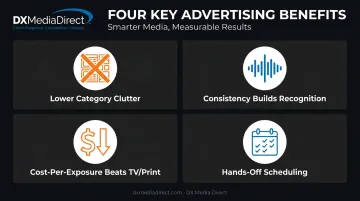
That last point matters more than agents give it credit for. A PPC campaign needs constant attention. A finished radio spot just runs.
The 3 Types of Radio Advertising for Real Estate
Real estate radio ads generally fall into three formats. Picking the right one depends on your goal: quick credibility, consistent branding, or borrowed trust from existing programming.
Live Reads and Endorsements The host reads your script live, in their own voice and style. Listeners already trust that host, and you're borrowing years of built rapport in thirty seconds. This format works well for agents entering a new market who don't mind a host ad-libbing slightly off script.
Produced (Recorded) Commercial Spots These are fully scripted, voiced, and mixed ads, run as standard 15, 30, or 60-second units with music and sound design. Because every listener hears the identical message, produced spots are the better choice for consistent branding: same name, tagline, and number, repeated exactly the same way every time.
Sponsorships and Underwriting You sponsor a recurring segment listeners already tune in for, such as traffic, weather, or community events. Your name gets tied to content people trust rather than interrupting it.
One caveat: noncommercial and public stations operate under FCC rules that prohibit promotional calls to action in underwriting acknowledgments. A straightforward "call me today" line may not fly there, so confirm a station's regulatory status before adapting existing commercial copy.
Choosing the Right Daypart and Station Format
Picking the right format is only half the equation; when and where that spot airs matters just as much. Not all airtime is equal, since dayparts split the broadcast day into blocks with distinct listener behavior:
- Morning drive (roughly 6-10 a.m.): Commuters, highest attention, premium pricing
- Midday (10 a.m.-3 p.m.): Background listening at work, lower attention
- Evening drive (roughly 3-7 p.m.): Second commute peak, strong recall
- Weekend: Broader blocks, often discounted, good for building repetition
Station format matters just as much as the time slot. Match the genre to your farm area:
- Talk and news stations often over-index with older, established homeowners, a good fit for move-up or downsizing sellers
- Country and adult contemporary formats tend to reach broad suburban family audiences, useful for first-time buyer campaigns
- Urban and rhythmic formats can better reach specific investor or renter-to-buyer segments in certain metros
Exact daypart hours vary by station. Confirm the contracted hours before comparing rate quotes.
How Much Does Radio Advertising Cost for Realtors?
There's no single number here. A 30-second spot might run $15 in a small-town market or several hundred dollars during morning drive in a top-25 metro. Four variables drive that spread:
| Cost Variable | What It Does to Price |
|---|---|
| Market size | Bigger metro means a bigger audience means a higher rate |
| Station ratings | Higher-rated stations command premium pricing, regardless of market size |
| Ad length | 60-second spots typically cost more than 15 or 30-second units |
| Daypart | Morning and evening drive carry the steepest premiums |
For context, public and community stations publish some of the only rate cards openly available. Utah's KZMU lists prerecorded underwriting spots at $10 to $50, while Houston's KPFT charges $54 to $70 per spot on a full schedule and up to $125 to $140 during peak periods.
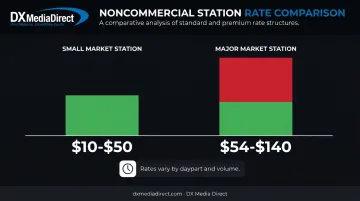
These are noncommercial underwriting rates, not standard commercial airtime, but they show how much daypart and volume alone can swing price at a single station.
Flight length and frequency affect total spend too. A station will almost always quote a better per-spot rate for a 13-week flight running 20 spots a week than for five isolated spots. Frequency is what builds the recognition described earlier; a single airing rarely moves the needle.
How Much Should You Budget?
There's no published NAR percentage of gross commission income earmarked specifically for marketing. The 2025 NAR Member Profile reports a median $58,100 in gross real estate income and $8,010 in total business expenses for 2024, but that expense figure covers everything from dues to gas, not marketing alone.
Many brokerages and coaches still recommend budgeting somewhere in the 5% to 10% of GCI range for marketing overall, with radio representing one line item inside that.
A smarter first move: run a defined test. Commit to a 90-day flight on one station and daypart combination before signing anything longer. That's enough time to see whether calls come in, without locking into a full year of a format that isn't working.
This is also where an experienced media-buying partner earns their fee. Station in-house sales teams and self-service portals sell their own inventory at their own rates.
A buyer with 35+ years of direct-response media negotiation, like DX Media Direct, works relationships across networks to access rates and remnant inventory that aren't offered through a station's front door or a programmatic dashboard.
How to Write a Real Estate Radio Ad That Converts
Every effective real estate radio spot follows a similar four-part structure:
- Name the listener's problem. "Still renting and watching home prices climb without you?"
- Present your solution. "I help renters in your neighborhood become homeowners, often with less down than they expect."
- State clearly who's talking. "I'm [Name] with [Brokerage]."
- Give one specific call to action. "Call [number] today for a free pre-approval check."
This structure dates back nearly a century, to some of the earliest real estate radio ads. It still works because it mirrors how people process a short message: notice, understand, trust, act.
Lead With Empathy, Not Urgency
Buying or selling a home is emotional, often one of the biggest financial decisions someone will make. A pushy line like 'Rates are rising, act now before it's too late!' triggers skepticism, not action.
Compare that to: 'If you're wondering whether now's the right time to sell, let's talk it through, no pressure, just answers.' Warmer copy builds the kind of trust radio is uniquely positioned to deliver.
Three Production Tips That Matter More Than Polish
- Write the copy yourself. Station staff writers are generalists. They don't know your farm area, your listings, or your voice the way you do
- Start with 60 seconds. It leaves room for the problem, solution, your name, and a CTA. Fifteen and thirty-second spots barely fit a name and number
- Close with one phone number, repeated once. Don't stack a website, QR code, and phone number into one spot—pick one CTA and repeat the number twice, slowly
Best Practices for Launching a Successful Radio Campaign
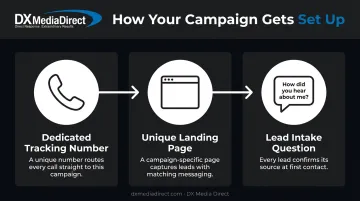
Radio without tracking is just an expensive guess. Before your spot airs, set up:
- A dedicated tracking phone number used only in the radio ad, separate from your website or business card number
- A unique landing page so web traffic from the ad is easy to isolate
- A quick intake question for new leads: "How did you hear about me?" as a backup layer of attribution
With tracking in place, plan for the call spike next. Radio drives immediate response, often within minutes of airing, unlike the slower trickle typical of digital. Missing that window means missing the lead. Most won't call back later. Have a live answering plan, CRM routing rule, or answering service ready before launch day, not after.
Once your answering plan is ready, test before you scale. Run a short, measured flight and review the numbers honestly. If calls don't come in, the problem could be the station, the daypart, or the script, and it takes experience to tell which.
This is where a media-buying partner who has run campaigns across dayparts and networks earns its value: distinguishing a media-mix problem from a creative problem, rather than guessing and hoping the next flight works better.
Frequently Asked Questions
How much does a 30-second radio ad cost?
Cost depends on market size, station ratings, and daypart. Small-market spots can run as low as $15 to $50, while drive-time slots in major metros often reach several hundred dollars per airing.
Is radio advertising still worth it?
Yes. Terrestrial radio still reaches most U.S. adults weekly, and fewer real estate competitors are using it compared to social and search, which reduces clutter and boosts recall.
What are the three types of radio advertising?
Live reads, where a host delivers your script on-air; produced spots, meaning professionally recorded commercials; and sponsorships or underwriting, which link your name to a trusted recurring segment.
How much should a realtor spend on advertising?
There's no official NAR benchmark, but many brokerages and coaches recommend budgeting roughly 5% to 10% of gross commission income toward marketing overall, radio included.
How do I measure the ROI of a radio ad campaign?
Use a dedicated tracking phone number and a unique landing page exclusive to the radio spot. Also ask every new lead how they heard about you as a backup check.
What is the best daypart for a real estate radio ad?
Morning and evening drive time typically deliver the strongest reach and recall, though exact daypart hours vary by station. Test your specific market before committing long-term.