Introduction
Media buyers today have two different playbooks: one built on human relationships and negotiated deals, the other on algorithms and split-second auctions. Direct advertising means picking up the phone and negotiating; programmatic means letting software bid on your behalf across thousands of exchanges.
This isn't just a technical distinction. It affects your cost per placement, how much control you have over brand safety, how fast you can launch, and how much revenue a campaign actually generates.
The scale tells the story. Programmatic buying is projected to account for roughly 92% of US digital display ad spending in 2025. Yet direct-negotiated deals still dominate TV, radio, and premium sponsorships, where guaranteed placement and measurable response matter more than raw reach.
So which approach actually fits your campaign? Let's break it down.
TL;DR
- Direct advertising is relationship-based buying; programmatic is automated, exchange-driven bidding
- Differences span cost structure, control, transparency, and scalability
- Direct advertising works best for guaranteed placements and brand-safe environments
- Programmatic wins on scale, real-time optimization, and granular audience targeting
- Most experienced advertisers combine both approaches rather than relying on just one
Direct vs Programmatic: Quick Comparison
Here's how the two approaches stack up across the factors that matter most to your budget and results.
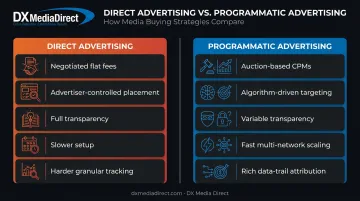
| Factor | Direct Advertising | Programmatic Advertising |
|---|---|---|
| Cost | Negotiated flat fees or guaranteed CPMs, often at a premium for exclusivity | Auction-based CPMs that fluctuate with real-time demand |
| Control & Targeting | Advertiser hand-picks exact placement, network, and context | Algorithms select impressions based on audience data and bidding rules |
| Transparency | Full visibility into where and when ads run | Varies by deal type: open exchanges carry more uncertainty |
| Scalability & Speed | Slower setup, limited to specific vendor relationships | Fast setup, scales across many networks simultaneously |
| Attribution | Harder to track granular impressions, though call and promo codes make revenue easy to trace directly | Rich data trail across touchpoints via dashboards |
That transparency gap carries real budget implications. ANA's Q2 2025 benchmark found average CPMs of $7.15 on private marketplaces versus $4.41 on the open exchange — a reminder that "programmatic" isn't one uniform price point. Deal type matters enormously.
Brand safety follows a similar pattern. Open-exchange buying carries more exposure to made-for-advertising sites and invalid traffic than negotiated placements, where you know exactly which network or publisher is running your creative before you ever spend a dollar.
What Is Direct Advertising?
Direct advertising is a manually negotiated media buy between an advertiser (or their agency) and a publisher, network, or broadcaster. No bidding software. No black-box algorithm. Just a negotiated agreement covering price, inventory, placement, and delivery terms.
This model predates programmatic by decades and still dominates in TV, radio, and premium digital sponsorships. TV's annual "upfront" market alone commits roughly $20 billion in primetime broadcast and cable inventory before a single episode airs.
Why advertisers still choose it:
- Guaranteed inventory — you know your ad runs, when, and where
- Negotiated rates through long-standing network relationships
- Full creative and placement control, reducing wasted spend on misaligned inventory
- Lower fraud risk since there's no open-exchange bidding involved
These benefits show up across several common formats:
- Direct-response TV (DRTV)
- Premium display sponsorships
- Native sponsorships
- Negotiated podcast and newsletter placements
- Linear and cable TV upfronts
Use Cases of Direct Advertising
Direct buying earns its keep when a campaign needs guaranteed placement and a measurable response, not just impressions. It's a favorite among:
- DTC brands running direct-response TV offers
- Subscription services needing consistent, trackable acquisition volume
- Financial services and legal advertisers targeting niche or older demographics
- B2B companies where a handful of premium placements outperform broad reach
Agencies with decades of network relationships can access rates and inventory positions that self-serve platforms structurally can't reach.
This is where DX Media Direct's 35 years of direct-response TV buying experience comes into play. The agency secures remnant inventory at a steep discount off standard rate card pricing, then applies that savings toward more frequency for the same budget.
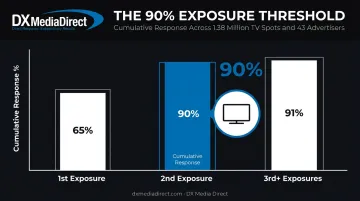
Historical DRTV analysis backs up why this channel still earns its place in a media plan: a study of 1.38 million TV spots across 43 advertisers found that roughly 90% of total response occurred after just one or two ad exposures. That's a fast, trackable payoff: exactly what direct-response advertisers need.
What Is Programmatic Advertising?
Programmatic advertising is the automated buying of ad inventory through DSPs (demand-side platforms), SSPs (supply-side platforms), and ad exchanges, largely powered by real-time bidding. Instead of a human negotiating a rate, software evaluates each available impression and bids on it in milliseconds.
The operational payoff:
- Removes manual negotiation overhead entirely
- Enables real-time optimization based on performance data
- Targets audiences at a granular level, which can lower cost-per-acquisition at scale
The Four Main Types of Programmatic Deals
Not all programmatic buying works the same way. The IAB defines four core transaction types:
- Open exchange (RTB): unreserved inventory, auctioned broadly to any eligible buyer
- Private marketplace (PMP): invitation-only auctions restricted to select buyers
- Preferred deals: fixed, pre-negotiated pricing with no guaranteed volume
- Programmatic guaranteed: reserved inventory with guaranteed delivery, automated execution
Use Cases of Programmatic Advertising
Programmatic earns its place when the goal is scale and continuous optimization rather than a single guaranteed placement. It tends to dominate in:
- E-commerce retargeting campaigns
- SaaS lead-generation funnels
- Mobile app-install campaigns
- Lower-funnel remarketing across multiple channels
The scale is hard to overstate. Programmatic already represents roughly 92% of US digital display spending, and industry benchmarking has repeatedly found real efficiency gains available within that spend. ANA's 2024 benchmark study found that the share of every $1,000 entering a DSP that effectively reached consumers rose from 36% to nearly 44%. Even within programmatic, waste reduction remains an active, ongoing effort.
Direct vs Programmatic: What's Better?
There's no universal winner here. The right choice depends on what you're weighing:
- Campaign goal: brand awareness vs. direct, trackable revenue
- Budget flexibility: fixed spend vs. variable, auction-driven costs
- Placement certainty: guaranteed inventory vs. flexible, real-time bidding
- Risk tolerance: stable CPMs vs. fluctuating, auction-based pricing
Choose direct when the priority is measurable revenue, brand safety, or guaranteed inventory: think a structured DRTV test where every dollar needs to show up in the profit column.
Choose programmatic when the priority is scale, granular targeting, or fast multi-channel testing across many audiences at once.
Most experienced advertisers don't pick one exclusively. A common approach: use programmatic for top-of-funnel reach and direct for high-value, conversion-focused placements. Agencies with decades of direct-response experience, like DX Media Direct, often blend both, relying on negotiated TV and radio placements to hit guaranteed revenue targets that automated platforms can't match.
Real-World Case Study: Direct Advertising in Action
Consider a common scenario advertisers run into: programmatic CPMs climb quarter over quarter, lead quality becomes inconsistent, and attribution data gets murkier the more channels get added to the mix. The dashboards look busy, but the profit-column number isn't moving.
This is exactly the gap direct-response TV was built to close.
DX Media Direct structures these situations as a 90-day direct-response TV test — a defined, relationship-negotiated media buy rather than an open-ended automated spend. The approach relies on:
- Remnant inventory access, often secured at a significant discount off standard rate card pricing
- Network relationships built over 35 years, giving access to dayparts and placements that self-serve platforms can't reach
- Performance tracking tied directly to calls, clicks, and sales, not just impressions
Clients using this model often see strong lead volume and quality once direct-response TV takes hold. One agency partner reported that lead flow and quality exceeded expectations almost immediately after launch, within that first 90-day test window.
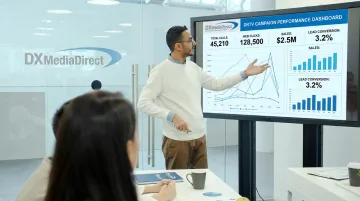
The takeaway: direct works best when you need a repeatable, scalable playbook backed by hard revenue numbers, not another round of inconclusive automated data.
If rising programmatic costs or unclear attribution are eating into your campaign ROI, a free, no-obligation consultation with DX Media Direct can help determine whether a direct-response TV test fits your goals.
Conclusion
Direct and programmatic advertising serve different jobs, not the same one. Direct wins when you need guaranteed placement, brand safety, and revenue you can trace back to a specific dollar spent. Programmatic wins when you need scale, granular targeting, and the ability to test across dozens of channels at once.
The real question is which option moves your specific numbers, including cost efficiency, measurable ROI, and campaign control, in the direction your goals require. For many advertisers, the honest answer is a blend of both, weighted according to what each campaign needs to prove. That's the calculation DX Media Direct helps clients run, pairing direct-response TV buys with programmatic reach wherever each delivers the better return.
Frequently Asked Questions
What does programmatic mean in advertising?
Programmatic advertising refers to the automated buying of ad inventory through software, DSPs, and real-time bidding, replacing manual negotiation with algorithm-driven placement decisions.
Is Google Ads considered programmatic?
Google Search Ads run on an auction system but aren't traditional programmatic display buying. Display & Video 360 (DV360), however, is Google's dedicated programmatic platform for automated, cross-inventory media buying.
What are examples of direct advertising?
Direct advertising includes direct-response TV (DRTV), premium display sponsorships, negotiated radio placements, TV upfront commitments, and sponsored newsletter or podcast slots.
What are the 4 types of programmatic advertising?
The four IAB-defined types are open exchange (RTB), private marketplace (PMP), preferred deals, and programmatic guaranteed, each varying in price structure and inventory access.
Is direct advertising more expensive than programmatic advertising?
Direct often carries higher upfront CPMs for guaranteed placement, but relationship-based rate negotiation and remnant inventory access, available through agencies like DX Media Direct, can deliver a lower effective cost-per-acquisition than programmatic.
Can direct and programmatic advertising be used together?
Yes, hybrid approaches are common, using programmatic for broad reach and direct buys for high-value, conversion-focused placements. This mix scales reach through programmatic exchanges while reserving negotiated, guaranteed placements for direct-response campaigns that demand higher conversion certainty.